
|
#1
●
03-24-2019, 12:13 PM
| ||||||||
 My Rank: PRIVATE Poster Rank:16313 Join Date: Mar 2019 Posts: 5 Mentioned: 0 Post(s) Quoted: 1 Post(s)
| ||||||||
|
A Fatal Outcome of Pica
A Fatal Outcome of Pica Note: There are detailed medical terms in this description. Pica is defined as the “compulsive eating of non-nutritional substances,” such as ice (pagophagia), dirt (geophagia), gravel, paint flakes, clay, hair (trichophagia), or laundry starch (amylophagia). The term was derived from the Latin word for a magpie (pica pica). The ingestion of foreign objects can either be accidental or intentional. Foreign body ingestion is a common occurrence in children and specific high-risk adult groups such as alcoholics, the elderly with dentures, prison inmates, and psychiatric patients. The most commonly ingested foreign objects retrieved from the esophagus include food-related objects such as chicken and fish bones, a bolus of meat, nuts/seeds and shells. A previously healthy 31 year old African male was assisting friends with the repair of the roof of a neighboring house. That evening at a social gathering the man complained of an apparent headache and went home early where he later died suddenly and unexpectedly. No history indicating the possibility of an underlying psychiatric illness was obtained. A postmortem full-body scan using the LODOX® Statscan was performed prior to the commencement of the autopsy and confirmed the presence of multiple sharp radio-opaque foreign objects in the region of the stomach, small bowel, descending colon, and sigmoid colon. At autopsy, examination of the clothing revealed blood stains on the shirt and trousers. Further inspection of the clothing revealed a box of “LION” double edge razor blades, a triangular piece of glass mirror and a single screw in the pockets of the shirt and trousers. No injuries were identified on external examination and the deceased was well nourished and of average build. Internal examination showed superficial incisional wounds to the tongue and blood was present in the mouth. No injuries were present in the neck structures and there were no fluid collections in the thoracic or abdominal cavities. Removal of the thoracic organs revealed an extensive posterior hemomediastinum (blood found in a membranous partition between two body cavities or two parts of an organ) and upon opening of the esophagus a single razor blade was found lodged within the esophageal lumen. Multiple incised wounds were present in the posterolateral wall of the esophagus, with associated signs of hemorrhage. The trachea contained blood and upon sectioning, the lungs showed patchy hyperemic areas suggestive of aspiration of blood. There was an incised wound in the anterior wall of the descending thoracic aorta subjacent/immediately posterior to the injuries described in the esophagus. The stomach was large and over distended. Upon opening, 1600 ml fresh blood was noted within the stomach. The mucosa was hyperemic and hemorrhagic. Approximately 15 metallic foreign objects in the form of screws, nails, and pieces of metal wire were present within the stomach in the pre-pyloric region. No serosal abnormalities or injuries were noted on the intestines. Upon opening of the intestines approximately 21 mixed foreign objects including nails, screws, pieces of metal wire, and a triangular piece of metal were present within the cecum, the largest of which measured approximately 7.5 cm in length. A single metallic nail was noted in the ileum and multiple small pieces of metal wire/staples were present in the descending colon and sigmoid colon. No perforations or hemorrhages were noted within the intestinal lumen. A total of 49 foreign objects were retrieved from the gastrointestinal tract. The visceral organs (liver, spleen, and kidney) were pale. The cause of death was ascertained to be hemorrhage secondary to foreign body (razor blade) ingestion. We described a case of pica characterized by the ingestion of numerous metallic foreign objects on different occasions over an undetermined period of time. The terminal event in our case was the ingestion of a razor blade with subsequent perforation of the esophagus and aorta. 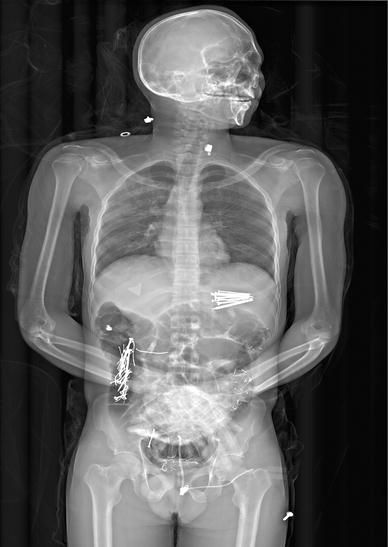 Fig. 1 A full body LODOX® Statscan depicting the presence of the foreign metal objects throughout the gastrointestinal tract—the razor blade is not visible in the esophagus 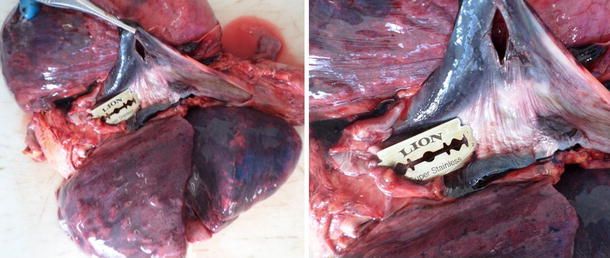 Fig. 2 The posterior aspect of the esophagus showing the perforating defect through the posterior wall 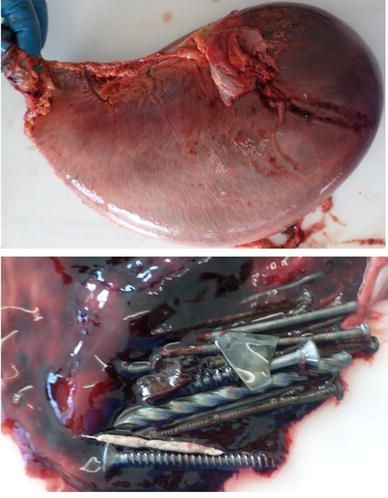 Fig. 3 The stomach showing multiple ingested metal objects 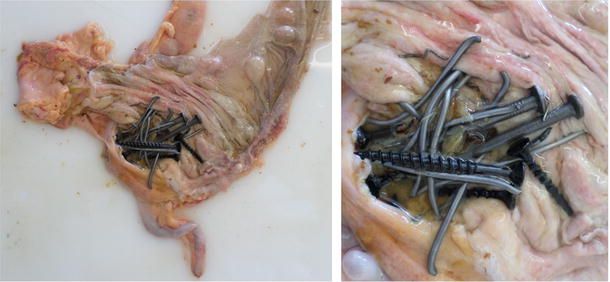 Fig. 4 The cecum showing multiple ingested metal objects at the ileocecal junction 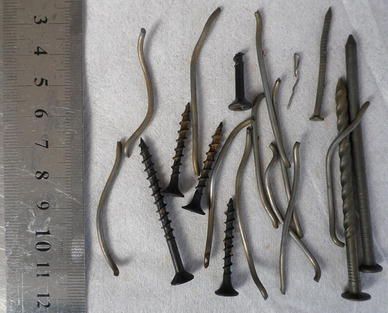 Fig. 5 The items retrieved from the cecum, including the largest item measuring approximately 7.5 cm in length 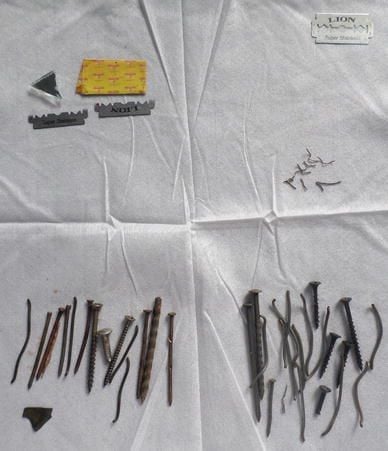 Fig. 6 All foreign objects retrieved from the gastrointestinal tract and clothing source: Forensic Science, Medicine, and Pathology - A fatal outcome of pica |
|
#2
●
03-24-2019, 12:34 PM
| ||||||||
 ★ Legacy Member ★ Poster Rank:903 Male Join Date: Jul 2009 Posts: 832 Mentioned: 2 Post(s) Quoted: 161 Post(s)
| ||||||||
|
Re: A Fatal Outcome of Pica
Excellent post.
|
|
#3
●
03-24-2019, 12:43 PM
| ||||||||
 ✝Mudderator from Hell✝ Poster Rank:10 e-mail Join Date: Oct 2006 Posts: 96,538
Contributions: 817
Mentioned: 476 Post(s) Quoted: 10336 Post(s)
| ||||||||
|
Re: A Fatal Outcome of Pica
that's one of the weirdest medical conditions someone can have in my book.
|
|
#5
●
03-24-2019, 05:43 PM
| ||||||||
 My Rank: SERGEANT MAJOR Poster Rank:295 Male Join Date: Dec 2018 Posts: 4,436
Contributions: 3
Mentioned: 22 Post(s) Quoted: 717 Post(s)
| ||||||||
|
Re: A Fatal Outcome of Pica
never made it past the airport body scanner®
|
|
#7
●
03-24-2019, 11:46 PM
| ||||||||
 My Rank: GUNNERY SERGEANT Poster Rank:653 female Join Date: Nov 2009 Posts: 1,342
Contributions: 8
Mentioned: 4 Post(s) Quoted: 300 Post(s)
| ||||||||
|
Re: A Fatal Outcome of Pica
Knew someone with this condition. Would drink so much water he had to take sodium pills. He had autism and was mr/dd and largely nonverbal. If anyone left a drink out unattended he'd get it. Not drink or sip he'd chug. I was told someone mixed ketchup and mustard and a bunch of stuff and had left it out he got into it. Said he'd chug and gag, chug and gag and chug and gag. He had some thing for pulling hair too. It was a fix he had to have and if he couldn't do it he'd act worse and worse it drove him nuts and he'd get violent. Gave him a bust from a beauty school they use to practice hair he wouldn't have anything to do with it. Someone guessed maybe he needed the reaction. |
|
#10
●
03-25-2019, 10:41 PM
| ||||||||
 My Rank: SERGEANT Poster Rank:962 Female-mulier est hominis confusio Join Date: Jan 2016 Posts: 748 Mentioned: 0 Post(s) Quoted: 404 Post(s)
| ||||||||
|
Re: A Fatal Outcome of Pica
Why KBS typically presents as compulsive eating, hypersexuality, insertion of inappropriate objects in the mouth, being placid in temperament, explosive anger at times and seizures  |





 . His skull is so underdeveloped though


