|
#1
●
01-14-2023, 11:13 PM
| ||||||||
 These are the rooms Poster Rank:26 of ruin. Join Date: Sep 2014 Posts: 54,011 Mentioned: 145 Post(s) Quoted: 30403 Post(s)
| ||||||||
|
Eye Injury
Source: A 40-year old gentleman who had no pre-existing medical illnesses presented to our eye clinic with a right eye penetrating injury, which occurred at his workplace on the same day of presentation. He worked as an operator in a steel manufacturing factory, where a piece of iron wire snapped off from an autowelding machine and struck him in the eye. At the time of injury, he was not wearing any eye protection. There was an immediate reduction in vision and severe pain in that right eye. During history taking, he mentioned that many stray cats wandered around his workplace, although he had no recent direct contact with them. Examination revealed best-corrected visual acuity of light perception, injected conjunctiva, and a full-thickness, 4-mm oblique macerated corneal laceration wound. The anterior chamber was shallow, with the presence of lens matter. The posterior segment could not be visualized. He was treated promptly with topical ciprofloxacin every two hours and intravenous ciprofloxacin 400 mg twice a day. The orbital x-ray did not show any intraocular foreign bodies. Lens aspiration, corneal suturing, and intracameral moxifloxacin injection were performed six hours post-injury. Intraoperatively, extensive posterior synechiae with fibrin were found in the anterior chamber. No foreign body was detected in the eye. The patient’s eye started deteriorating on postoperative day three. Ocular motility was restricted in all directions of gaze. There was progressive eyelid swelling with severely chemosed conjunctiva and infiltration over the central cornea. The anterior chamber was filled with fibrin and hypopyon, and the fundus could not be visualized (Figure 1). B-scan ultrasonography showed vitreous opacities with multiple loculations in the posterior chamber . Computed tomography of the orbit revealed ill-defined hyperdense lesions within the right globe, with irregular septation . A diagnosis of exogenous panophthalmitis was made, and the patient was treated with intensive antimicrobial agents including topical ceftazidime 5% and topical gentamycin 1.4% hourly as well as intravenous ciprofloxacin 400 mg twice a day. The systemic antibiotic was escalated to ceftriaxone 1 g daily and metronidazole 500 mg three times a day on day five of illness when the eye condition did not improve. Intravitreal taps were taken, and four doses of intravitreal antibiotic injections of 2 mg in 0.1 ml ceftazidime and 1 mg in 0.1 ml vancomycin were given throughout his admission. Aqueous and vitreous humor cultures both revealed the growth of P. multocida. Unfortunately, despite intensive antimicrobial therapy, the resolution of panophthalmitis was poor and the visual acuity ended up being no perception of light. 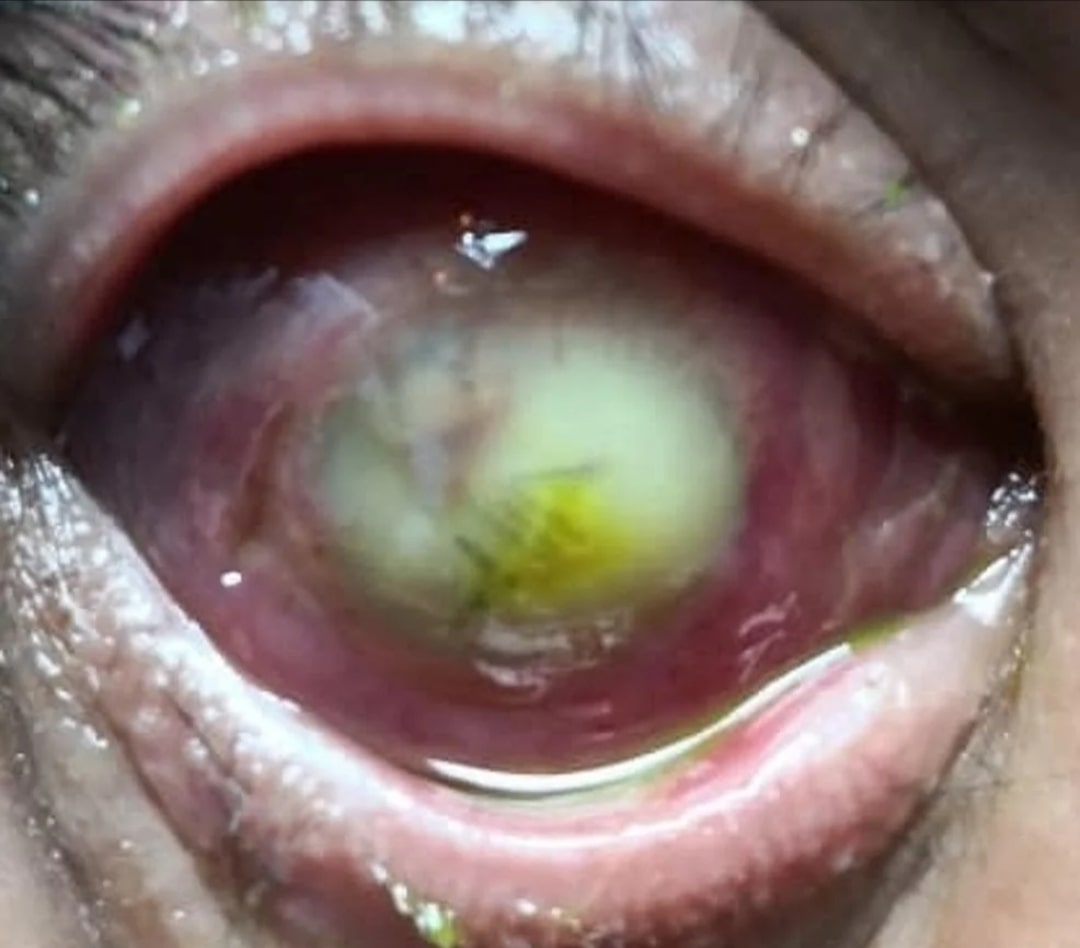 · |
|
#4
●
01-16-2023, 01:06 PM
| ||||||||
 ♚ Legacy Gold Member ♚ Poster Rank:206 Iceman Join Date: Aug 2017 Posts: 7,505 Mentioned: 19 Post(s) Quoted: 3630 Post(s)
| ||||||||
|
Re: Eye Injury
During history taking, he mentioned that many stray cats wandered around his workplace, although he had no recent direct contact with them. Interesting thing to add but I'm guessing that's what gave him the conjunctivitis which led to his eye infection after the injury. |