|
#1
●
10-08-2021, 08:40 AM
| ||||||||
 ♚ Legacy Gold Member ♚ Poster Rank:911 Join Date: Jul 2020 Posts: 822
Contributions: 10
Mentioned: 13 Post(s) Quoted: 173 Post(s)
| ||||||||
|
Exuberant Oral Myiasis Caused by Musca Domestica (Housefly)
A 42-year-old female patient reported with a chief complaint of pain and swelling in upper front teeth since the past 3 days. History of present illness revealed discomfort and mobility with upper anterior teeth since 2 months and difficulty in eating since last 20 days. 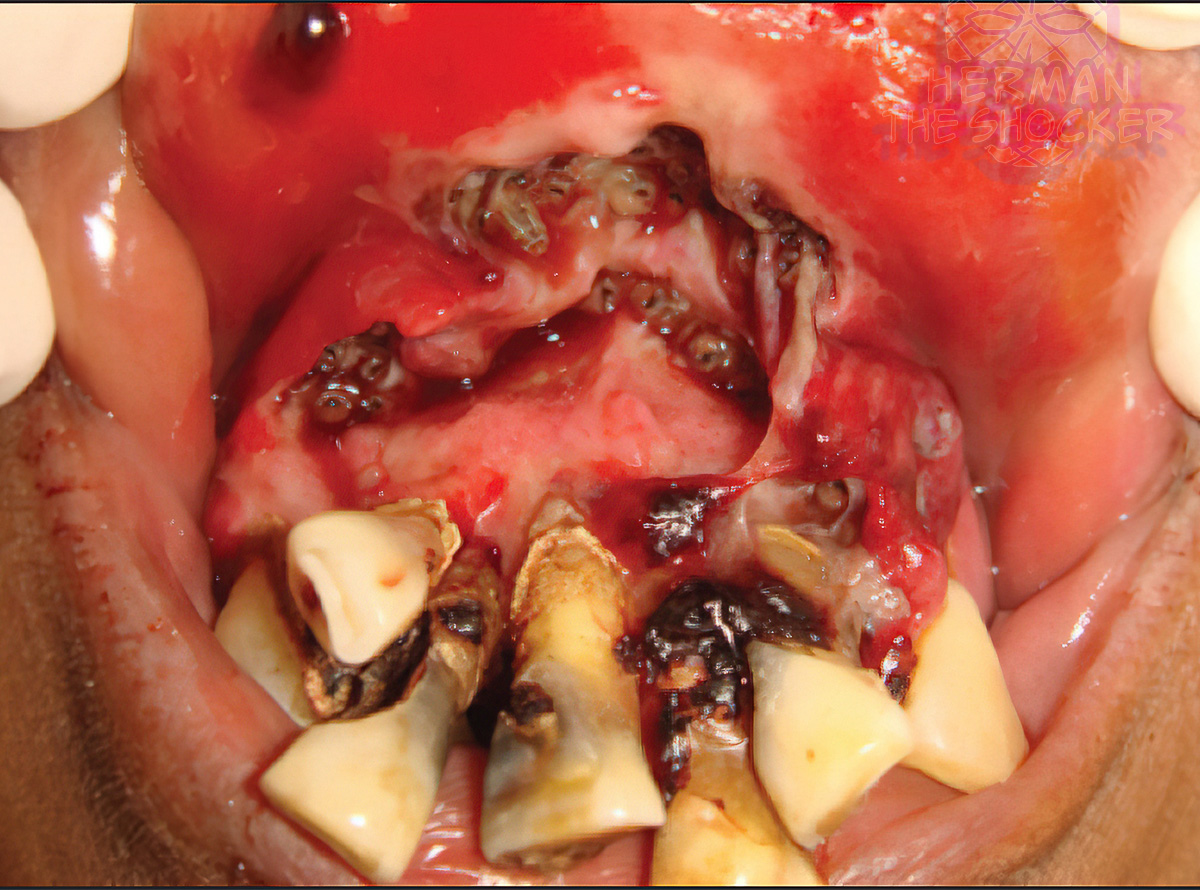 Fig.1 Intraoral swelling with obliteration of vestibule, tunnels with evident larvae, extruded teeth and necrotic areas. The patient was a farm laborer with low socioeconomic background residing in a rural area. Extra-oral examination revealed retruded chin and proclinated maxillary anteriors (Class II overjet with incompetent lips), few of which appeared to be on the verge of exfoliation. There was a diffuse swelling involving the upper lip with prominence of the vermilion border. The lip also appeared slightly erythematous, though there was no rise in local temperature. 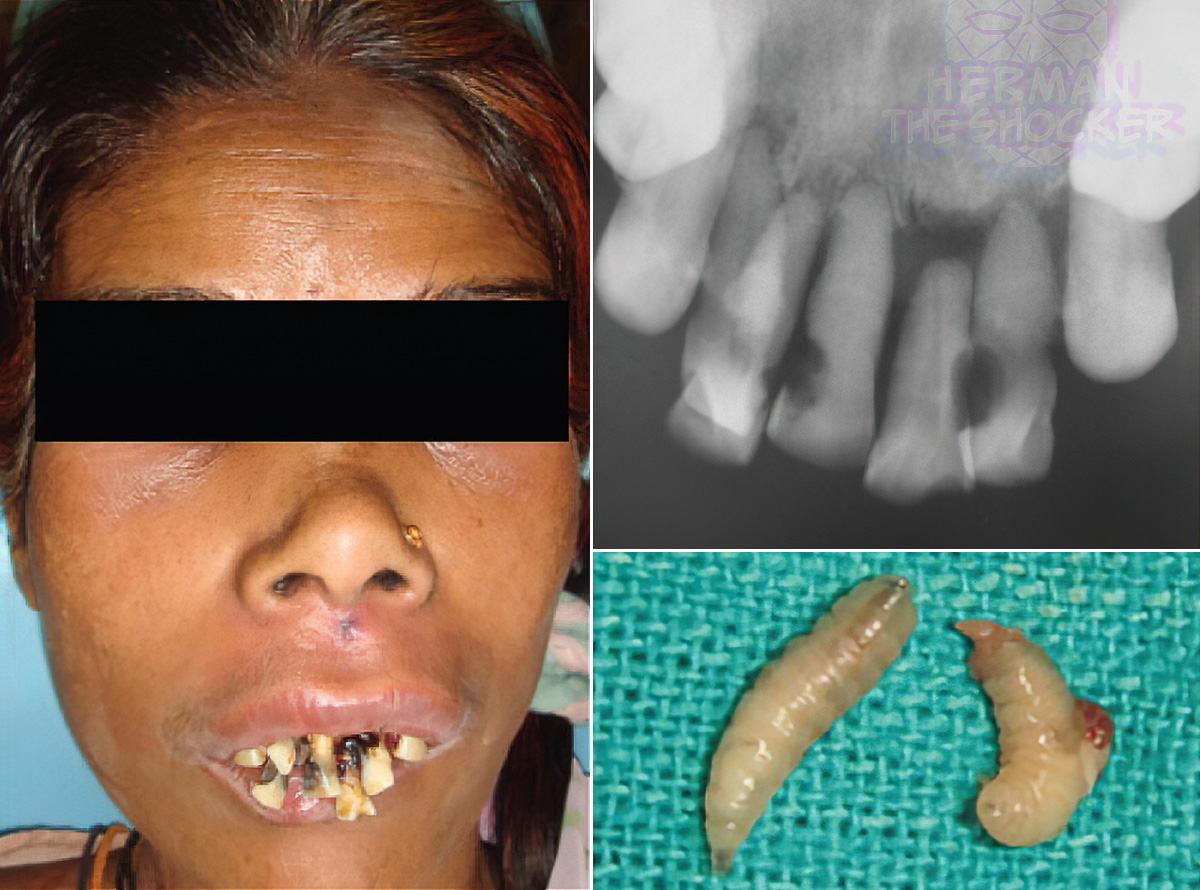 Fig.2 Extra-oral lip swelling, mild erythema and pathologically extruded carious teeth. Radiograph with destruction of supporting alveolar bone and floating carious teeth. Larvae. Intra-oral examination revealed poor oral hygiene, fetid odor and severe periodontitis. There was a solitary swelling involving the anterior maxilla extending from mesial surface of maxillary right first premolar to the distal surface of maxillary left canine measuring approximately 6 × 4 centimeters. The upper anterior vestibule was obliterated and demonstrated cleavages and tunnels in labial mucosa and underlying tissues with numerous visible larvae that exhibited wriggling movement. The involved mucosa was swollen, erythematous and also bled easily. Maxillary anterior teeth exhibited pathologic migration along with extrusion and severe gingival recession extending to the apical thirds. Maxillary incisors (teeth # 11, 12, 21 and 22) were carious. Necrotic areas and calculus deposition was also associated with these teeth. Occlusal radiograph of maxilla revealed destruction of the supporting alveolar bone with floating teeth. Based on these clinical and radiographic findings, the case was diagnosed as oral myiasis. Treatment plan was primarily aimed at encouraging the larvae to come out of the involved area. Topical application of turpentine oil was done with autoclaved gauze soaked in it in order to asphyxiate the larvae. Subsequent mechanical removal of maggots with blunt cotton pliers harvested approximately 55-65 maggots. The patient was educated and motivated with regards to personal hygiene measures with special emphasis on oral hygiene instructions. Three week follow-up demonstrated satisfactory and uneventful healing with complete resolution of lesions. - This post is for educational purposes only and is nonprofit. Under Section 107 of the US Copyright Act of 1976; Allowance is made for "Fair Use" for purposes such as criticism, comment, news reporting, teaching, scholarship, and research. OP is not a medical expert. No copyright infringement intended. This post does not encourage or glorify violence/harassment. Images might have been upscaled and enhanced. Text might have been shortened and simplified/reorganized for online view. |
|
#2
●
10-08-2021, 08:57 AM
| ||||||||
 ✝Mudderator from Hell✝ Poster Rank:10 e-mail Join Date: Oct 2006 Posts: 96,469
Contributions: 817
Mentioned: 476 Post(s) Quoted: 10329 Post(s)
| ||||||||
|
Re: Exuberant Oral Myiasis Caused by Musca Domestica (Housefly)
Nasty  Great thread  |
|
#4
●
10-08-2021, 08:53 PM
| ||||||||
 ♚ Legacy Gold Member ♚ Poster Rank:912 Join Date: Oct 2020 Posts: 822 Mentioned: 0 Post(s) Quoted: 119 Post(s)
| ||||||||
|
Re: Exuberant Oral Myiasis Caused by Musca Domestica (Housefly)
I just brushed my teeth like 20 times...WTFF!
|
|
#5
●
10-09-2021, 07:46 AM
| ||||||||
 ☆☆☆Jumbo Lesbian Cunt☆☆☆ Poster Rank:57 My pronouns are thin/skinny Join Date: Nov 2012 Posts: 25,931
Contributions: 1
Mentioned: 160 Post(s) Quoted: 13918 Post(s)
| ||||||||
|
Re: Exuberant Oral Myiasis Caused by Musca Domestica (Housefly)
My grandma (born in 1928 to a financially less fortunate and poorly educated farming family in Saskatchewan) needed to have all her teeth pulled at a young age due to severe gingivitis. At least being a northern prairie kid spared her the further indignity of myiasis. Or she never mentioned it.   |
|
#8
●
10-22-2021, 07:27 AM
| ||||||||
 My Rank: MASTER SERGEANT Poster Rank:556 Too many to choose from...apparently Join Date: Jan 2010 Posts: 1,817 Mentioned: 0 Post(s) Quoted: 63 Post(s)
| ||||||||
|
Re: Exuberant Oral Myiasis Caused by Musca Domestica (Housefly)
Imagine getting a blowjob with those choppers !??
|