
|
#1
●
09-25-2009, 05:23 PM
| ||||||||
 ink freak Poster Rank:685 female Join Date: May 2009 Posts: 1,276 Mentioned: 0 Post(s) Quoted: 9 Post(s)
| ||||||||
|
*****Ebola Haemorrhagic Fever****
Ebola haemorrhagic fever (EHF) is a viral haemorrhagic fever and one of the most virulent viral diseases known to humankind. The Ebola virus was first identified in the western equatorial province of Sudan and in a nearby region of Zaire (now Democratic Republic of the Congo) in 1976 after significant epidemics in Nzara, southern Sudan and Yambuku, northern Zaire. There are five distinct species of the Ebola virus: Bundibugyo, Côte d’Ivoire, Reston, Sudan and Zaïre. Bundibugyo, Sudan and Zaïre species have been associated with large outbreaks of Ebola haemorrhagic fever (EHF) in Africa causing death in 25-90% of all clinically ill cases, while Côte d’Ivoire and Reston have not. The Ebola virus is transmitted by direct contact with the blood, body fluids and tissues of infected persons. Transmission of the Ebola virus has also occurred by handling sick or dead infected wild animals (chimpanzees, gorillas, monkeys, forest antelope, fruit bats). The predominant treatment is general supportive therapy. source:http://www.who.int/csr/disease/ebola/en/index.html ** that last one I'm not sure if he died of ebola. he looked stabbed**  ·  · 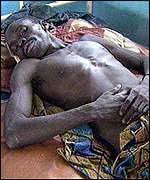 · 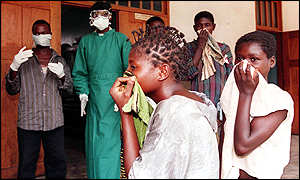 · 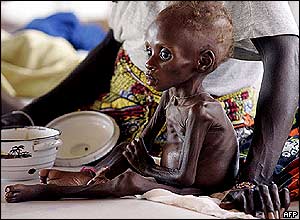 · 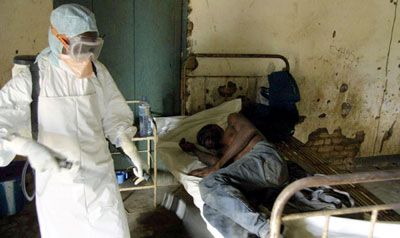 · 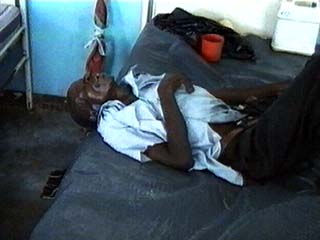 ·  · |
|
#3
●
09-25-2009, 05:36 PM
| ||||||||
| ink freak Poster Rank:685 female Join Date: May 2009 Posts: 1,276 Mentioned: 0 Post(s) Quoted: 9 Post(s)
| ||||||||
|
Re: *****Ebola Haemorrhagic Fever****
**During the incubation period, which can last about 1 week, symptoms include: * Arthritis * Backache (low) * Diarrhea * Fatigue * Headache * Malaise * Nausea * Sore throat * Vomiting Late symptoms include: * Bleeding from eyes, ears, and nose * Bleeding from the mouth and rectum (gastrointestinal bleeding) * Depression * Eye inflammation (conjunctivitis) * Genital swelling (labia and scrotum) * Increased feeling of pain in skin * Rash over the entire body that often contains blood (hemorrhagic) * Roof of mouth looks red * Seizures, coma, delirium As many as 90% of patients die from the disease. Patients usually die from shock rather than from blood loss. Exams and Tests There may be signs and symptoms of: * Coma * Disseminated intravascular coagulation * Shock Tests used to diagnose Ebola fever include: * CBC * Electrolytes * Tests of how well the blood will clot (coagulation studies) * Tests to show whether someone has been exposed to the Ebola virus Treatment There is no known cure. Existing medicines that fight viruses (antivirals) do not work well against this virus. The patient is usually hospitalized and will most likely need intensive care. Supportive measures for shock include medications and fluids given through a vein. Bleeding problems may require transfusions of platelets or fresh blood. Outlook (Prognosis) As many as 90% of patients die from the disease. Patients usually die from shock rather than blood loss. Possible Complications Survivors may have unusual problems, such as hair loss and sensory changes. When to Contact a Medical Professional Call your health care provider if you have traveled to Africa (or if you know you have been exposed to Ebola fever) and you develop symptoms of the disorder. Early diagnosis and treatment may help improve the chances of survival. source:http://health.nytimes.com/health/gui....html#Symptoms |
|
#8
●
09-30-2009, 02:36 AM
| ||||||||
 My Rank: CORPORAL Poster Rank:1487 Join Date: Feb 2009 Posts: 388 Mentioned: 0 Post(s) Quoted: 1 Post(s)
| ||||||||
|
Re: *****Ebola Haemorrhagic Fever****
Anyone read The Hot Zone? this might sound bad but when I first saw pictures of ebola victims, I was underwhelmed. The way the book described it, it sounded like a gore fest. Still, I can't even imagine the suffering these poor people went through. |
|
#9
●
09-30-2009, 09:33 AM
| ||||||||
| ink freak Poster Rank:685 female Join Date: May 2009 Posts: 1,276 Mentioned: 0 Post(s) Quoted: 9 Post(s)
| ||||||||
|
Re: *****Ebola Haemorrhagic Fever****
yeah i read that book (my mom has it) when i was in 8th grade.. i did a full report and everything for science class.. i may read hundreds more books. but that one will stay with me... i've the book so many times...
|
|
#10
●
10-08-2009, 03:37 AM
| ||||||||
| My Rank: PRIVATE Poster Rank:9684 Join Date: Oct 2009 Posts: 15 Mentioned: 0 Post(s) Quoted: 1 Post(s)
| ||||||||
|
Re: *****Ebola Haemorrhagic Fever****
it's crazy to see all these pictures of diseases, deformities and other issues and don't really put ourselves in the situation. what if this was us?? it's insane shit to think about and we should be happy we never had to live through it.
|





 oohh, that poor wee child!


