|
The Death of Herod Agrippa (New Research Reveals His Horrific Desease)
What Disease Killed King Herod? 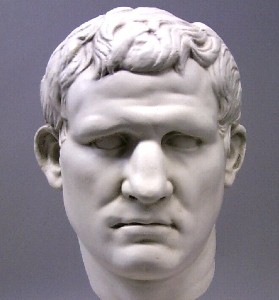
A brief introduction to the man: Agrippa I also known as Herod Agrippa or simply Herod (10 BCE - 44 CE), King of the Jews, was the grandson of Herod the Great, and son of Aristobulus IV and Berenice. His original name was Marcus Julius Agrippa, so named in honour of Roman statesman Marcus Vipsanius Agrippa, and he is the king named Herod in the Acts of the Apostles, in the Bible, "Herod (Agrippa)" (Ἡρώδης Ἀγρίππας). He was, according to Josephus, known in his time as "Agrippa the Great". 
His early beginnings: Josephus informs us that, after the murder of his father, young Agrippa was sent by Herod the Great to the imperial court in Rome. There, Tiberius conceived a great affection for him, and had him educated alongside his son Drusus, who also befriended him, and future emperor Claudius. On the death of Drusus, Agrippa, who had been recklessly extravagant and was deeply in debt, was obliged to leave Rome, fleeing to the fortress of Malatha in Idumaea. There, it was said, he contemplated suicide For more history of how he came to rule over the Jews: http://en.wikipedia.org/wiki/Agrippa_I 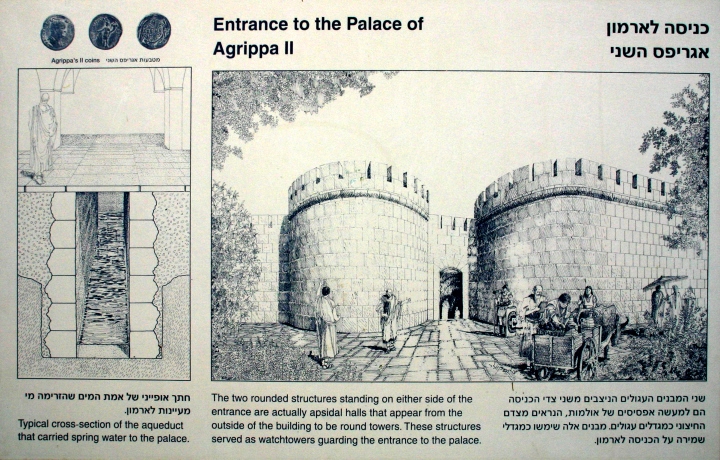
His Palace today:  Bijal P. Trivedi
January 28, 2002
The life of Herod the Great—king of ancient Judea—was the stuff of legend, but the cause of his grisly death more than 2,000 years ago has been a mystery.
Now, after studying ancient accounts of Herod's death, Jan Hirschmann, a physician at the University of Washington School of Medicine in Seattle, thinks the king probably died of chronic kidney disease, complicated by a particularly nasty case of gangrene.
Hirschmann revealed his findings last week at the Historical Clinical Pathology Conference, held at a University of Maryland medical center in Baltimore.
Herod (B.C. 73–B.C. 4) was a friend of the Emperor Augustus and knew Julius Caesar and Mark Anthony. Among his considerable achievements, he built the largest artificial harbor in the Mediterranean area.
Some of his actions were much less glorious: He executed one of his 10 wives and three of his 14 children, and might have ordered the infamous Slaughter of the Innocents in his quest to kill the baby Jesus.
Hirschmann's diagnosis was based on accounts written by biographer Flavius Josephus, who lived 75 to 100 years after Herod. Josephus had consulted the writings of Herod's court historian, Nicholas of Damascus.
Josephus wrote: "He had a fever, though not a raging fever, an intolerable itching of the whole skin, continuous pains in the intestines, tumors of the feet as in dropsy, inflamation of the abdomen, and gangrene of the privy parts."
According to Josephus, Herod also suffered from asthma, limb convulsions, and foul breath.
Other people have proposed that Herod had died of gonorrhea. Hirschman disagreed. He concluded that the string of symptoms, with the exception of genital gangrene, were more consistent with chronic kidney disease.
Faced with "no diagnostic epiphanies," Hirschmann said he decided to focus on the symptom of itching. "There are very few diseases that cause itching," he explained, adding that he narrowed the list of likely causes to fewer than ten. Among the possible causes were hypo- and hyper-thyroidism and Hodgkin's disease.
The confounding factor that muddied the investigation was Josephus' report of genital gangrene as one of Herod's symptoms. Hirschmann concluded that this was caused by a rare infection of the male genitalia, called Fournier's gangrene.
Now in its eighth year, the Historical Clinical Pathologic Conference reexamines the death of a famous person from the past who died from causes that have not been fully explained. Every year an anonymous clinical and personal history is released to the medical community and assigned to a specific discussant whose job is to figure out who the person was and the cause of death. The Sickness, Death and Funeral of Herod
What the modern historian needs to do is to catalogue the events that occurred from the day of the lunar eclipse until Herod died, then add on the time that elapsed for his funeral and burial, and then count the period from Herod’s burial to the springtime Passover which found Archelaus (the son of Herod) reigning in Jerusalem. The events are well recorded by Josephus. True, Josephus does not give in his writings the exact number of days from the lunar eclipse to the next Passover, but this interval of time can be generally determined without difficulty. Note the sequence of events recorded by Josephus that shows this.
The day before the lunar eclipse two prominent Jewish rabbis were burnt alive at the command of Herod for tearing down a golden eagle which he had erected over the eastern gate of the temple, “and on that very night there was an eclipse of the moon.” 1 The morning after the eclipse, Josephus said Herod’s illness became worse. He had been sick some two or three months. People began to say that the intensification of Herod’s affliction was a result of the rabbis’ deaths. 2 One has to allow two or three days after the eclipse for Herod’s physical deterioration to become noticeable. His physicians then tried “one remedy after another.” 3 For several remedies to be practiced on Herod in order to cure him occupied at least four or five days ― a remedy for each day. The elapsed time for these events would reasonably occupy (at a bare minimum): one week.
Those various remedies performed on Herod, however, did not improve his condition. The physicians then recommended that he leave Jericho, which was then his temporary residence, and retreat to the mineral baths at Callirrhoe. These baths were located on the Dead Sea about 25 miles southeast of Jericho. Herod heeded their advice. Since he was very ill and getting worse, it would have taken at least a day for him to have been carefully transported to the baths, probably longer. He then began a period of treatment using the mineral waters. The therapy certainly took two or three days to give the chemicals in the waters a chance to work. But use of the baths gave Herod no sign of improving his condition. He then ordered his attendants to carry him back to Jericho. The elapsed time for these events associated with taking Herod to the baths of Callirrhoe and returning to Jericho would have occupied at least one week. The interval of time would now be two weeks away from the eclipse.
Once back at his palace in Jericho, Herod devised a monstrous plan. Since he knew his death was not far off, and realizing that most of the Jewish people had a vehement hatred of him, he decided on a scheme which would have the whole nation in mourning at the time of his death. He had many prominent Jewish elders from all areas of his kingdom assemble at Jericho. Without the elders realizing his intention, Herod’s plot was to place them in custody, then on the day of his death, they were to be executed. In Herod’s warped reasoning this would guarantee that the entire Jewish nation would go into a state of mourning.
This heinous plan was put into action. Messengers were sent from Jericho to all parts of Herod’s realm bearing orders for the elders of the cities and villages to appear at Jericho on pain of death for their refusal. 4 Since the northern cities of Herod’s kingdom were at least 130 miles away, a period of 3 days for the couriers to reach the elders, a day or so for them to prepare for the trip, and then 3 or 4 days for the elders to reach Jericho would occupy, at the very least, a week’s time. Josephus said these municipal elders with other Jewish dignitaries finally arrived at Jericho and were locked up in the hippodrome (the racetrack area). The elapsed time for this assemblage of elders was at the very least one week. The interval of time now being three weeks away from the eclipse.
Josephus said that after this, letters came from Augustus in Rome giving Herod permission to kill his son Antipater. The king had him executed immediately and Herod died 5 days later. 5 Herod’s survivors then determined that the elders imprisoned in the hippodrome were not to be killed. They were released and many were allowed to return home. The elapsed time for these events would reasonably occupy 5 to 7 days (now almost four weeks away from the eclipse). http://www.askelm.com/star/star010.htm In summery A physician has suggested a grisly new theory as to what killed King Herod, of biblical fame.
It was chronic kidney disease complicated by a severe infection that led to the rotting of his genitals, said Jan Hirschmann, a clinician at a Veterans' Administration hospital and professor of medicine at the University of Washington.
The condition, known as Fournier's gangrene, was announced Friday after a "historical autopsy" -- an annual event at the Clinico-Pathologic Conference (CPC) organized by the VA and University of Maryland School of Medicine. Herod will always stand as one of the most deplorable characters of New Testament literature. He was a vicious ruler who neither feared God, nor regarded his fellows. He was the man who issued the bloody order that all male babies, two years old and under, in the environs of Bethlehem be slaughtered (Matthew 2:16). “But when Herod was dead, behold an angel of the Lord appears in a dream to Joseph in Egypt, saying, Arise and take the young child and his mother, and go into the land of Israel: for they are dead that sought the young child’s life” (2:19-20). Herod had died in a most dramatic fashion. Josephus states that a loathsome disease descended upon the ruler as a judgment from God on account of his sins. He describes the horrible details —burning fever, ulcerated entrails, foul discharges, convulsions, stench, etc. (Antiquities 17.6.5). (3) It is of special interest that Matthew says, “They are dead that sought the young child’s life” (2:20). Why the plural “they,” since only Herod’s death is mentioned in the previous verse?
Several ingenious grammatical theories have been suggested by commentators. The simplest explanation, however, may be in a curious historical oddity. Herod had a son whose name was Antipater. Antipater was of the same cruel disposition as his father. He would doubtless have been every bit as much of a threat to the Lord as his evil sire, had he succeeded his wicked father to the throne. In fact, Antipater was a rival to the throne. As Herod’s oldest son, he had complained that his father’s life was dragging on so long that he would be an old man by the time he became king.
When he mistakenly thought that Herod had died, he evidenced great joy. When word of that rejoicing reached the ailing king, he had his son killed immediately. This was only five days before Herod himself expired (Josephus, Wars 1.23.7). Flavius Josephus wrote the following account
of Herod Agrippa's death which matches the account
found in the Bible:
"After Agrippa had ruled in Judea for three full
years, he traveled to the city of Caesarea, which in
the past was called Strato's Tower. There he put on
an exhibition in honor of Caesar, declaring this to be
a festival for the Emperor. And there came a large
number of officials and those of a high-ranking
status. At sunrise on the following day he put on a
robe made of all silver and walked into the theater.
Then the silver shown brightly as the sun's first rays
fell upon it and he sparkled in the sunlight, dazzling
the crowd and causing a sort of fear and trembling in
those who were viewing the spectacle. The crowds
then began to shout from various parts of the theater,
words which in truth were not for his best,
addressing him as a god, and crying out, "We have in
the past honored you as a man, but now we honor
you as one with a nature greater then any mortal
being.”
"The king did not rebuke, nor disagree with the
flattery of the crowd . . . Shortly afterwards he
experienced a violent attack with a severe pain in his
stomach . . . The king was carried quickly into the
palace and word of this account reached the ears of
all his subjects, that it would not be long before he
died . . . And when he had suffered for five straight
days from the pain in his stomach, he died at the age
of fifty-four after ruling for seven years.'
The Bible gives an identical account in Acts
chapter 12:19-23: (After Herod had the apostle James
put to death with the sword, and put Peter in
prison. Peter was broken out of jail by an angel of the
Lord.) . . .
"Then Herod went from Judea to Caesarea and
stayed there a while. He had been quarreling with the
people of Tyre and Sidon; they now joined together
and sought an audience with him. Having secured the
support of Blastus, a trusted personal servant of the
king, they asked for peace, because they depended
on the king's country for their food. On the appointed
day, Herod, wearing his royal robes, sat on his throne
and delivered a public address to the people. They
shouted, "This is the voice of a god, not of man."
Immediately, because Herod did not give praise to
God, an angel of the Lord struck him down, and he
was eaten by worms and died. Apparently by all accounts Herod Agrippa succumbed to a kidney infection that progressed to internal gangrene that then spread to his genitals with the complication of Forniers Disease. The death of Herod Agrippa should certainly be regarded as one of the most horrific and nasty ever to be recorded in history. Internal gangrene. Gangrene affecting one or more of your organs, most commonly your intestines, gallbladder or appendix, is called internal gangrene. This type of gangrene occurs when blood flow to an internal organ is blocked — for example, when your intestines bulge through a weakened area of muscle in your abdomen (hernia) and become twisted. Internal gangrene often causes a fever and severe pain. Left untreated, internal gangrene can be fatal.
Fournier's gangrene. Fournier's gangrene is an uncommon type of gangrene that involves the genital organs. Men are more often affected, but women can develop this type of gangrene as well. Fournier's gangrene usually arises due to an infection in the genital area or urinary tract and causes genital pain, tenderness, redness and swelling. Coins stamped with Herod Aggripa's image:   King Herod went down from Judea to Caesarea and stayed there. [...] And upon a set day Herod, arrayed in royal apparel, sat upon his throne and delivered an oration unto them. And the people gave a shout, saying, 'It is the voice of a god, and not of a man!' And immediately the angel of the Lord smote him, because he gave not God the glory; and he was eaten by worms and gave up the ghost.
[Acts of the apostles 12.19b-23]
This was the story according to Luke, the author of the Acts of the apostles; he seems to delight in the terrible end of the man who had prosecuted the first Christians. The same story is told by Flavius Josephus:
Now when Agrippa had reigned three years over all Judea, he came to the city Caesarea [...] There he exhibited shows in honor of the emperor [...] On the second day of the festival, Herod put on a garment made wholly of silver, and of a truly wonderful contexture, and came into the theater early in the morning; at which time the silver of his garment was illuminated by the fresh reflection of the sun's rays upon it. It shone out after a surprising manner, and was so resplendent as to spread a horror over those that looked intently upon him. At that moment, his flatterers cried out [...] that he was a god; and they added, 'Be thou merciful to us; for although we have hitherto reverenced thee only as a man, yet shall we henceforth own thee as superior to mortal nature.'
Upon this the king did neither rebuke them, nor reject their impious flattery. But as he presently afterward looked up, he saw an owl sitting on a certain rope over his head, and immediately understood that this bird was the messenger of ill tidings, as it had once been the messenger of good tidings to him; and he fell into the deepest sorrow. A severe pain also arose in his belly, and began in a most violent manner. He therefore looked upon his friends, and said, 'I, whom you call a god, am commanded presently to depart this life; while Providence thus reproves the lying words you just now said to me; and I, who was by you called immortal, am immediately to be hurried away by death. But I am bound to accept of what Providence allots, as it pleases God; for we have by no means lived ill, but in a splendid and happy manner.'
After he said this, his pain was become violent. Accordingly he was carried into the palace, and the rumor went abroad that he would certainly die in a little time. But the multitude presently sat in sackcloth, with their wives and children, after the law of their country, and besought God for the king's recovery. All places were also full of mourning and lamentation. Now the king rested in a high chamber, and as he saw them below lying prostrate on the ground, he could not himself forbear weeping. And when he had been quite worn out by the pain in his belly for five days, he departed this life, being in the fifty-fourth year of his age, and in the seventh year of his reign.
[Flavius Josephus, Jewish Antiquities 19.343-350] Historical Notes on Herod Agrippa: It was his father, Herod Agrippa I, who had the apostle James executed [Acts 12:1-2] and then cast the apostle Peter into prison [Acts 12:3]. He died a gruesome death in 44 A.D., which is described in Acts 12:20-23. It was his great-grandfather, Herod the Great, who spoke to the magi from the east when they came seeking the Christ-child, and it was also he who ordered the slaughter of all baby boys under the age of two. It was one of his uncles, Herod Antipas, who ordered the death of John the Baptist, and to whom Pontius Pilate sent Jesus just prior to His crucifixion. It should further be noted that the entire Herod family were Idumeans -- i.e., they were descended from Abraham and Isaac, but through Esau rather than through Jacob. They saw themselves as part of God's covenant with Abraham, but they had not gone into Egypt with Jacob, nor had they been part of the group led out of Egyptian bondage by Moses, nor part of the group entering the promised land some 40 years later. Thus, there was always somewhat of a state of tension between the descendants of Jacob and Esau, even though both were descendants of Abraham and Isaac. The Herods also tended to side with Rome, rather than with the Jewish people, in social and political matters (and quite often even in religious matters). They were notorious opportunists. As a result, most Jews had little regard for them, although there was a small Jewish sect known as the Herodians, who tended to be rather enamored with the power, prestige and position of these Herods. Medical Notes: Fournier’s gangrene (FG) is a rare but life threatening disease. Although originally thought to be an idiopathic process, FG has been shown to have a predilection for patients with diabetes as well as long term alcohol misuse; however, it can also affect patients with non-obvious immune compromise. The nidus is usually located in the genitourinary tract, lower gastrointestinal tract, or skin. FG is a mixed infection caused by both aerobic and anaerobic bacterial flora. The development and progression of the gangrene is often fulminating and can rapidly cause multiple organ failure and death. Because of potential complications, it is important to diagnose the disease process as early as possible Although antibiotics and aggressive debridement have been broadly accepted as the standard treatment, the death rate remains high Last photos is of internal gangrene caused by untreated kidney infection, much like what Herod Agrippa suffered from.
Next is of Fornier's disease involving the scrotum. This usually occurs as a result of untreated internal gangrene involving urinary tract. It must of been the final indignity afflicting Herod the Great. Gonads rotting off. Life must of really sucked for Herod Agrippa at the end.
|


![Fourniers-Gangrene-skin-sloughed-off[1].jpg](https://www.documentingreality.com/forum/attachments/f149/329448d1418183963-death-herod-agrippa-new-research-reveals-his-horrific-desease-fourniers-gangrene-skin-sloughed-off-1-.jpg)
![F1.large[1].jpg](https://www.documentingreality.com/forum/attachments/f149/329450d1326225710-death-herod-agrippa-new-research-reveals-his-horrific-desease-f1.large-1-.jpg)
![F2.large[1].jpg](https://www.documentingreality.com/forum/attachments/f149/329451d1326225730-death-herod-agrippa-new-research-reveals-his-horrific-desease-f2.large-1-.jpg)

 Excellent, dont know why but the last pic looks like its a big pie just out of the oven and ready to eat! Yum