|
#1
●
07-11-2014, 08:20 PM
|
 ✖ The Antique Christ ✖ Poster Rank:106 Gonzo Punk Join Date: Jan 2009 Posts: 15,478
Contributions: 62
15,478Posts 39,153Thanked 2,046Quoted 23Mentioned 62Contrib. |
|
Childs Bad Reaction to Amoxicillin
A 14-month-old boy was brought to the emergency department (ED) with a severe rash. One week previously, the child was diagnosed with sinusitis and began receiving amoxicillin and clavulanate. Six days later, he developed an urticarial-like rash. The antibiotic was discontinued, and he began receiving diphenhydramine. The next day, he presented to the ED with a worsening, “dusky” rash. Review of systems was significant for recent refusal to walk, which resolved with ibuprofen. Physical examination revealed a nontoxic, mildly uncomfortable child. Temperature of 102.2°F (39°C), shotty lymphadenopathy, and edema of the hands and feet were noted. Urinalysis result was negative. His rash is pictured in the Figure. 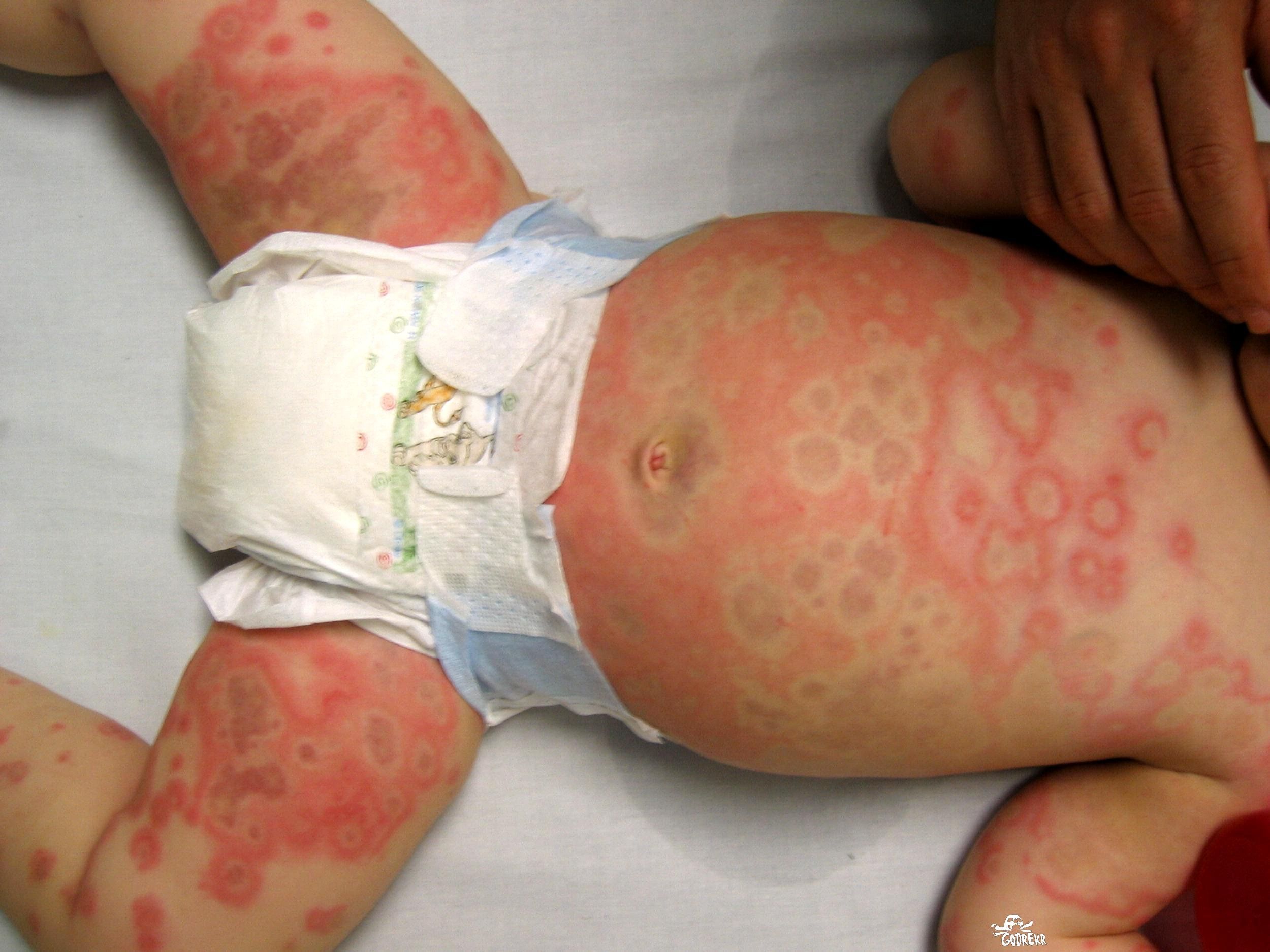 Widespread rash on initial presentation to the ED. Diagnosis Serum sickness–like reaction to amoxicillin The diagnosis of serum sickness–like reaction to amoxicillin was confirmed by dermatology consultation in the ED. The patient was subsequently discharged from the ED, with close follow-up in the dermatology clinic. Serum sickness–like reactions develop 1 to 2 weeks after exposure to the offending agent. The clinical features include fever, rash, polyarthralgias, and polymyalgias, often manifesting in children as a refusal to walk. Lymphadenopathy, malaise, proteinuria, edema, and abdominal pain are occasionally present. Serum sickness–like reactions occur most commonly with administration of cefaclor but have also been observed with numerous other antibiotics and drugs. The mechanism is unknown. In contrast to true serum sickness, circulating antigen-antibody complexes are not present. The differential diagnosis includes life-threatening disease processes, such as erythema multiforme, Kawasaki’s disease, and disseminated gonococcal or meningococcal infections. Serum sickness–like illness is differentiated by the history and nontoxic appearance of the patient. Serum sickness–like illness is self-limited and has a favorable prognosis. In a case series of 8 patients, only half were hospitalized and all had benign outcomes. Treatment involves discontinuing the causative drug. Antihistamines and nonsteroidal antiinflammatory drugs may be used to alleviate the pruritus and pain. For severe presentations, a short course of corticosteroids can be prescribed. Future avoidance of the offending drug and related agents is recommended. |
|
#2
●
07-11-2014, 08:24 PM
|
 ★ Legacy Member ★ Poster Rank:197 All woman Join Date: Jun 2012 Posts: 7,761 7,761Posts 11,231Thanked 1,420Quoted 22Mentioned 0Contrib. |
|
Re: Childs Bad Reaction to Amoxicillin
I think my mother said I was like this after penicillin, along with the fact that I started swelling up like a balloon. Had to get a shot of epinephrine!
|
|
#3
●
07-11-2014, 10:18 PM
|
 ★ Legacy Member ★ Poster Rank:53 Join Date: Mar 2013 Posts: 28,044
Contributions: 33
28,044Posts 47,276Thanked 11,875Quoted 175Mentioned 33Contrib. |
|
Re: Childs Bad Reaction to Amoxicillin
I have had a reaction to Keflex, but not this severe!!  Poor little kid! |
|
#4
●
07-12-2014, 12:03 AM
|
 My Rank: STAFF SERGEANT Poster Rank:796 male Join Date: Mar 2010 Posts: 992 992Posts 2,091Thanked 222Quoted 0Mentioned 0Contrib. |
|
Re: Childs Bad Reaction to Amoxicillin
antibiotics are EVIL!!! never, ever, EVER give them to kids....EVERR!!! ....said the granola, mom-blogger |
|
#6
●
07-12-2014, 12:44 AM
|
| ★ Legacy Member ★ Poster Rank:197 All woman Join Date: Jun 2012 Posts: 7,761 7,761Posts 11,231Thanked 1,420Quoted 22Mentioned 0Contrib. |
|
Re: Childs Bad Reaction to Amoxicillin
Suppose it was your child. Even if the child had a serious, possibly fatal condition that refused to respond to any treatment, and the doctor told you that the only course of action to save his or her life was the use of antibiotics, you'd still say no?
|
|
#7
●
07-12-2014, 01:51 AM
|
 ☆☆☆Jumbo Lesbian Cunt☆☆☆ Poster Rank:57 My pronouns are thin/skinny Join Date: Nov 2012 Posts: 25,917
Contributions: 1
25,917Posts 30,808Thanked 13,921Quoted 160Mentioned 1Contrib. |
|
Re: Childs Bad Reaction to Amoxicillin
Quetza is making light of those idiotic anti-medicine hippie types.  Those people are an affront to progress in general.   |
|
#9
●
07-12-2014, 09:36 AM
|
| ☆☆☆Jumbo Lesbian Cunt☆☆☆ Poster Rank:57 My pronouns are thin/skinny Join Date: Nov 2012 Posts: 25,917
Contributions: 1
25,917Posts 30,808Thanked 13,921Quoted 160Mentioned 1Contrib. |
|
Re: Childs Bad Reaction to Amoxicillin
Uncomfortable rash and a high fever. Poor wee muffin.  |
|
#10
●
07-12-2014, 06:33 PM
|
| My Rank: STAFF SERGEANT Poster Rank:796 male Join Date: Mar 2010 Posts: 992 992Posts 2,091Thanked 222Quoted 0Mentioned 0Contrib. |
|
Re: Childs Bad Reaction to Amoxicillin
thank you for having your sarcasm detector tuned and working |