|
#1
●
02-16-2014, 11:42 PM
| ||||||||
| So Fucking Banned Poster Rank:893 male Join Date: Feb 2014 Posts: 846 Mentioned: 3 Post(s) Quoted: 557 Post(s)
| ||||||||
|
Agent Orange
Emergency and the U.S. military as part of its herbicidal warfare program, Operation Ranch Hand,[1] during the Vietnam War from 1961 to 1971.[2] It was a mixture of equal parts of two herbicides, 2,4,5-T and 2,4-D. Herbicides, or weed-killing chemicals, had long been used in American agriculture. After World War I, the military of various nations realized their potential for war and developed techniques to use them. Although the Italians had used lethal chemicals delivered from the air in Abyssinia in 1936, the Allies and Axis in World War II abstained from using the weapon either because of legal restrictions, or to avoid retaliation in kind (although chemical warfare was widespread during World War I, it delivered via wind or artillery shells rather than aircraft). During the early 1950s, the British were the first to employ herbicides to destroy the crops of communist insurgents in Malaya during the Malayan Emergency.[3] In 1961, President Ngo Dinh Diem of South Vietnam asked the United States to conduct aerial herbicide spraying in his country. In August of that year, the South Vietnamese Air Force initiated herbicide operations with American help. But Diem's request launched a policy debate in the White House and the State and Defense Departments.[1] Agent Orange was manufactured for the U.S. Department of Defense primarily by Monsanto Corporation and Dow Chemical. It was given its name from the color of the orange-striped barrels in which it was shipped, and was by far the most widely used of the so-called "Rainbow Herbicides".[4] During the Vietnam War, between 1962 and 1971, the United States military sprayed nearly 20,000,000 US gallons (76,000,000 l) of chemical herbicides and defoliants in Vietnam, eastern Laos and parts of Cambodia, as part of Operation Ranch Hand.[5][6] The program's goal was to defoliate forested and rural land, depriving guerrillas of cover; another goal was to induce forced draft urbanization, destroying the ability of peasants to support themselves in the countryside, and forcing them to flee to the U.S. dominated cities, thus depriving the guerrillas of their rural support and food supply.[6][7] The US began to target food crops in October 1962, primarily using Agent Blue. In 1965, 42 percent of all herbicide spraying was dedicated to food crops.[7] Rural-to-urban migration rates dramatically increased in South Vietnam, as peasants escaped the war and famine in the countryside by fleeing to the cities. The urban population in South Vietnam nearly tripled: from 2.8 million people in 1958, to 8 million by 1971. The rapid flow of people led to a fast-paced and uncontrolled urbanization; an estimated 1.5 million people were living in Saigon slums.[8] United States Air Force records show that at least 6,542 spraying missions took place over the course of Operation Ranch Hand.[9] By 1971, 12 percent of the total area of South Vietnam had been sprayed with defoliating chemicals, at an average concentration of 13 times the recommended USDA application rate for domestic use.[10] In South Vietnam alone, an estimated 10 million hectares (25 million acres, 39,000 square miles) of agricultural land was ultimately destroyed.[11] Overall, more than 20% of South Vietnam's forests were sprayed at least once over a nine-year period.[7] The 2,4,5-T used to produce Agent Orange was contaminated with 2,3,7,8-tetrachlorodibenzodioxin (TCDD), an extremely toxic dioxin compound. In some areas, TCDD concentrations in soil and water were hundreds of times greater than the levels considered safe by the U.S. Environmental Protection Agency.[12][13] Vietnam estimates 400,000 people were killed or maimed, and 500,000 children born with birth defects as a result of the use of contaminated batches[14] of the herbicide.[4][15][16][17] The Red Cross of Vietnam estimates that up to 1 million people are disabled or have health problems due to contaminated Agent Orange.[18] The United States government has challenged these figures as being unreliable and unrealistically high.[19][20] oh and did you notice Monsanto was the one that allowed it 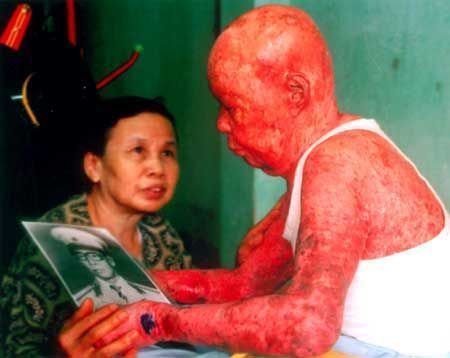 · 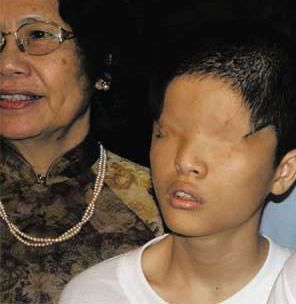 ·  ·  · |
|
#2
●
02-17-2014, 12:25 AM
| ||||||||
 My Rank: GUNNERY SERGEANT Poster Rank:696 male Join Date: Feb 2013 Posts: 1,242 Mentioned: 3 Post(s) Quoted: 236 Post(s)
| ||||||||
|
Re: Agent Orange
Yep, these guys make death and disfigurement a business don't they?  |
|
#5
●
02-17-2014, 03:06 AM
| ||||||||
| My Rank: LANCE CORPORAL Poster Rank:1885 Male Join Date: Apr 2010 Posts: 273 Mentioned: 1 Post(s) Quoted: 46 Post(s)
| ||||||||
|
Re: Agent Orange
the girl on the last pic must have great peripheral vision  |
|
#7
●
02-17-2014, 03:13 AM
| ||||||||
| So Fucking Banned Poster Rank:1377 Female Join Date: Aug 2013 Posts: 437
Contributions: 1
Mentioned: 0 Post(s) Quoted: 72 Post(s)
| ||||||||
|
Re: Agent Orange
btw the second photo looks like a funny photoshop trick. its real I know. but looks hilarious.
|
|
#8
●
02-17-2014, 04:11 AM
| ||||||||
| So Fucking Banned Poster Rank:893 male Join Date: Feb 2014 Posts: 846 Mentioned: 3 Post(s) Quoted: 557 Post(s)
| ||||||||
|
Re: Agent Orange
well i would like to find something with like a arm comming out its chest because i keep finding the same pictures over and over nothing exciting
|