|
#1
●
01-07-2012, 02:48 AM
|
 *DR's Thread Killer* Poster Rank:323 Male Join Date: Apr 2010 Posts: 4,026 4,026Posts 2,184Thanked 35Quoted 1Mentioned 0Contrib. |
|
A Study of Gunshot Wounds
My goal would be to work in Firearms Forensics, however I am not even close to my goal. Interesting shit none the less.... 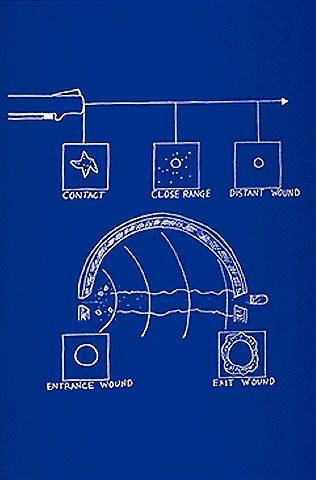 The upper diagram illustrates the basic differences between the skin appearance of a contact, close (intermediate), and distant (indeterminate) range gunshot wound. The appearance of the wounding characteristics in the skull is shown in the lower diagram in which there is beveling of the skull outward away from the direction of origin of the bullet. 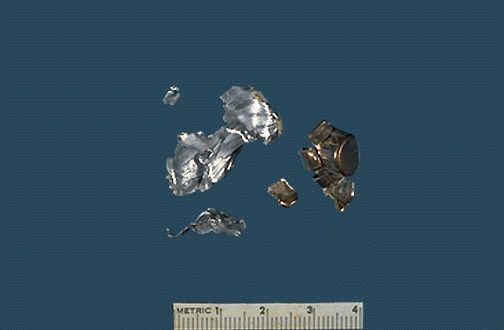 When bullets strike a target, there can be considerable deformation and fragmentation. In this case, the lead bullet has become markedly deformed and has separated from the copper jacket at the right. 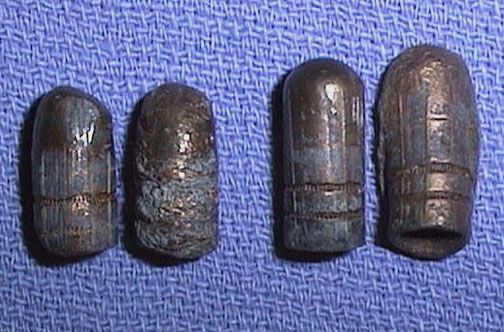 Bullets fired from a gun will have "striae" (linear grooves) imparted as a consequence of traversing the barrel, and these marks help to identify the weapon. Comparison of bullets involves "class" (caliber and rifling) and "individual" characteristics based upon burrs or imperfections in the barrel, particularly the muzzle, that impart specific markings, or striae, to fired bullets. Individual characteristics are used to try and determine if a specific gun was used in a crime. The sets of bullets shown here are from the same class, but deformations in recovered bullets (the right of each pair) can complicate comparison.  This is an contact gunshot entrance wound. Since the barrel contacts the skin, the gases released by the fired round go into the subcutaneous tissue and cause the star-shaped laceration. Note also the grey-black discoloration from the soot, as well as the faint abrasion ring. [Image contributed by Todd Grey, MD, University of Utah] 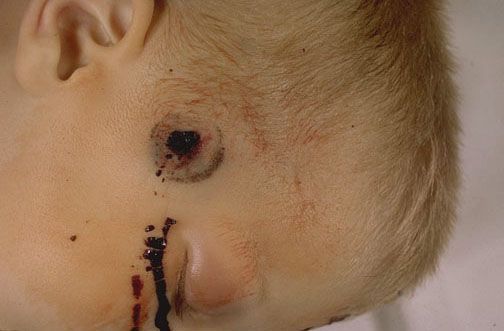 An abrasion ring, formed when the force of the gases entering below the skin blow the skin surface back against the muzzle of the gun, is seen here in this contact range gunshot wound to the right temple. [Image contributed by Todd Grey, MD, University of Utah] 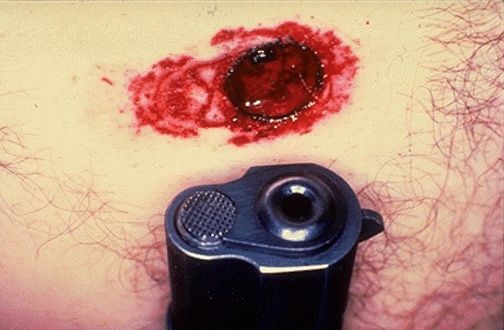 The abrasion ring, and a very clear muzzle imprint, are seen in this contact range gunshot wound. [Image contributed by Todd Grey, MD, University of Utah] 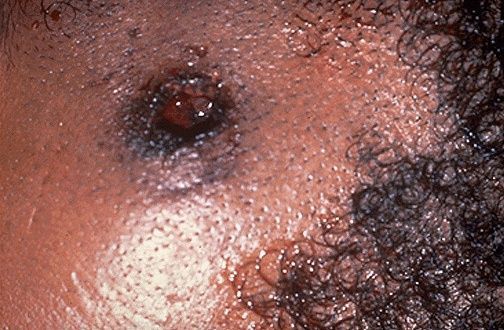 This is a contact range gunshot entrance wound with grey-black discoloration from the burned powder. 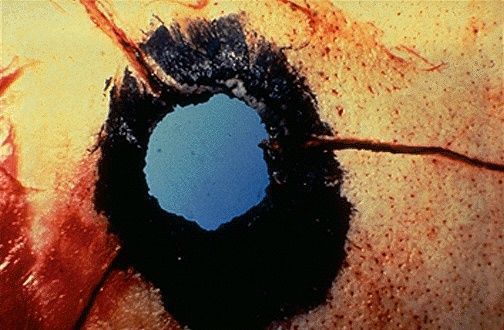 The surface of the skull demonstrates the heavy soot in this contact range entrance wound, as well as radiating fracture lines. The direction of fire was thus toward the back of this picture. [Image contributed by Todd Grey, MD, University of Utah] 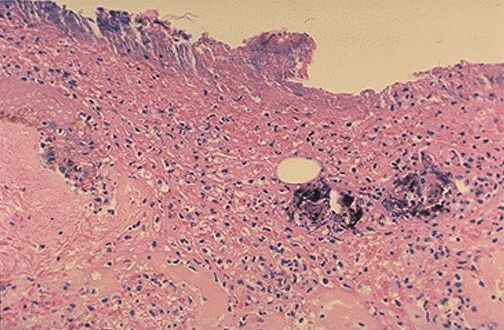 This is an intermediate range gunshot entrance wound in which there is powder "tattooing" around the entrance site. 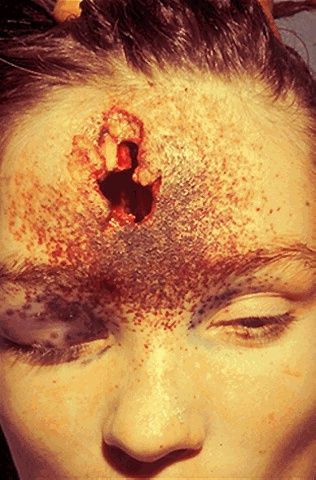 Powder tattooing is seen in this intermediate range gunshot wound. The actual entrance site is somewhat irregular, because the bullet can tumble in flight. 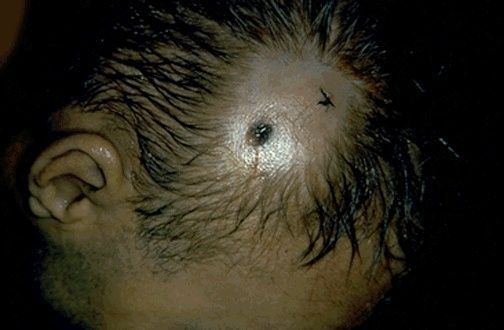 Displayed here is an entrance at the left and an exit at the right. This particular bullet struck at an angle to produce the ovoid entrance. Exit wounds vary considerably in size and shape because the bullet can be deformed in its transit through the body. There may be no exit wound at all if the bullet's energy is absorbed by the tissues. Some bullets (such a "hollowpoint") are designed to deform so that all their energy will be converted to tissue damage and not exit. 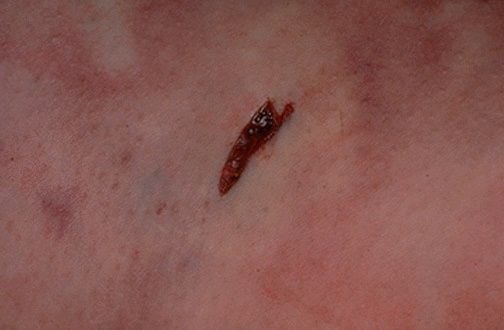 Here is a slit-like exit wound. The projectile became deformed and flattened while traversing the body, producing a laceration upon exit. Note that there is no powder or soot visible in this exit wound. [Image contributed by Todd Grey, MD, University of Utah] 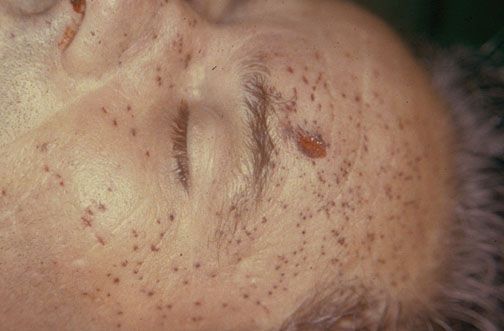 This is an intermediate range gunshot entrance wound in which there is powder "tattooing" around the entrance site. |

 great presentation thx