|
#1
●
09-17-2021, 09:21 AM
|
 ♚ Legacy Gold Member ♚ Poster Rank:914 Join Date: Jul 2020 Posts: 820
Contributions: 13
820Posts 27,646Thanked 173Quoted 13Mentioned 13Contrib. |
|
The Shocker's Mix 9
Some of the stuff I work on doesn't make the cut so I thought about gathering them up in a single post. So basically it's images I have little or no info about or I've decided that they don't get their own thread, for example, because of low image/content quality, lack of backstory or additional info/knowledge, possibly uninteresting, only one image but not very special. I still do the usual image work including upscaling and color correction as needed, as I prefer to have my content high quality and educational. - - - Case 1 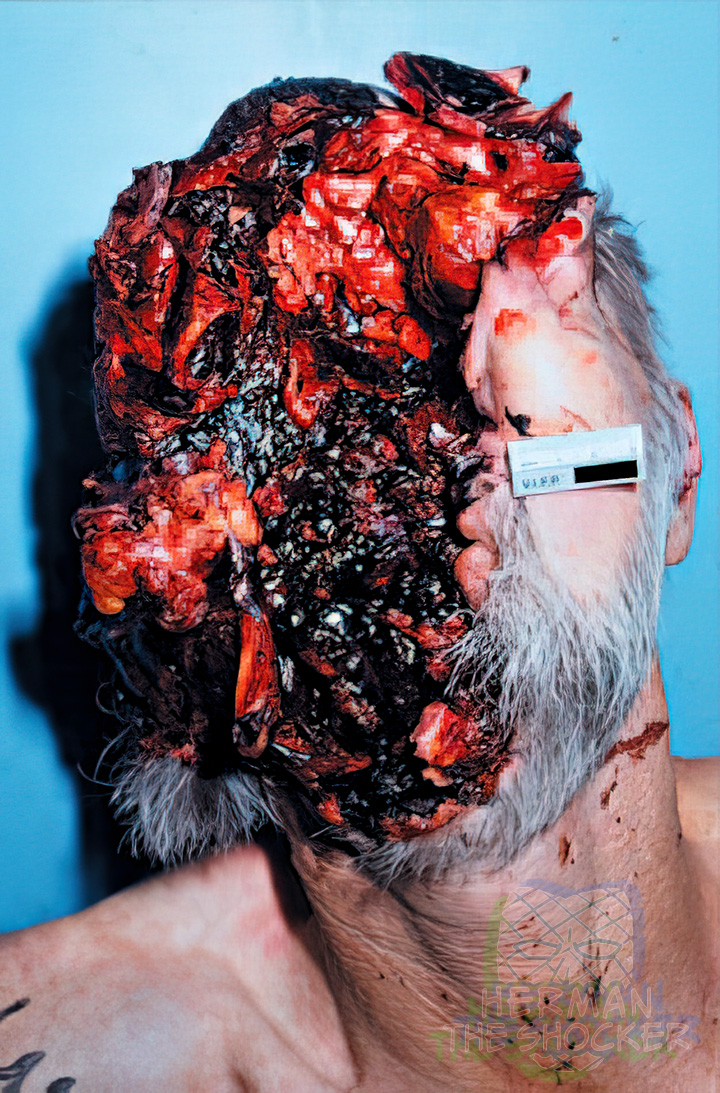 Fig1.1 This victim shot himself under the chin creating a massive tissue destruction. 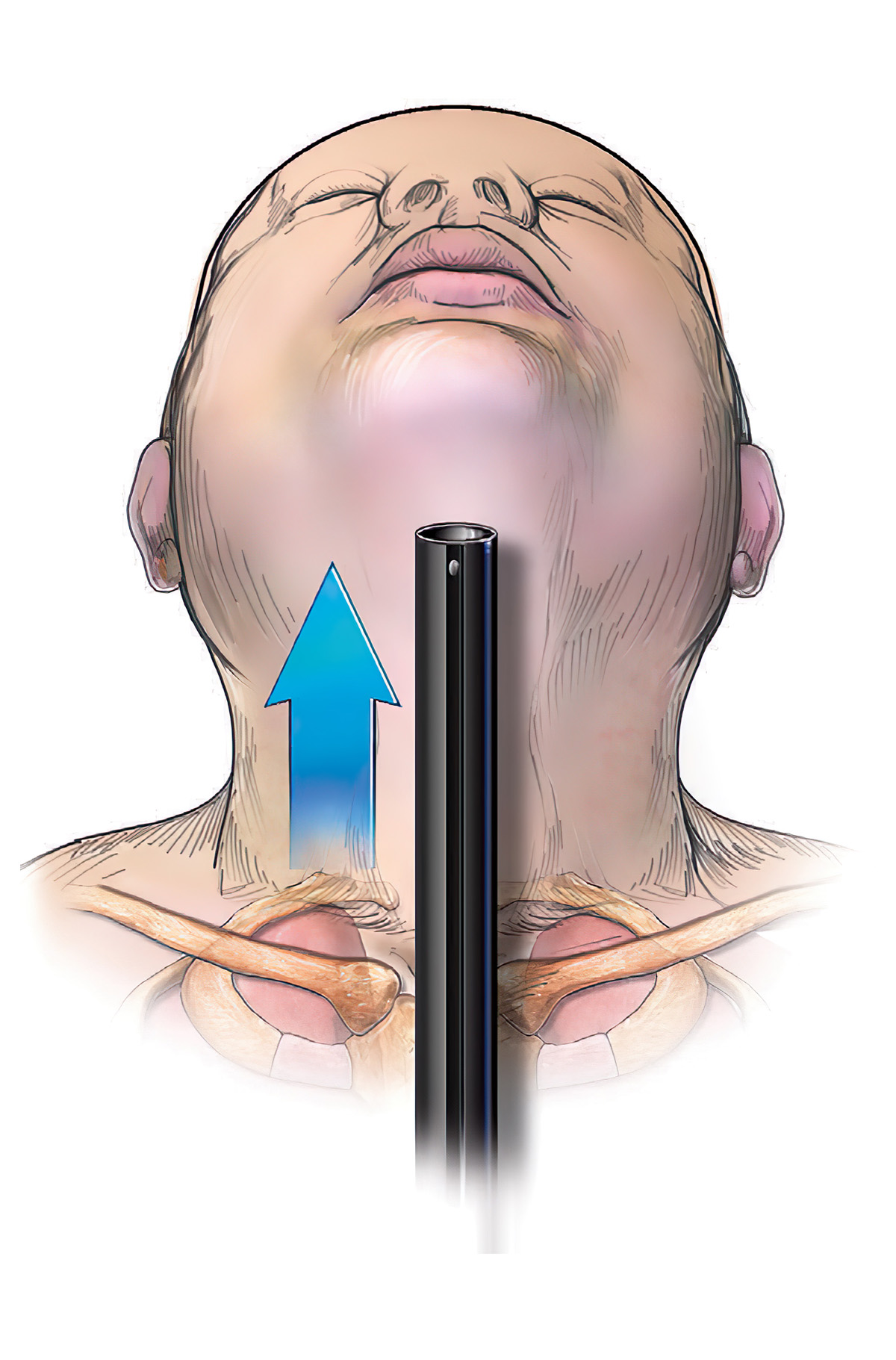 Fig1.2 This graphic shows an under-the-chin suicide. 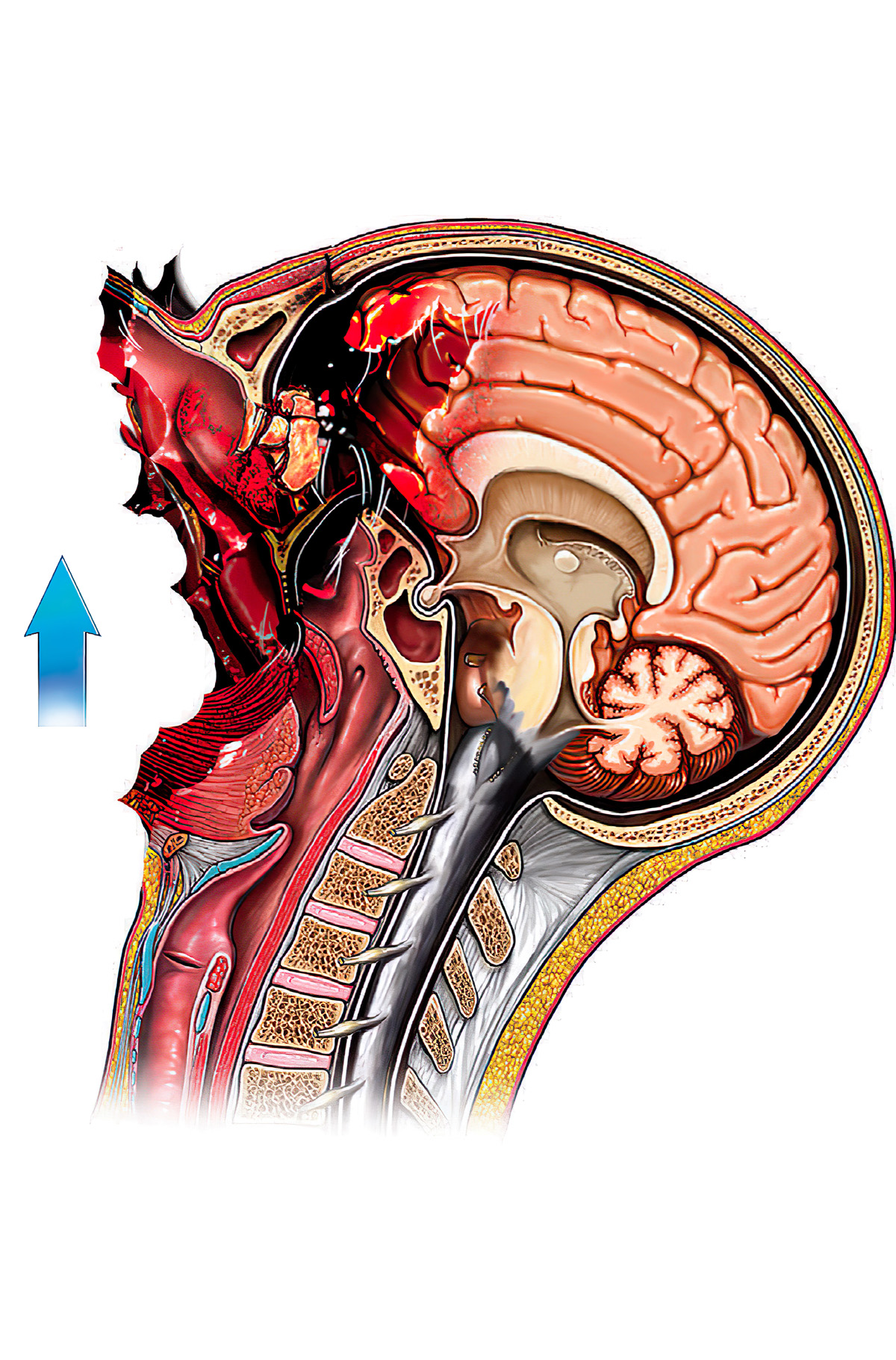 Fig1.3 This graphic shows the effect of an under-the-chin shotgun wound. This individual killed himself with a gunshot under the chin creating a massive tissue destruction. Facial disruption can be seen after the muzzle was placed beneath the chin. In this case, the gun was angled somewhat anteriorly, sparing much of the brain. Death would be expected although survival is seen in some exceptional cases. No further info or what type of gun was used. Head injuries from shotguns and high-powered rifles are typically quite devastating, often with extensive soft tissue destruction, skull fractures, and pulpifaction of the brain. Occasionally, the brain is largely expelled from the cranial vault and may be found near the body. Self-inflicted submental and transoral wounds may produce serious but survivable brain injuries if the path of the bullet is limited to the frontal area. In the head, neck, and limbs, shotgun exit wounds can be ragged and very large, with extensive tissue damage. In a suicide where the gun has been placed in the mouth, there will be significant disruption of the head, and brain may be expelled, the so-called “burst head” effect. - Case 2 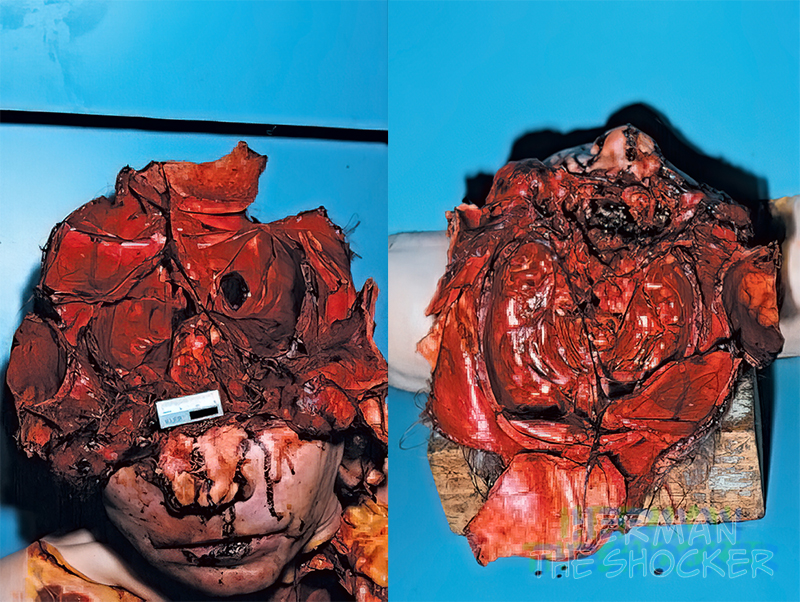 Fig2.1 The catastrophic effect of an intraoral discharge. The catastrophic effect of an intraoral discharge. The head has completely opened up in a petal like fashion. Close examination shows the cerebellar hemispheres in situ, as is frequently the case. No further info. Centerfire rifles, whether military or hunting, frequently cause a strong ‘explosive’ effect with comminution of bones and laceration of brain tissue up to a so-called Kröhnlein shot (exenteratio cranii). Shotgun injuries differ substantially depending on the range of fire. Close-range shots have a tremendous effect similar to centerfire rifles by literally riddling brain tissue and blasting the skull. The high internal cranial pressure often leads to long skin tears, also detached from the bullet opening, as well as extensive bone fracture systems and brain tissue destruction. The head is the most common location for a suicidal shotgun wound (74%), followed by the chest (20%) and then the abdomen (6%). In head wounds, the most common location was intraoral (50%), followed by under the chin (19%); side of head, including parietal and temporal wounds (15%); and the face, including the forehead (13%). - Case 3 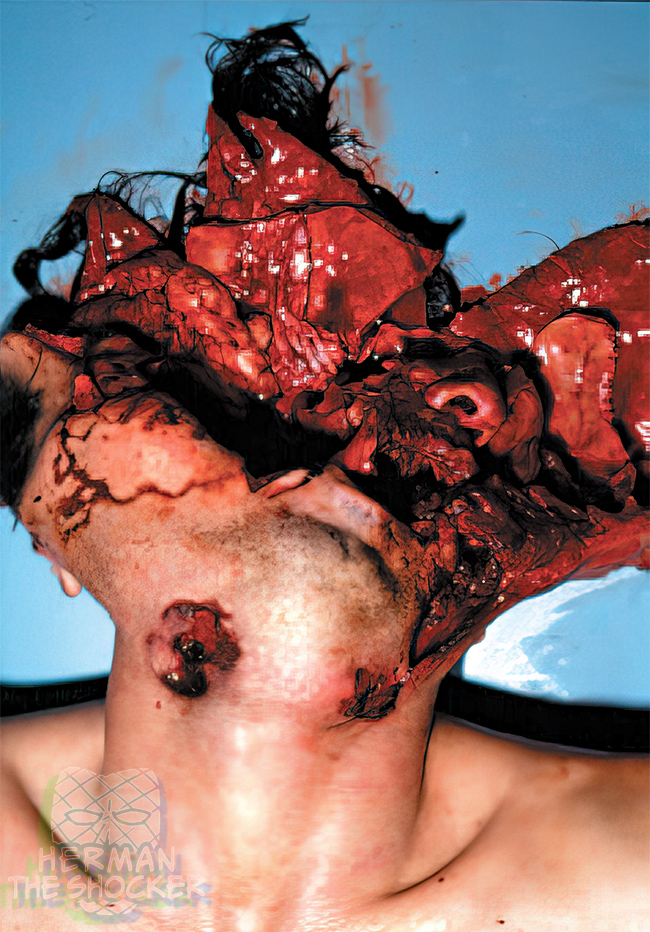 Fig3.1 Massive explosive burstlike exit wound to the head from a .30-06 hunting rifle. Massive explosive burstlike exit wound to the head from a .30-06 hunting rifle suicide. Note outward petal like displacement of the calvarium and scalp. Note also the well demarcated muzzle imprint and entry defect beneath the chin. Head injuries from shotguns and high-powered rifles are typically quite devastating, often with extensive soft tissue destruction, skull fractures, and pulpifaction of the brain. Occasionally, the brain is largely expelled from the cranial vault and may be found near the body. - Case 4 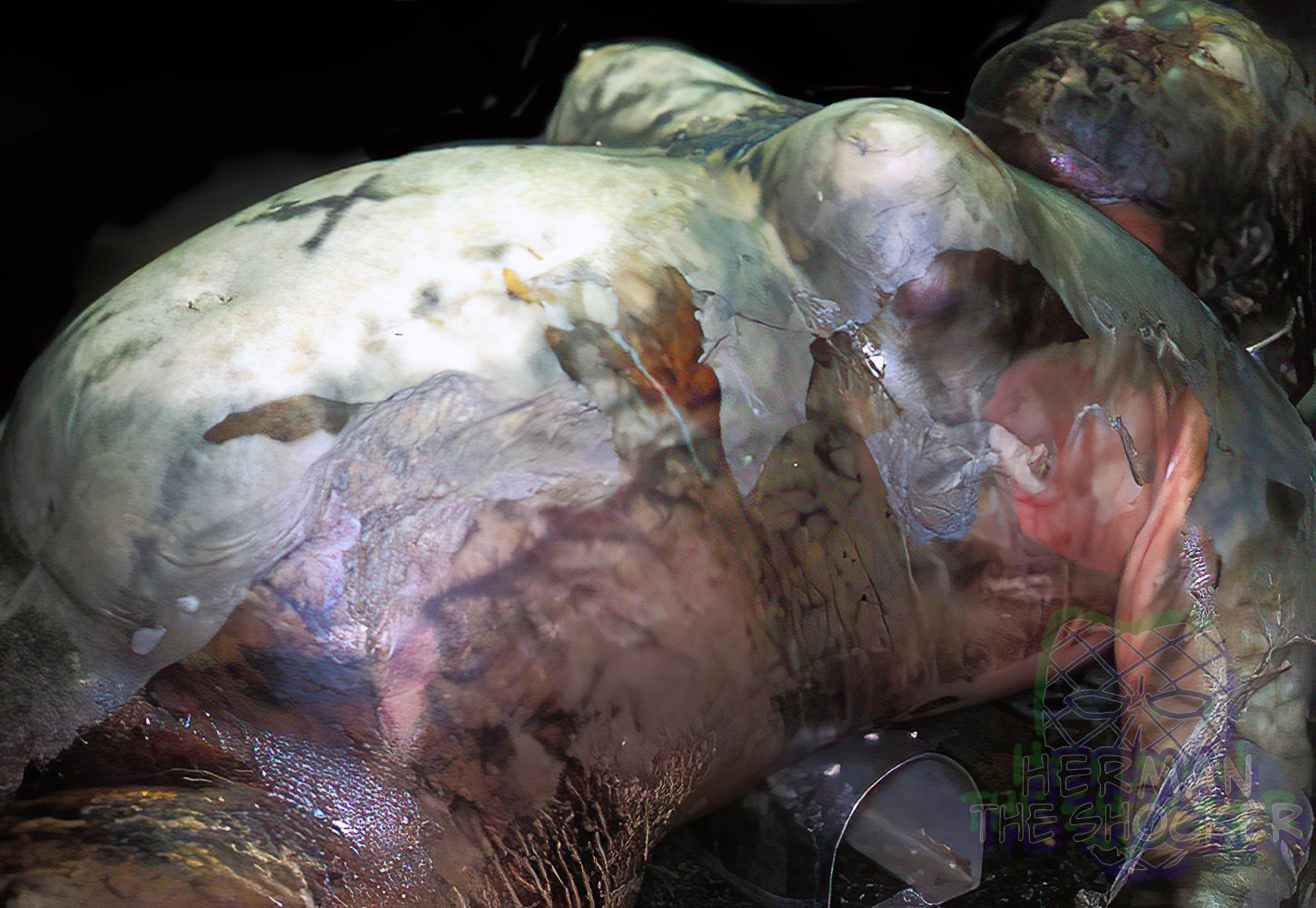 Fig4.1 Body of a woman who died while taking a bath. This is the body of a 74-year-old woman who died while taking a hot bath, she was found 3 days later. The body is bloated and venous marbling can be seen. No further info. Decomposition, or putrefaction, is a combination of two processes: autolysis and bacterial action. Autolysis is the breakdown of cells and organs through an aseptic chemical process caused by intracellular enzymes. Because it is a chemical process, it is accelerated by heat, slowed by cold, and stopped by freezing. Bacterial action results in the conversion of soft tissues in the body to liquids and gases. The chemicals produced as a result of putrefaction are cadaverine and putrescine, hydrogen sulfide and other sulfides, which generate a horrible smell. Putrefaction begins immediately upon death and usually becomes noticeable within 24 hours. As soon as death occurs, the bacteria or microorganisms within the intestinal tract escape from the bowel into the other tissues of the body. As they grow, they begin to produce gases and other properties that distort and discolor the tissues of the body. The discoloration is a dark greenish combination of colors and is generally pronounced within 36 hours. As a result, the body begins to swell from the putrefactive gases, emitting an extremely repugnant odor. Marbling is a common finding usually found after at least 24 h since death occurred and is a red, green, and black discoloration that follows the vessels of the body due to the breakdown of hemoglobin. Marbling occurs when certain types of bacteria found in the abdomen “migrate” to the blood vessels, causing them to assume a purple-greenish tint. This effect gives the skin on some body parts — usually the trunk, legs, and arms — the appearance of marble (hence its name). - Case 5  Fig5.1 Shotgun suicide. There was no info about this case, so here's just some general info: At close range, the shotgun is the most formidable and destructive of all small arms. For birdshot and buckshot loads, the severity and lethality of a shotgun wound depends on the number of pellets that enter the body, the organs struck by the pellets, and the amount of tissue destruction. Typically, these wounds are jagged, irregular lacerations with everted edges and bone fragments under the skin. The head is the most common location for a suicidal shotgun wound (74%), followed by the chest (20%) and then the abdomen (6%). In head wounds, the most common location was intraoral (50%), followed by under the chin (19%); side of head, including parietal and temporal wounds (15%); and the face, including the forehead (13%). In the case of homicides, 59% occurred at a distant range, 21% occurred at an inter-mediate range, and 8% were at contact range. There was not a significant most common location for homicidal shotgun wounds, though the head, chest, and multiple locations all occurred about 25% of the time, representing the three most common locations. The most common locations of wounds to the head were face, including forehead (37%), and the side of the head, including parietal and temporal wounds (23%). (Molina et al. 2007). Shotguns differ from rifles and handguns in construction, ammunition, ballistics, and use. Rifles and handguns fire a single projectile down a rifled barrel. Shotguns have a smooth bore. Although they can fire a single projectile, they are usually employed to fire multiple pellets. Rifled shotgun barrels, intended for use with slugs, are available. Shotguns may be autoloaders, pump (slide action), over/under, side-by-side, bolt action, or single shot. Some shotguns usually intended for military and/or police use convert from semiautomatic to pump action and back as the user desires. - Case 6  Fig6.1 Catastrophic disruption of the head after a distant range discharge. Catastrophic disruption of the head after a distant range discharge. Homicide with a 30-06 Springfield rifle. Note petal like outward disruption of the head in all planes with expulsion of much of the brain. After reconstruction, the entry wound is now evident. All elongated curvilinear lacerations lead to a circular defect overlying the left mid-forehead area. Photographs were very low quality. No further info. Head injuries from shotguns and high-powered rifles are typically quite devastating, often with extensive soft tissue destruction, skull fractures, and pulpifaction of the brain. Occasionally, the brain is largely expelled from the cranial vault and may be found near the body. Despite the extreme amount of cranial destruction, careful and meticulous reapproximation of the calvarium, scalp, and facial tears allows for the demonstration and confirmation of the entrance wound. Reconstruction of the wound can be very important to determine particular wound characteristics in cases of alleged homicide. - This post is for educational purposes only and is nonprofit. Under Section 107 of the US Copyright Act of 1976; Allowance is made for "Fair Use" for purposes such as criticism, comment, news reporting, teaching, scholarship, and research. OP is not a medical expert. No copyright infringement intended. This post does not encourage or glorify violence/harassment. Images might have been upscaled and enhanced. Text might have been shortened and simplified/reorganized for online view. |
|
#2
●
09-17-2021, 09:39 AM
|
 Für Immer Verloren Poster Rank:50 Boredom + Despair Join Date: Sep 2017 Posts: 30,197
Contributions: 743
30,197Posts 192,617Thanked 10,332Quoted 136Mentioned 743Contrib. |
|
Re: The Shocker's Mix 9
Great mix, mate.
__________________ "I'd give the world for the chance just to see your face again. Still I pretend that you're still standing by." |
|
#4
●
09-17-2021, 03:22 PM
|
 My Rank: PRIVATE FIRST CLASS Poster Rank:3579 Male Man Join Date: May 2017 Posts: 97 97Posts 201Thanked 15Quoted 0Mentioned 0Contrib. |
|
Re: The Shocker's Mix 9
Last thing going through their heads? Bullets. Thanks again for these set of images, herman
|
|
#5
●
09-17-2021, 03:49 PM
|
 ★ Legacy Member ★ Poster Rank:252 So many choices now Join Date: Jul 2015 Posts: 5,542 5,542Posts 19,786Thanked 2,120Quoted 15Mentioned 0Contrib. |
|
Re: The Shocker's Mix 9
Kudos as usual, Herman. What you consider as cast-off is what anyone else would be thrilled to post. Eyeballs are very resilient to blam-blam type trauma. |
|
#6
●
09-17-2021, 04:36 PM
|
| So Fucking Banned Poster Rank:302 Join Date: Mar 2010 Posts: 4,310
Contributions: 1
4,310Posts 16,895Thanked 1,445Quoted 2Mentioned 1Contrib. |
|
Re: The Shocker's Mix 9
Mr. HermanTheShocker, Your content has always been of very high quality, and most certainly educational. Thanks for posting. |
|
#8
●
09-18-2021, 10:14 AM
|
| My Rank: MASTER GUNNERY SERGEANT Poster Rank:350 "IT"-Species; Genus-genius Join Date: Jan 2013 Posts: 3,611 3,611Posts 5,349Thanked 619Quoted 0Mentioned 0Contrib. |
|
Re: The Shocker's Mix 9
Herman, what were these stooges thinking? You may pick their brains for the answers.
|