|
#1
●
02-26-2023, 12:17 PM
|
 ♚ Legacy Gold Member ♚ Poster Rank:914 Join Date: Jul 2020 Posts: 820
Contributions: 13
820Posts 27,652Thanked 173Quoted 13Mentioned 13Contrib. |
|
Post-Mortem Repositioning of Human Bodies in Fires
The images are shit quality but maybe someone here finds this interesting. --- One of the indicators forensic fire investigators try to use in the reconstruction of fatal fires is interpreting the position of a burned body and its limbs in a fire scene. Both scene investigators and forensic pathologists have attempted to reconstruct the final moments of the victim’s life by examining the remains – sometimes as the remains are documented at the scene, but often after recovery, removal, transport, and delivery to the morgue. These later processes can alter or even destroy badly burned remains to such a state that any interpretation is guesswork. Even more distressing is the lack of empirical knowledge about the effects of fire on a body during an actual fire. Because very few forensic personnel have ever watched a deceased body burn in a fire and with such limited empirical data, it is not surprising that much of the attempted reconstruction is guesswork and misinterpretation. The annual Forensic Fire Death Investigation Course (FFDIC) has been offered in San Luis Obispo, California since 2008. The field exercise of this unique course involves the preparation of 10 to 12 different fire scenes in which one or two unembalmed human cadavers are exposed to each fire. The events include structure (room and contents) fires – often to flashover and beyond. Others include road-side dumps and vehicle body disposal. Some fires are brief in duration – 10-20 minutes – some involve 6-8 hours of fire exposure. A variety of fire scenarios is created each year for the FFDIC course by the instructors to give the students exposure to different fire scene conditions. These can range from body disposals in burning automobiles, to roadside dumps fueled by brush, wood pallets, tires, and trash), to furnished rooms ignited by a number of different mechanisms to recreate both accidental and intentional fires. The rooms were purpose-built using wood studs and gypsum wallboard wall- and ceiling coverings. The furniture and clothing was obtained second-hand from local donation centers. Each room or vehicle was fitted with thermocouples to record temperatures (with one usually placed in the center of the upper torso to record internal body temperatures). Unembalmed human cadavers refrigerated at near 0°C, were dressed and positioned in various positions suitable for the scenario. It was necessary to use unembalmed cadavers since the embalming process hardens the tissues, preventing their normal reaction to heat. The cadavers were obtained by the Medical Education and Research Institute,(MERI), Memphis, TN as specified donations and provided to the San Luis Obispo County Sheriff -Coroner Office in accordance with applicable medical ethical guidelines for use in the FFDIC class only. At the end of the course, the remains were resealed in their original body bags and transported back to MERI for cremation. --- Test 1: Sustained fire on bed in small cubicle. Body of elderly male adult, dressed in cotton sweat shirt and pants on modern box spring, covered with cotton blanket. Body in supine position with legs extended straight and arms by sides. Fire ignited with open flame to paper at edge of blanket. Brief flashover fire. Fire duration was 7 hrs (self-extinguished). 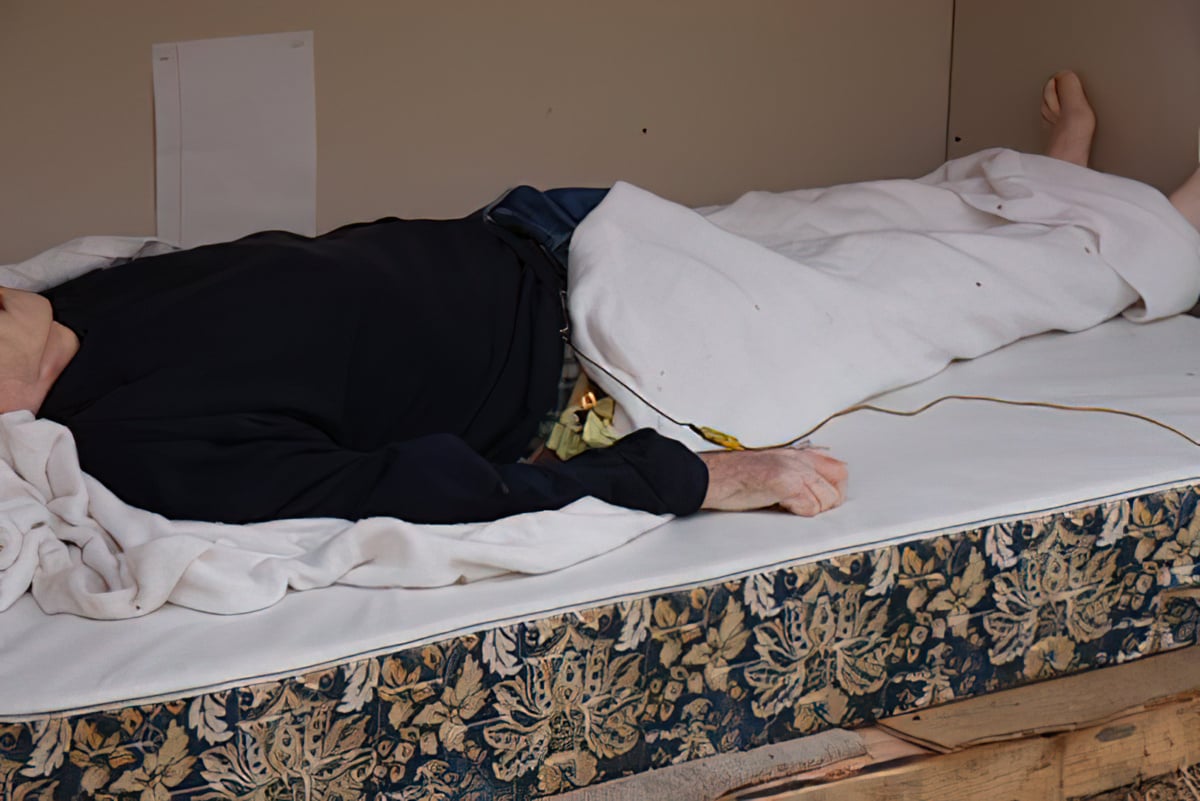 Fig.1 Test 1: Sustained fire on bed. Body of elderly male adult, dressed in cotton sweat shirt and pants on modern box spring, covered with cotton blanket. Body in supine position with legs extended straight and arms by sides. Fire ignited with open flame to paper at edge of blanket. Fire duration was 7 hrs (self-extinguished). 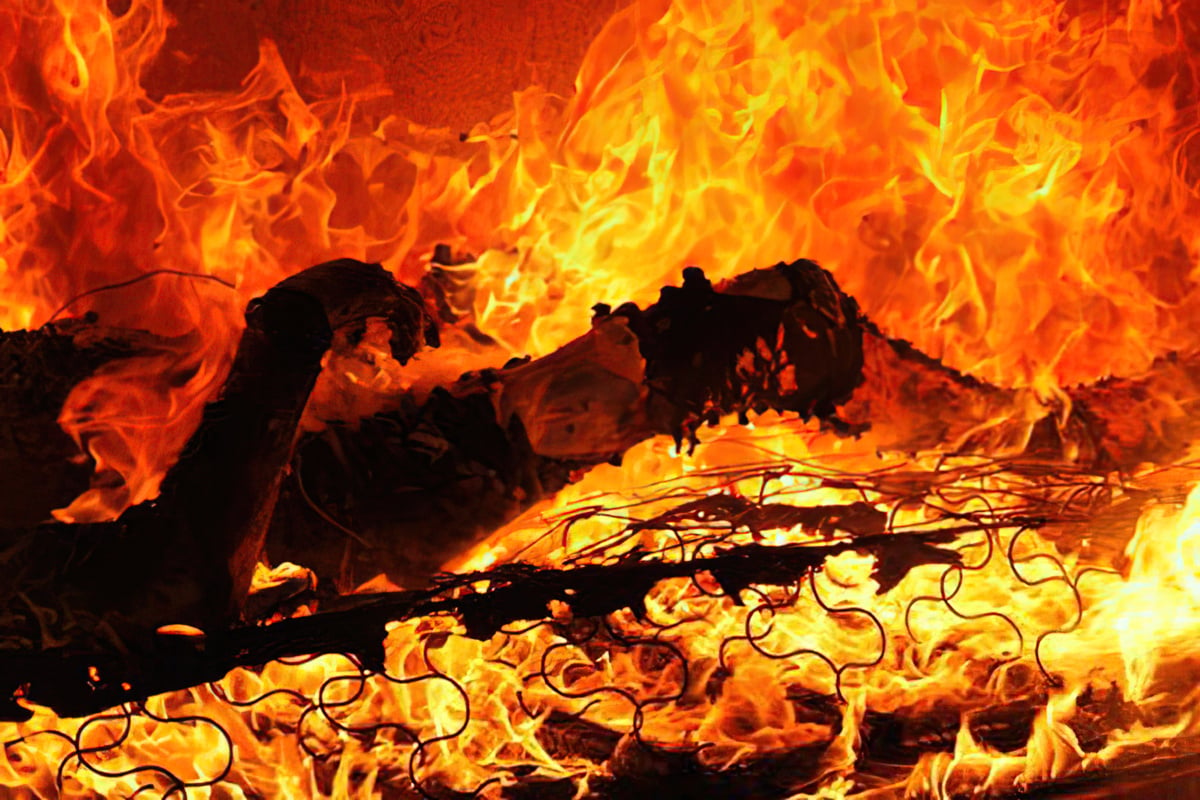 Fig.2 Test 1: At 16min, the right arm is raising at the elbow and the legs are flexing upward due to flexing of the knees. 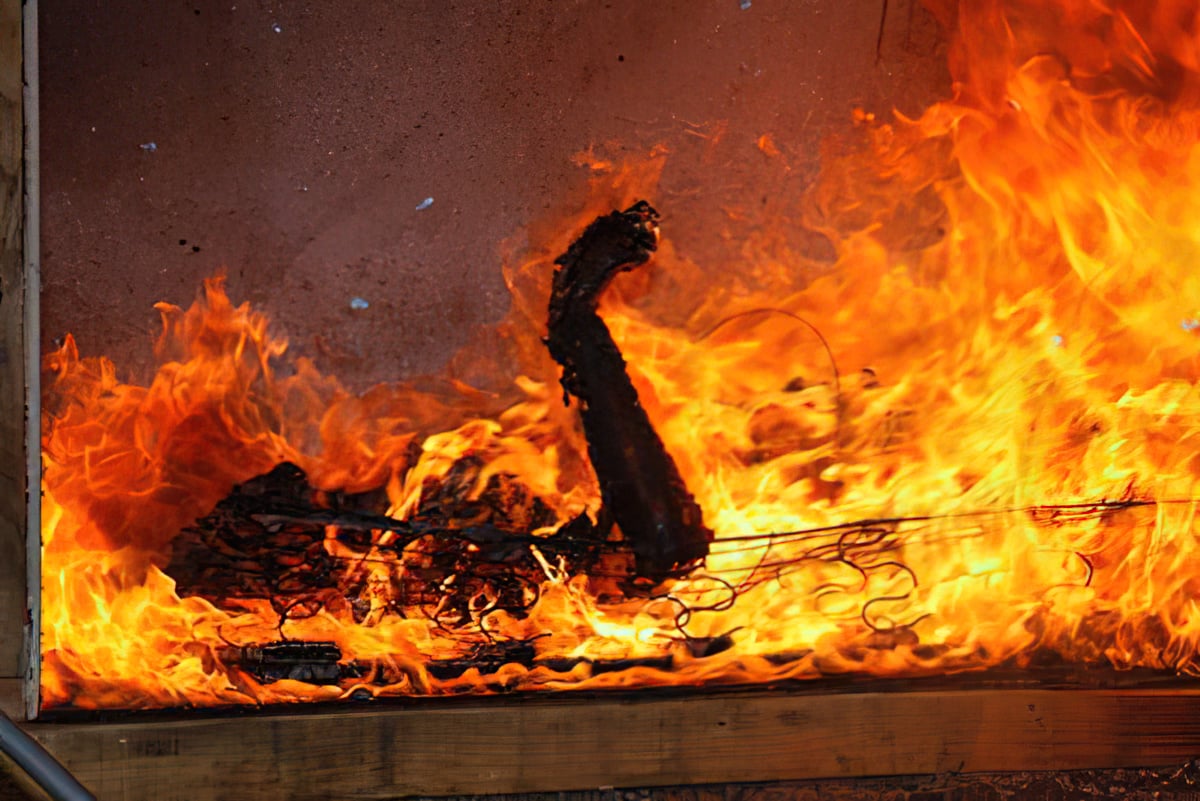 Fig.3 Test 1: At 21min, right arm is raised. Fingers are disarticulated. 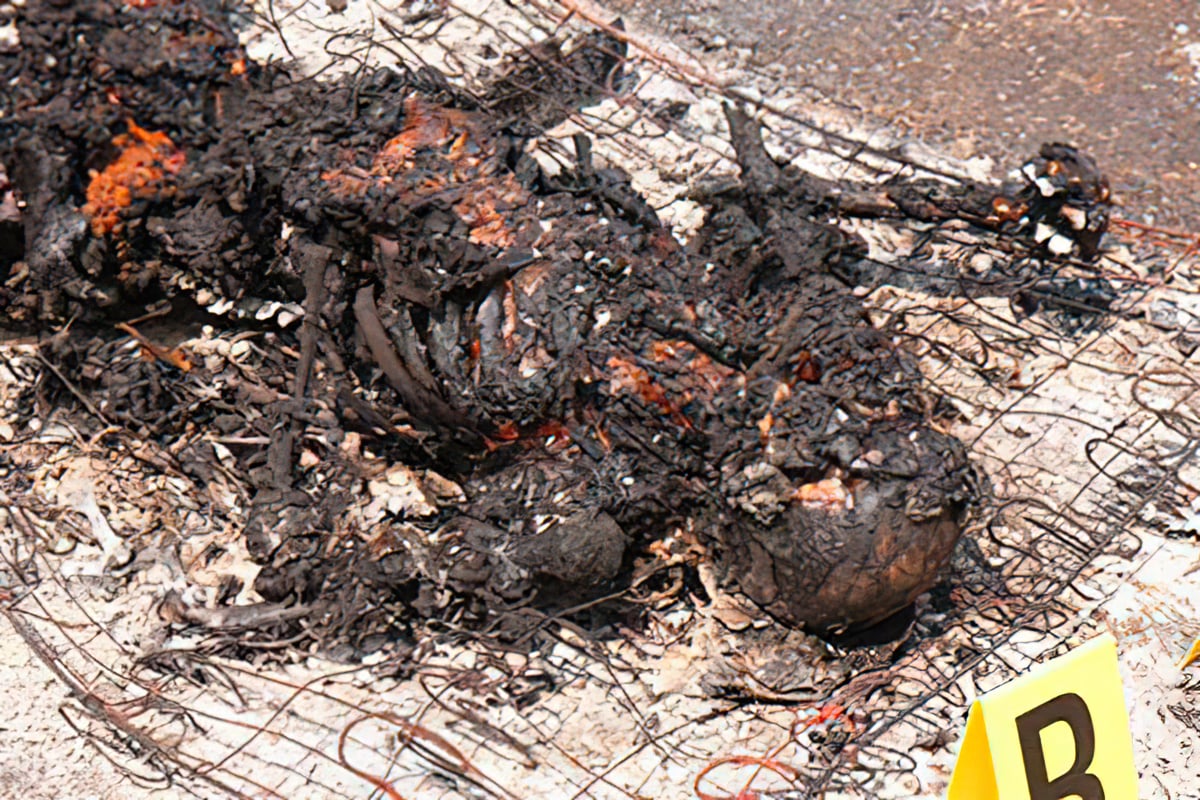 Fig.4 Test 1: After self-extinguishment at 7hrs, both arms are flexed at shoulders and elbows. Hands are in a very different position than at the start. 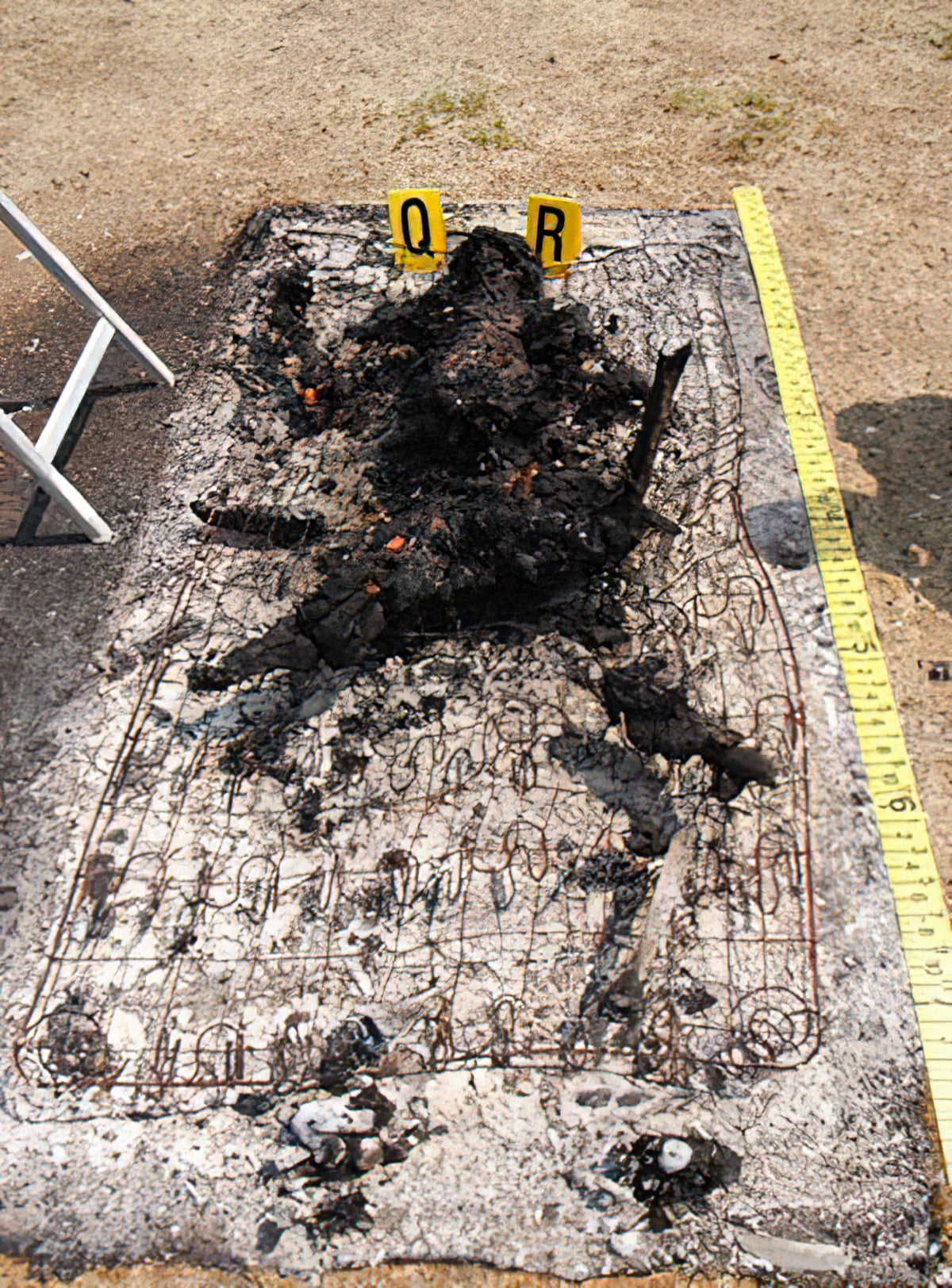 Fig.5 Test 1: The feet are disarticulated, the knees are flexed outward. The left femur was broken mechanically before the fire and it is in an upright position to the body. --- Test 2: Sustained fire on bed in small cubicle. Body of elderly male adult in supine position on modern box spring, dressed in cotton sweatshirt and pants and covered with a cotton blanket. Arms at sides, legs straight. Fire ignited in paper under edge of blanket at shoulder. Brief flashover fire. Fire duration was 6.25 hrs (self-extinguished). 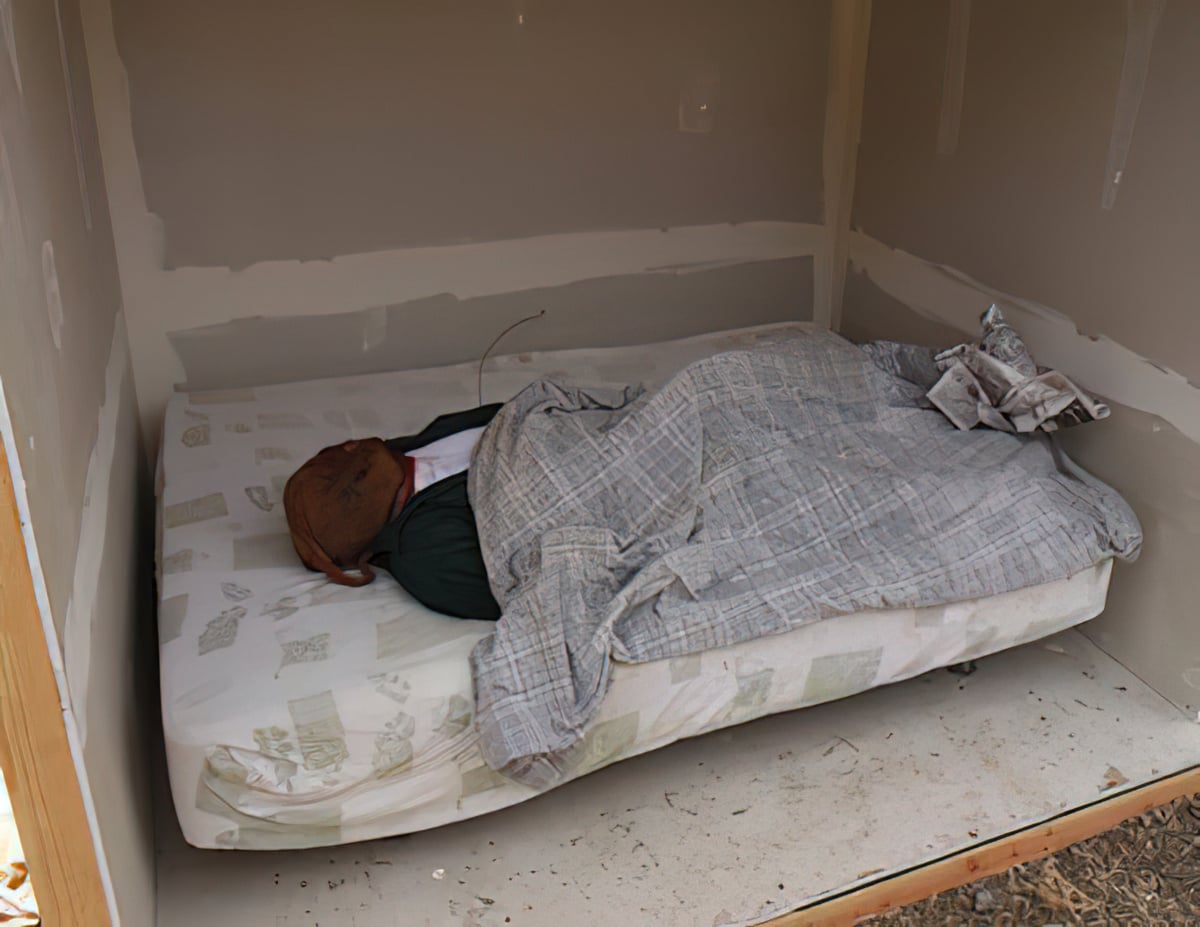 Fig.6 Test 2: Sustained fire in bed. Body of elderly male adult in supine position on modern box spring, dressed in cotton sweatshirt and pants and covered with a cotton blanket. Arms at sides, legs straight. Fire ignited in paper under edge of blanket at shoulder. 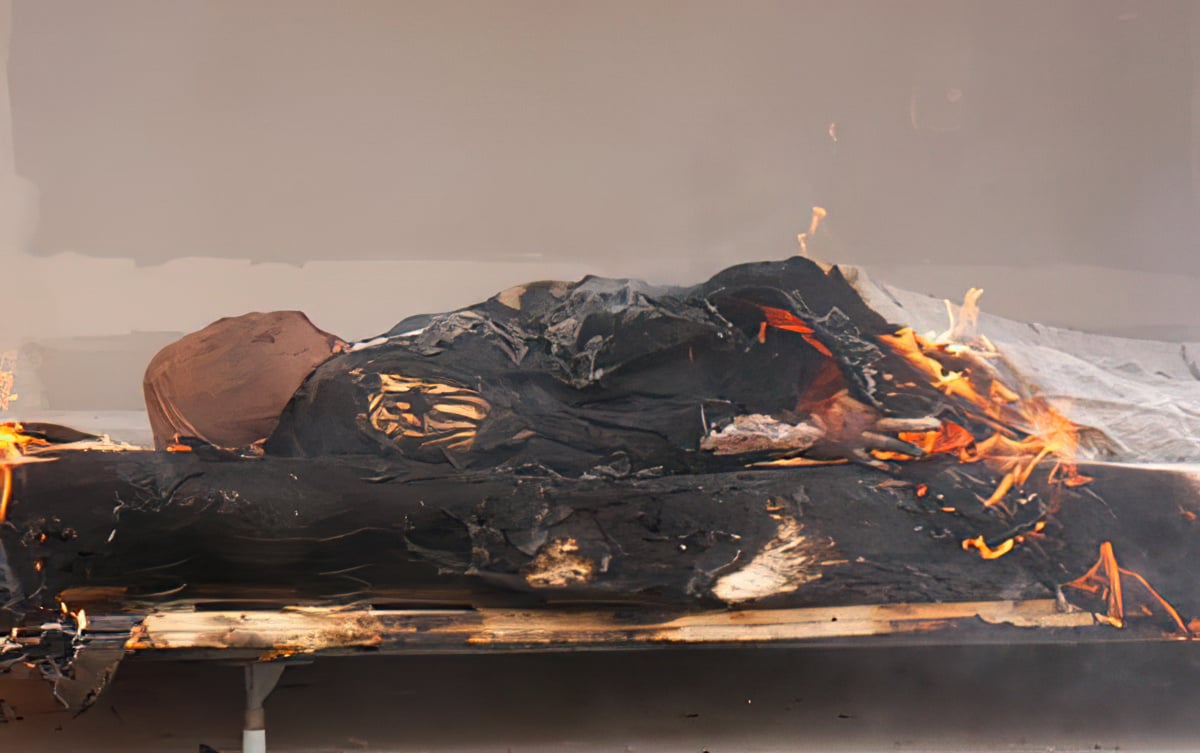 Fig.7 Test 2: At 1hr:16min, the modest fire in the box spring and blanket are causing the fingers of the right hand to flex downward (towards the heat). 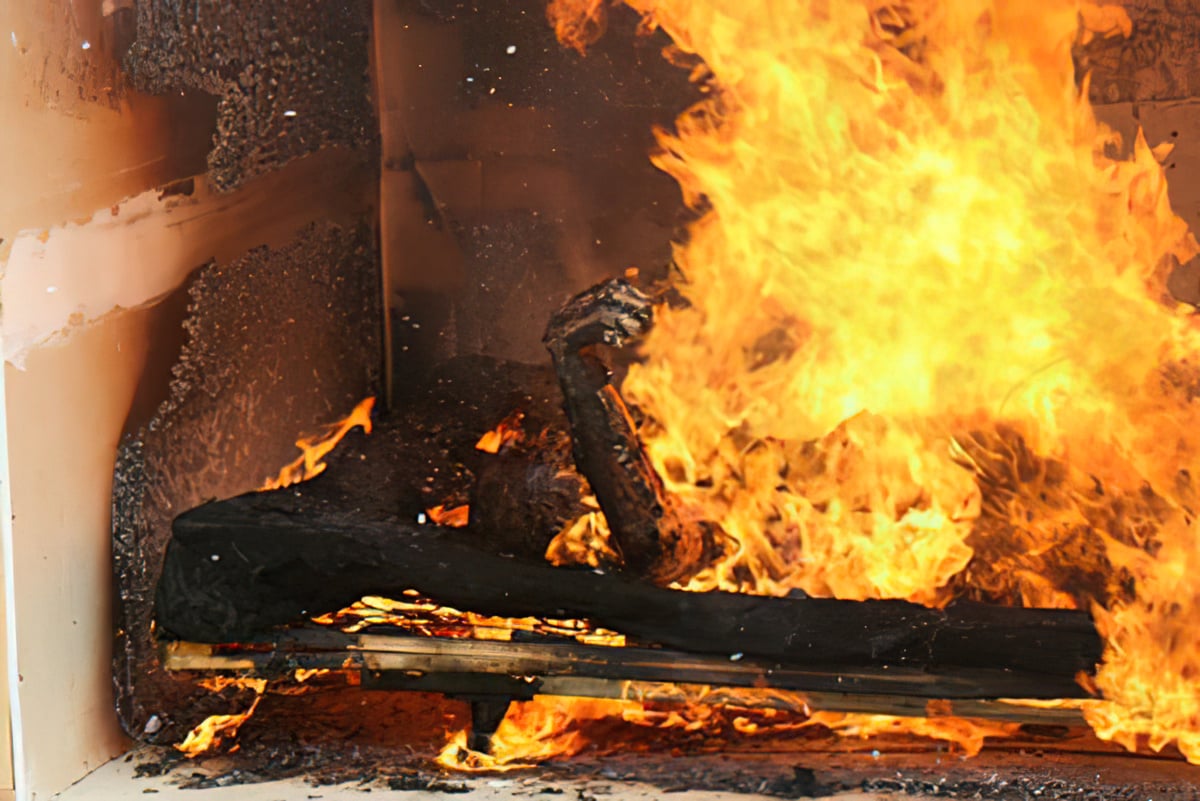 Fig.8 Test 2: At 1hr:55min, there is a substantial fire in the box spring and a pool fire supported by the body fat that has rendered out and gathered on the gypsum wallboard floor covering beneath the torso. Fingers clenched but intact, arm is raised from the shoulder and elbow. 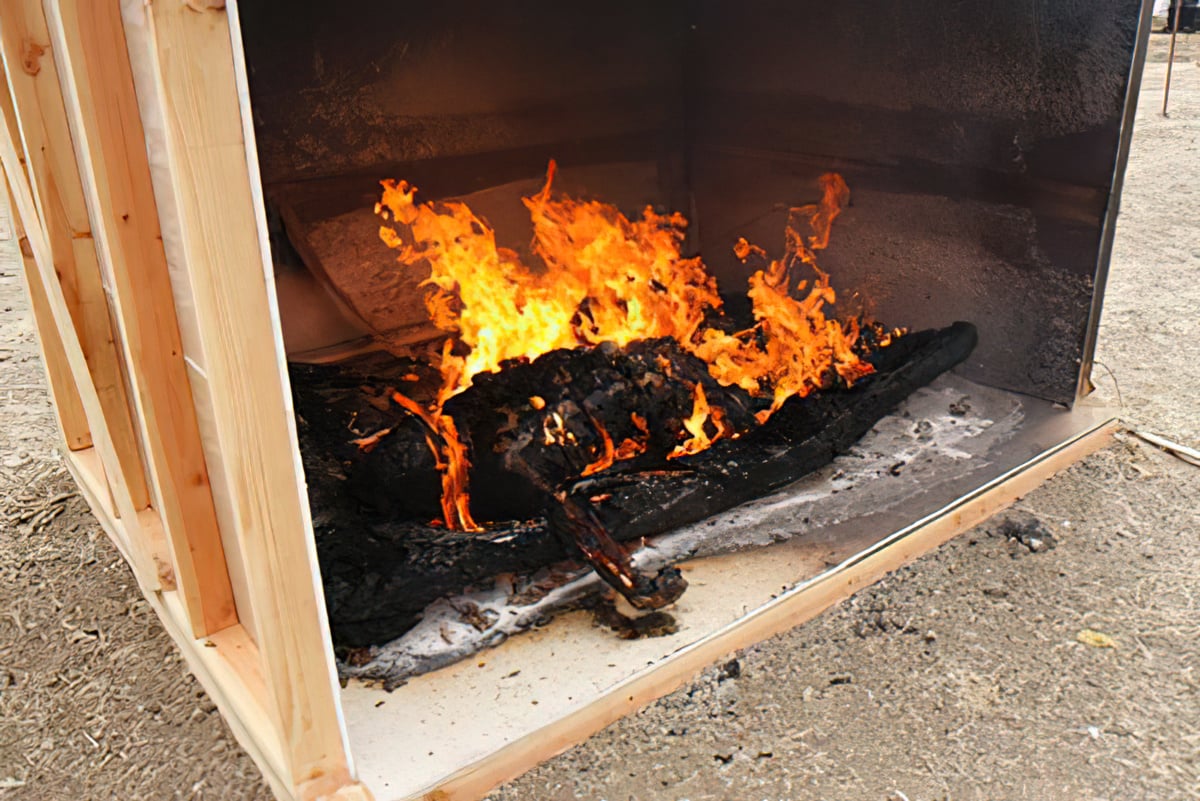 Fig.9 Test 2: At 2hrs:15min, the fire is localized on the body and the pool fire beneath it. The right arm has collapsed outward. 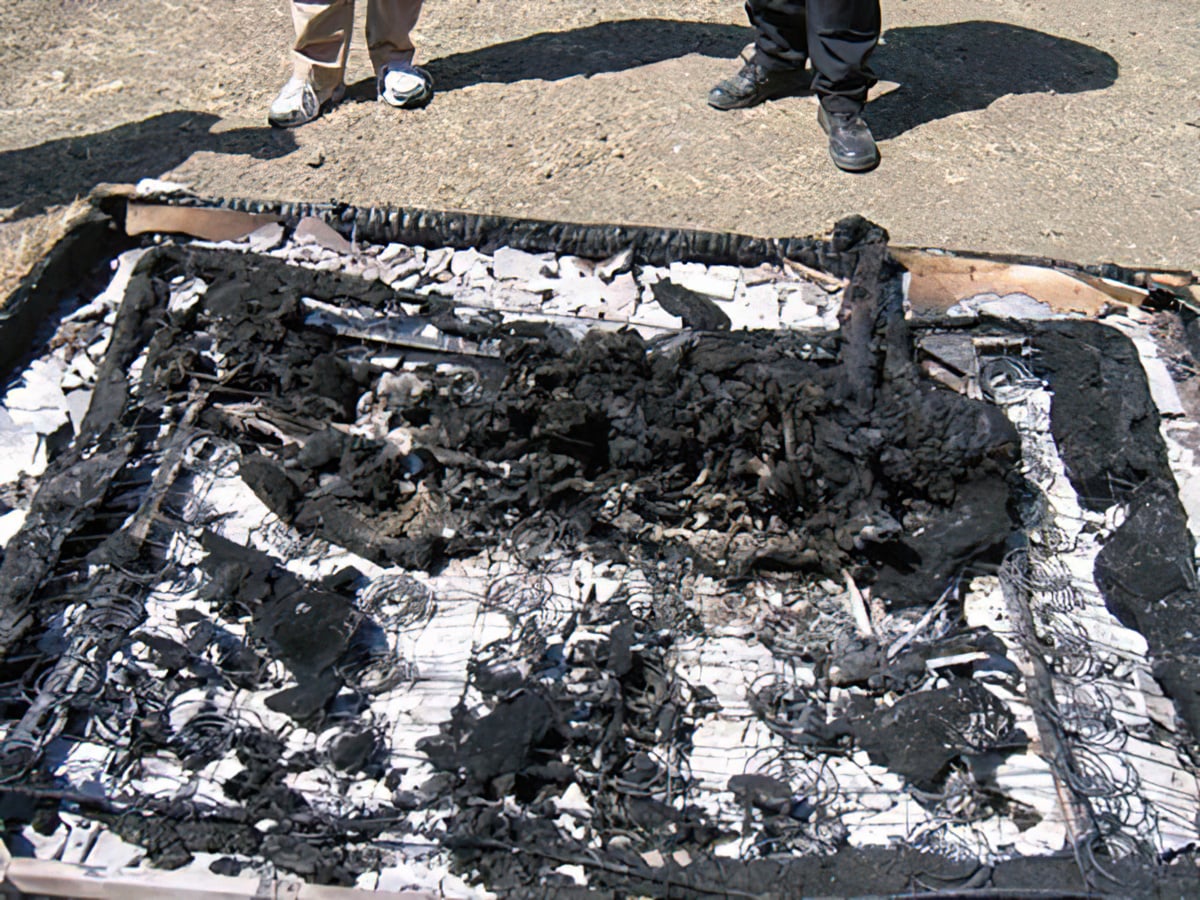 Fig.10 Test 2: After self-extinguishment at 6hrs:15min, the full extent of repositioning can be seen. The left arm is extended out at right angle from the body and the bones heavily calcined and fragmented. The right arm extended out away from the body and is still relatively intact. The knees are flexed outward (legs in a plie ballet position). --- Test 3: Open (three-sided) cubicle fire with two bodies. One body (previously exposed to a low intensity fire) on bed, other slumped in chair. Fire started in paper trash between body and chair. Fire went to flashover at about 7min, post-flashover burning for 13 more minutes (total fire duration was 20 min). 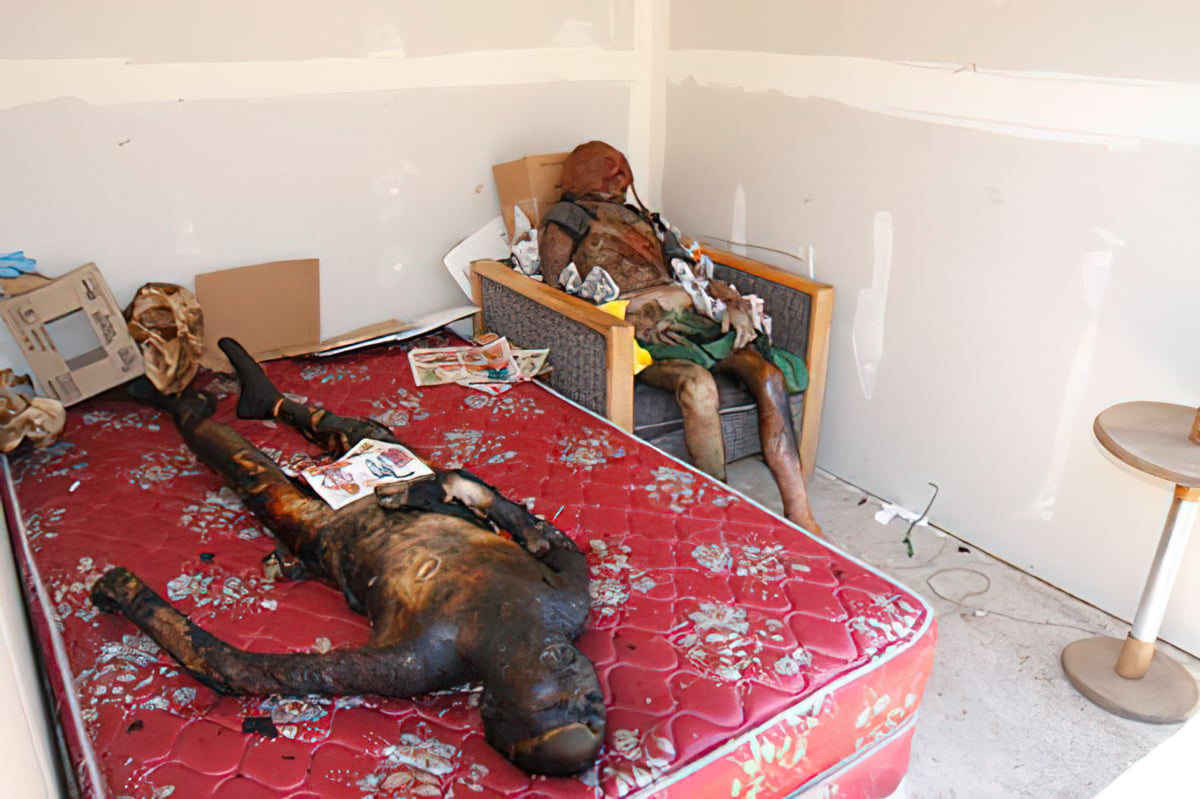 Fig.11 Test 3: Open cubicle fire with two bodies. One body (previously exposed to a low intensity fire) on bed, other slumped in chair. Fire started in paper trash between body and chair. Fire went to flashover at about 7min, post-flashover burning for 13 more minutes (total fire duration was 20 min.) 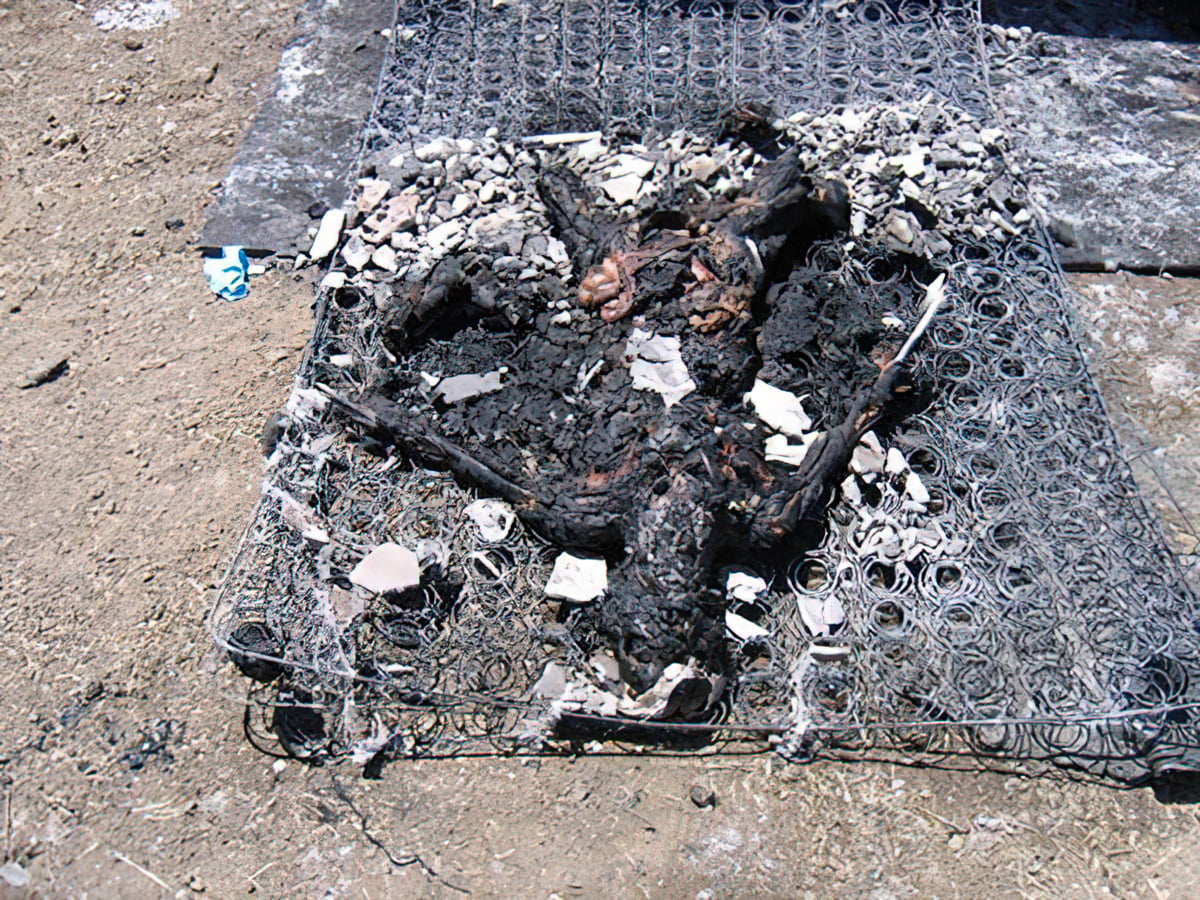 Fig.12 Test 3: Body on mattress displays extensive destruction of soft tissue on arms (hands disarticulated), head tilted back, and arms and legs in different positions than at start of the fire. 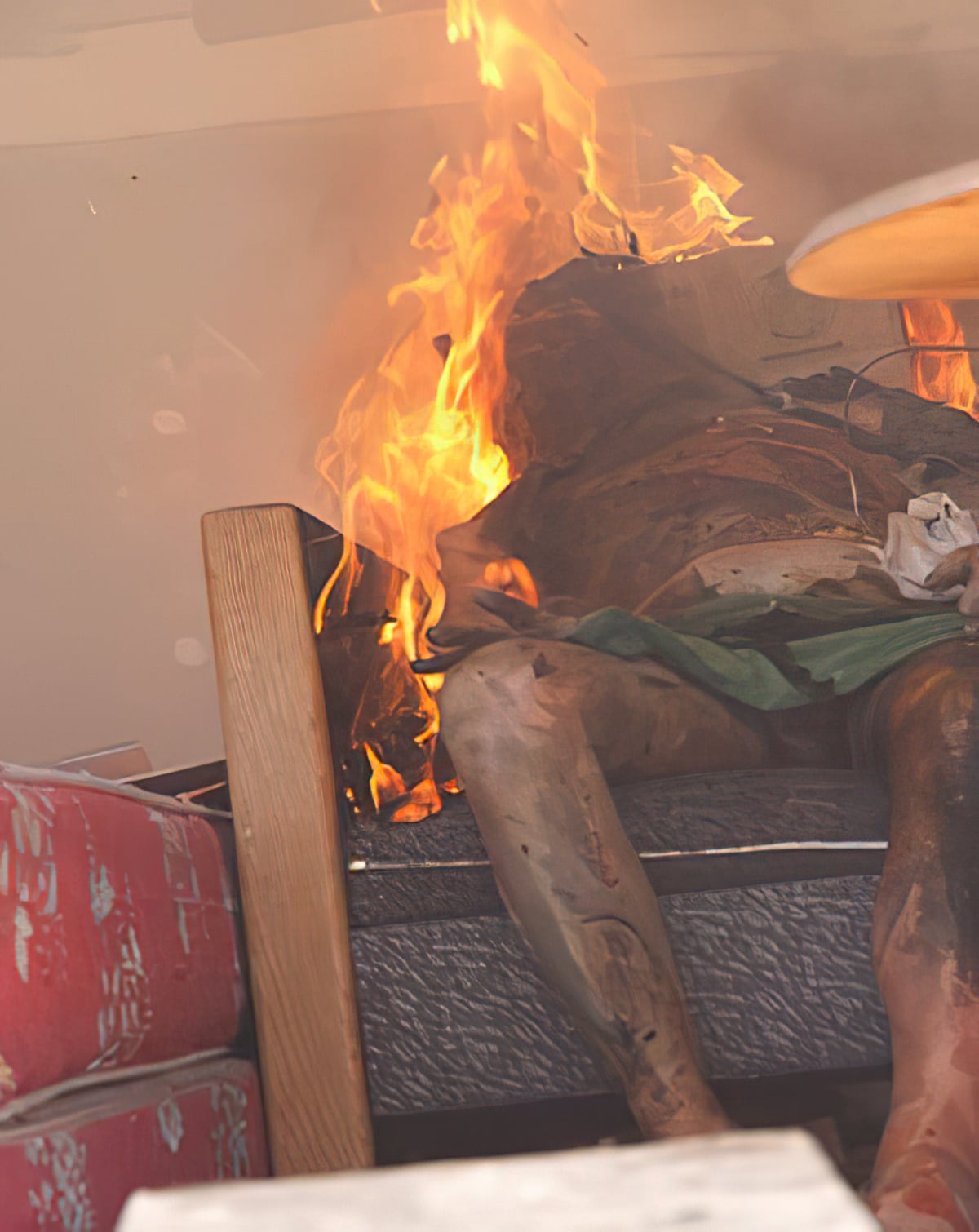 Fig.13 Test 3: At 6min, the fingers of the right hand are splayed outward and the body is twisting to the right. The torso is moving towards the fire as muscles shrink from heat exposure. 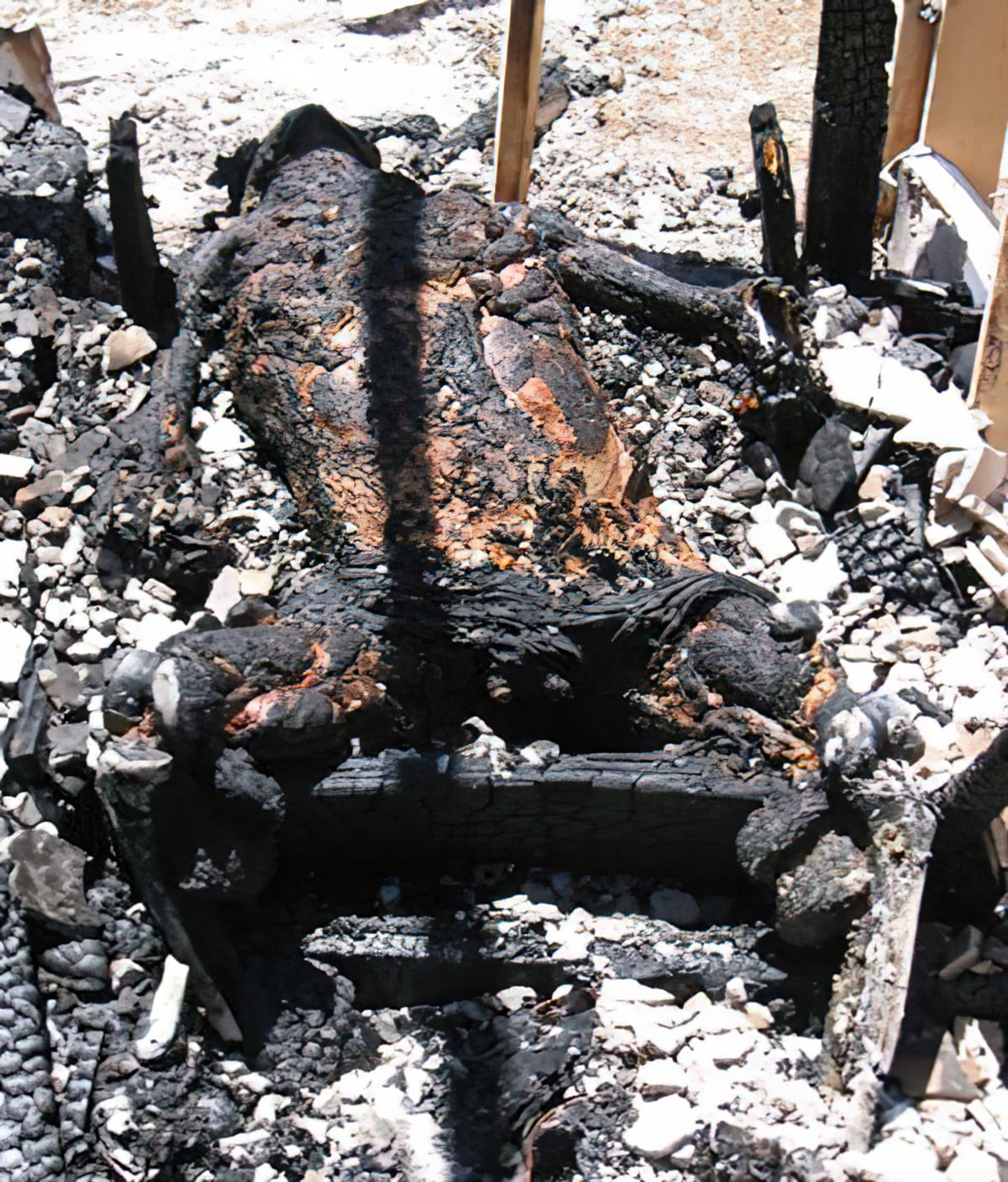 Fig.14 Test 3: Radiant heat during flashover has caused significant loss of soft tissue from the front of the torso, arms, and legs. Head tilted back (due to shrinkage of muscles at back of neck.) Legs spread apart. --- Test 4: Bed fire in furnished cubicle. Adult male body in supine position with legs straight and arms slightly extended. Fire started on bed. Total duration: 13min (including flashover). 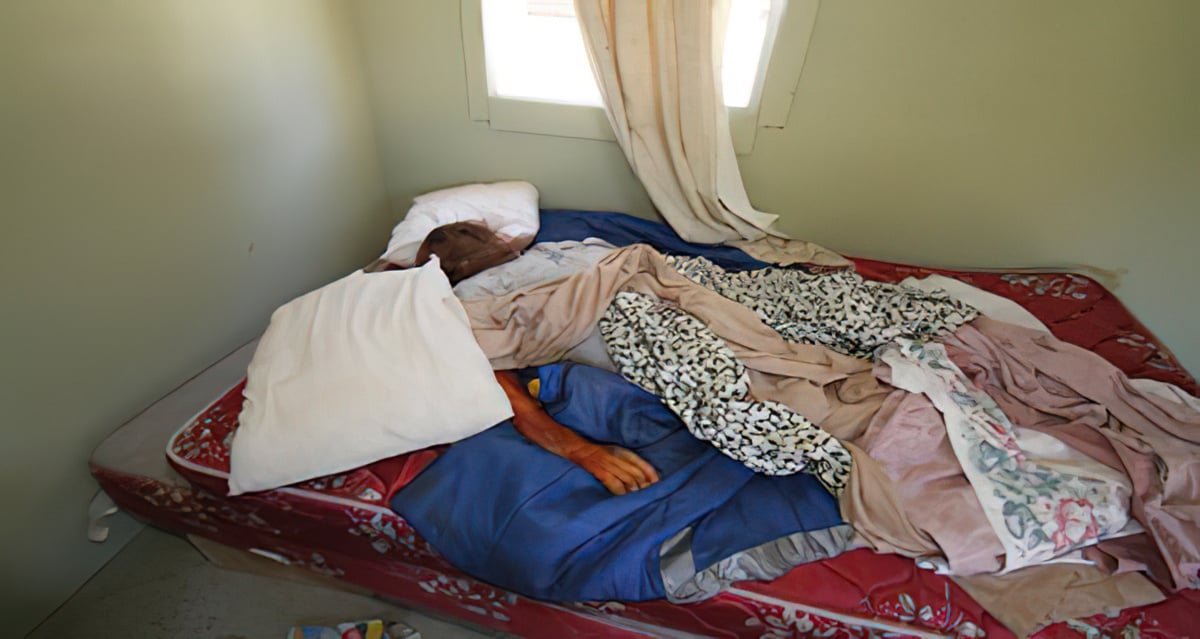 Fig.15 Test 4: Bed fire. Adult male body in supine position with legs straight and arms slightly extended. Fire started on bed. Total duration: 13min (including flashover). 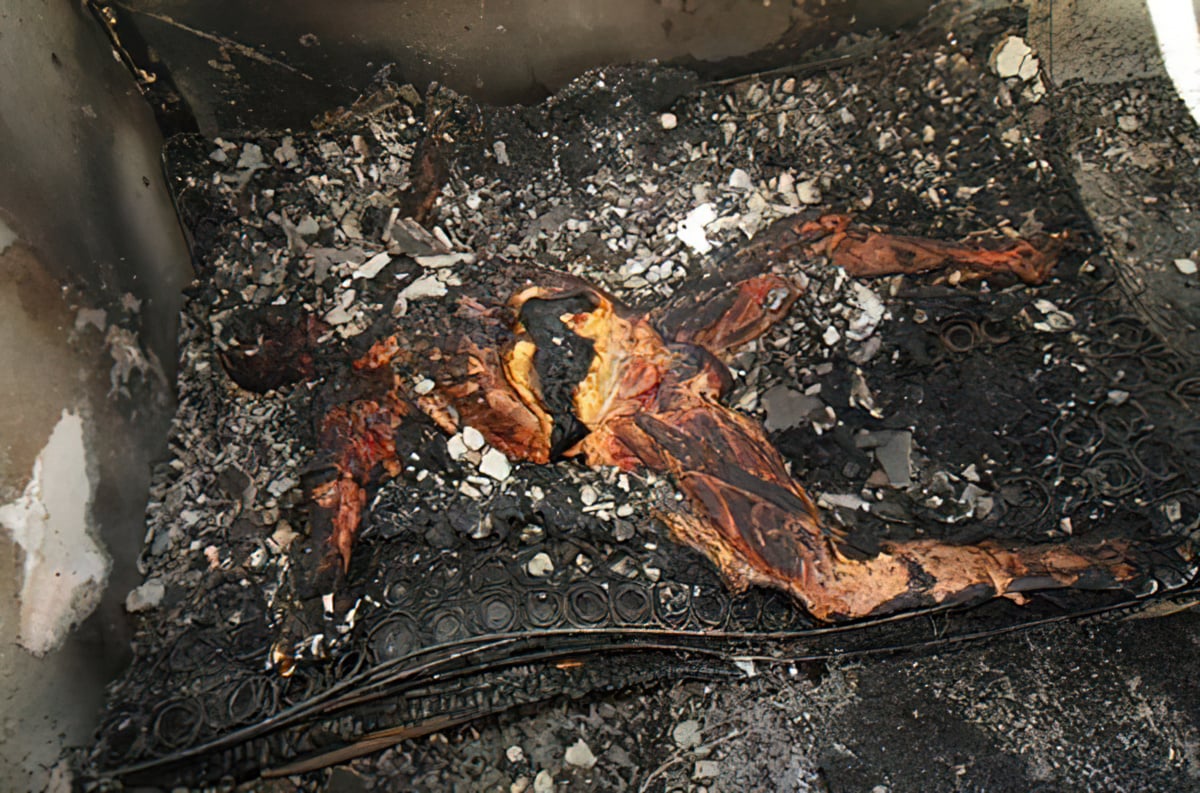 Fig.16 Test 4: Post-flashover: right arm extended out from shoulder. Legs spread. Right leg is nearly off bed. Collapse of bedsprings is aiding movement towards edge. --- Test 5: Airplane crash (into adjoining room). Body on bed ignited by fire extending from crash. One arm at side, right arm across chest, legs skewed. Fire duration in room: 15.5 min. 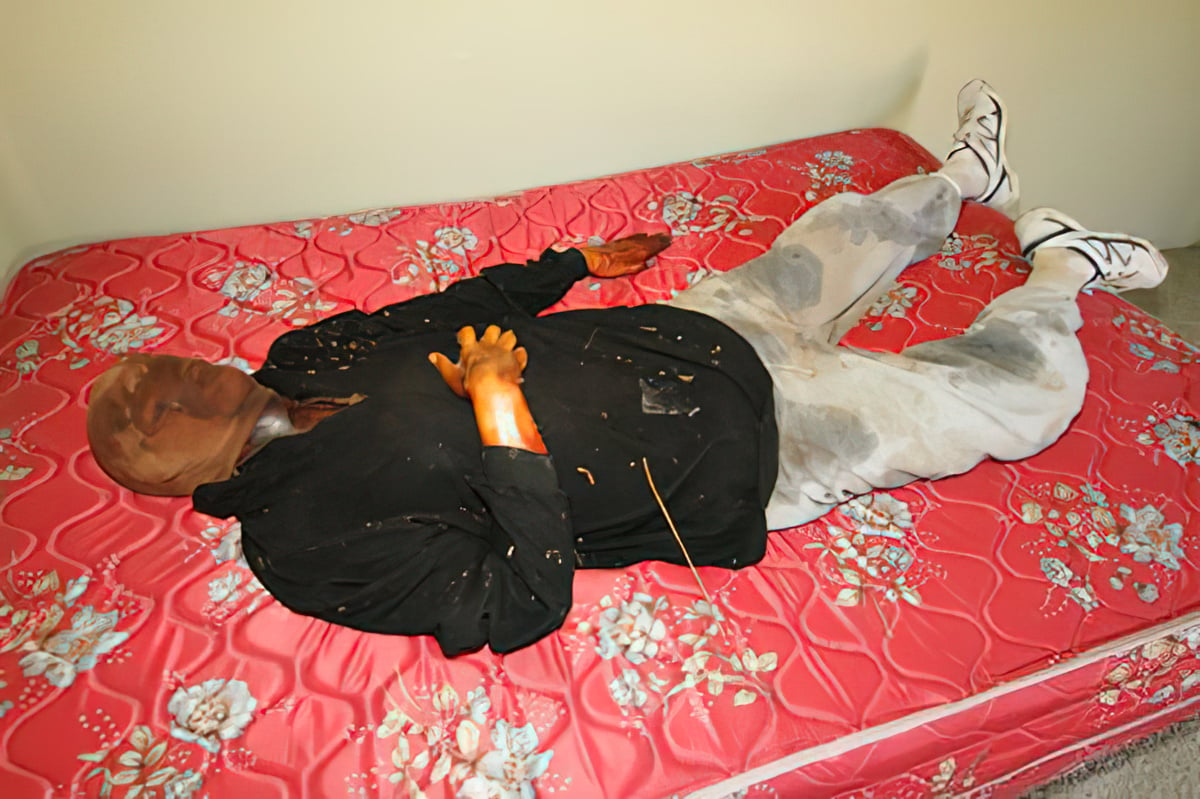 Fig.17 Test 5: Airplane crash (into adjoining room). Body on bed ignited by fire extending from crash. One arm at side, right arm across chest, legs skewed. 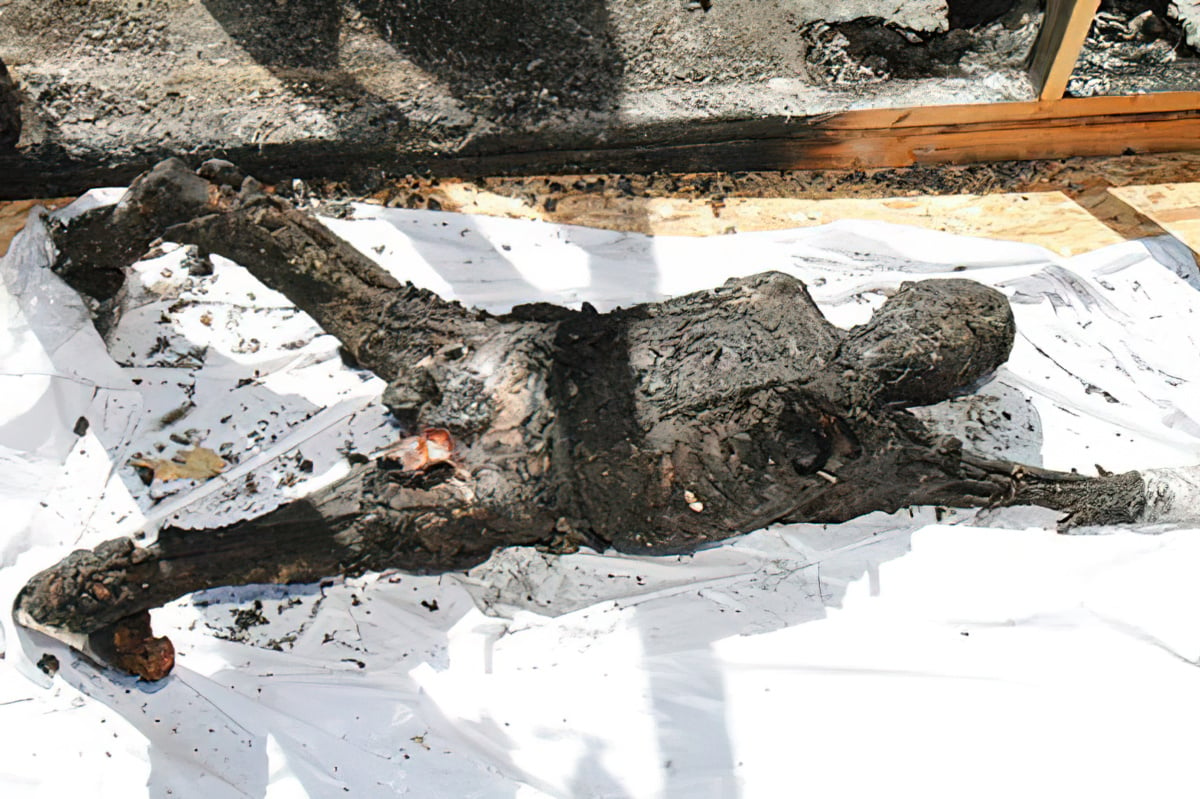 Fig.18 Test 5: After 15.5min fire in room, left arm is extended above head, right arm is by side. Lower legs bent at knees, lower extremities disarticulated. --- Test 6: Open (3-sided) cubicle – two bodies – one on bed inside cubicle, one in recliner chair outside facing fire. Body of nude adult male on bed in supine position, legs extended arms at sides. Second body seated in recliner. Duration of cubicle fire: 15min. 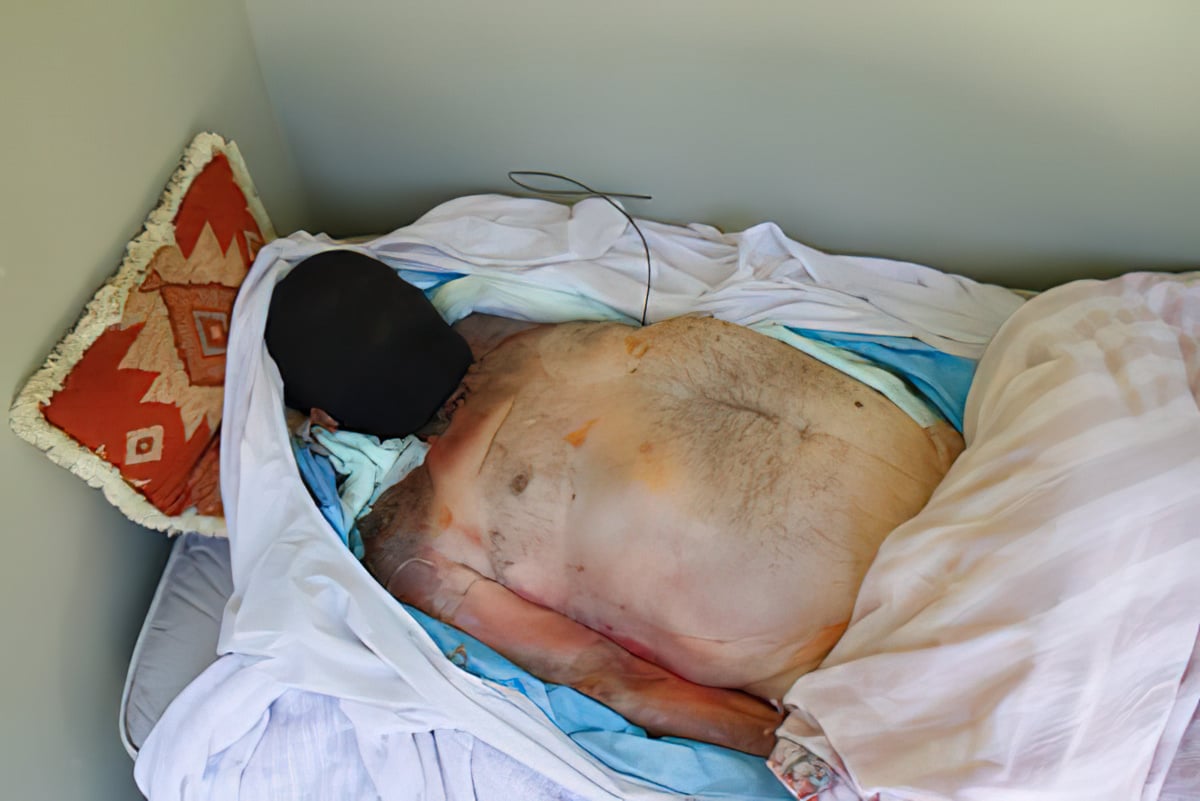 Fig.19 Test 6A: Open cubicle – two bodies – one on bed inside cubicle, one in recliner outside facing fire. Body of nude adult male in supine position, legs extended, arms at sides. 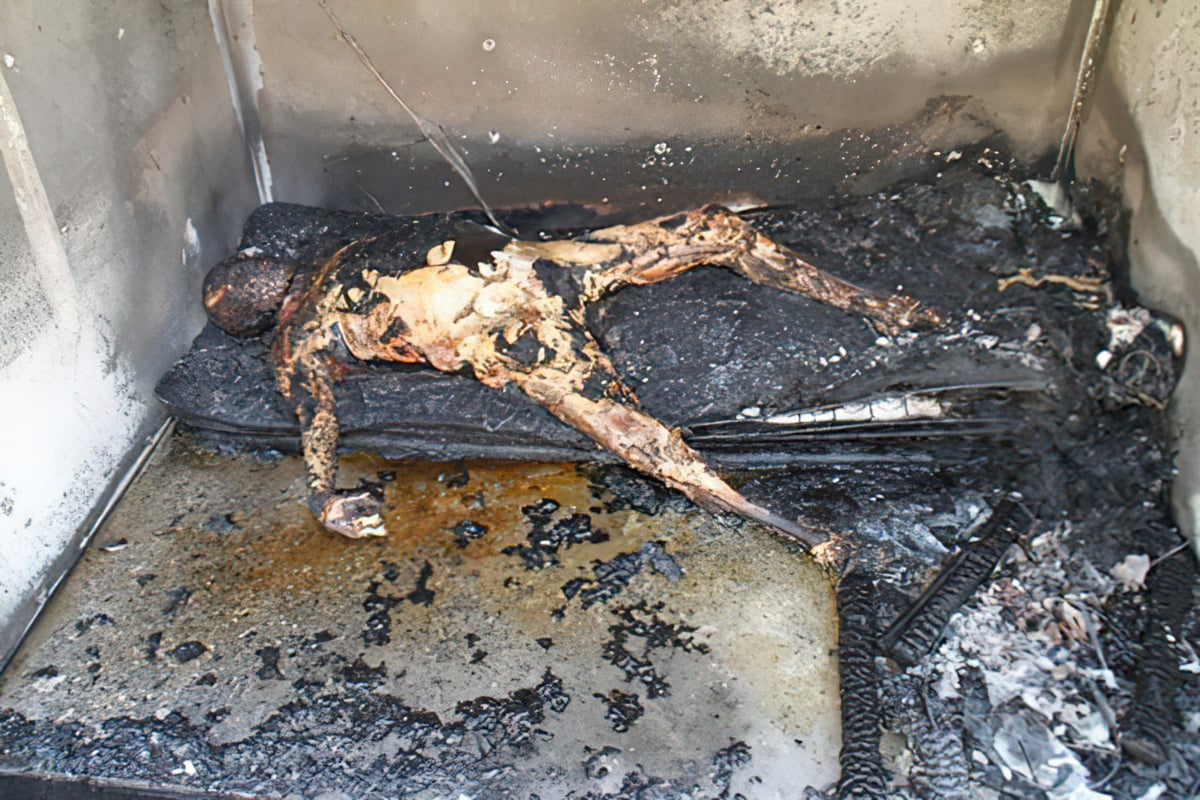 Fig.20 Test 6A: 15min. Subcutaneous fat exposed on torso and legs. Right arm extended out over edge of bed from shoulder. Right leg extended out over edge of bed. Left leg bent at knee. Intense fire on bed but did not proceed to flashover (carpet and wall still intact). Mattress collapse aiding movement towards edge. 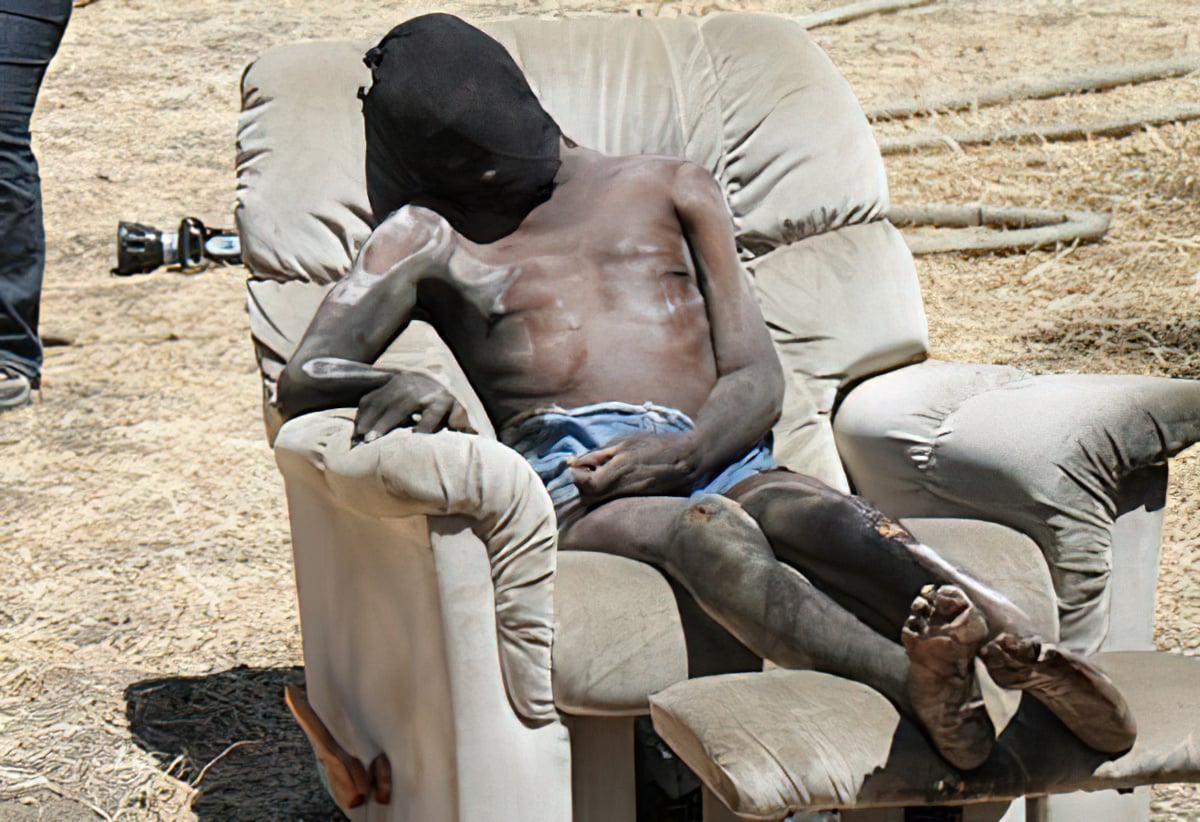 Fig.21 Test 6B: Body in recliner. Starting position. 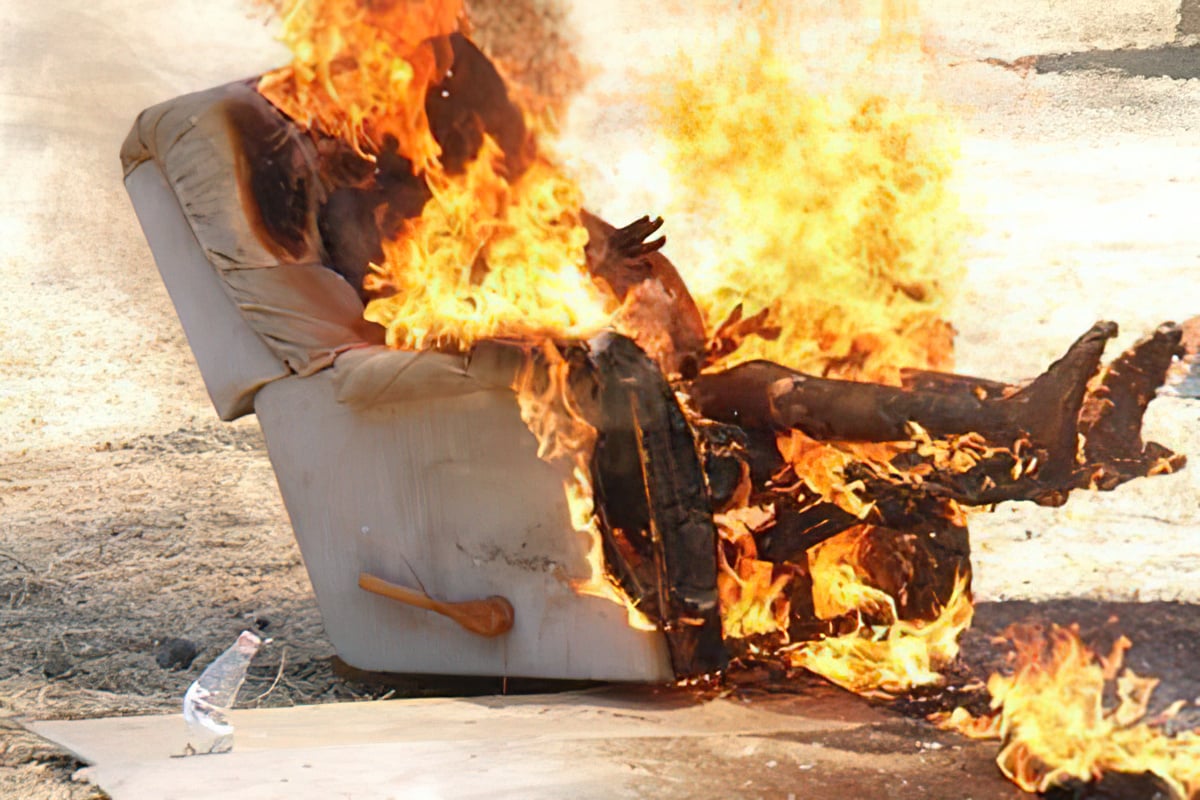 Fig.22 Test 6B: Fire on recliner ignited at 8min by radiant heat from cubicle fire. Hands and forearms raised and fingers splayed. Head turning towards fire, feet curling towards fire as tendons and muscles in sole shrink from heat. 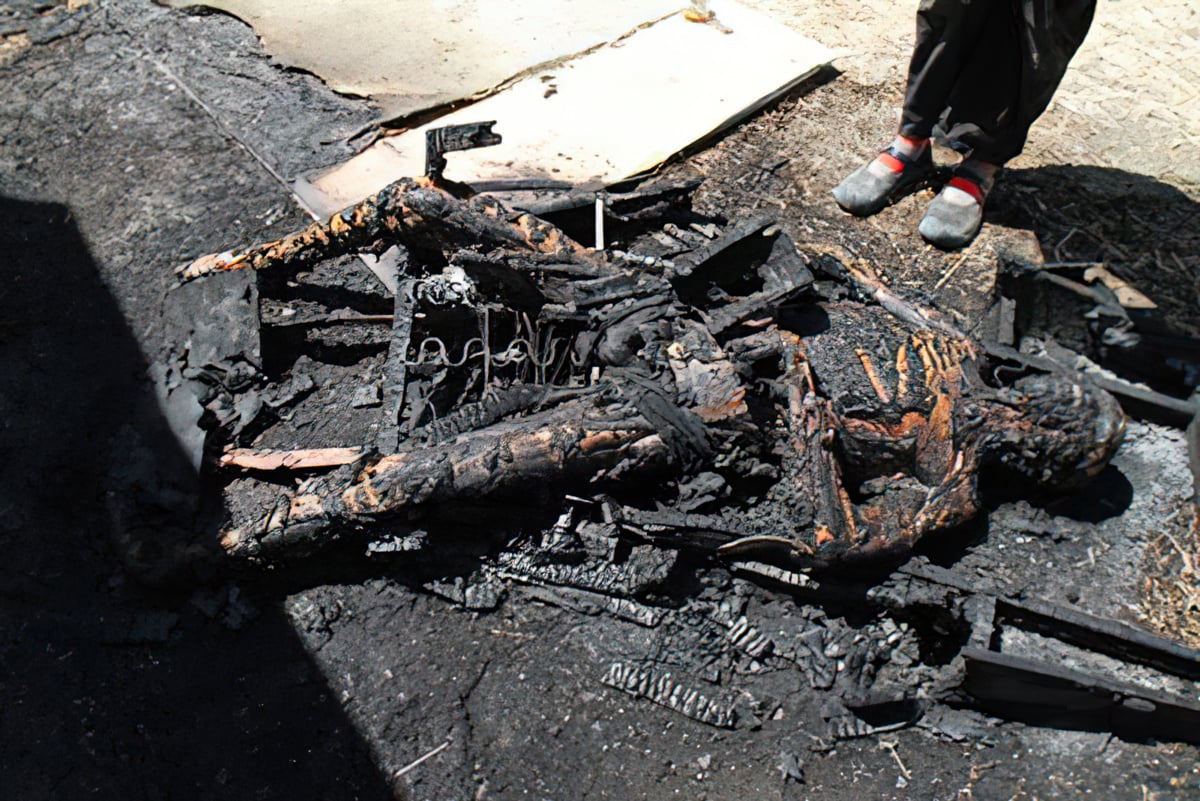 Fig.23 Test 6B: After fire, left arm crossed across body, legs splayed, feet disarticulated. Position of body changed by collapse of chair beneath. --- Test 7: Furnished cubicle – body in bed. Clothed, adult body on bed, supine position, legs straight, arms at sides. Duration 24 min including flashover. 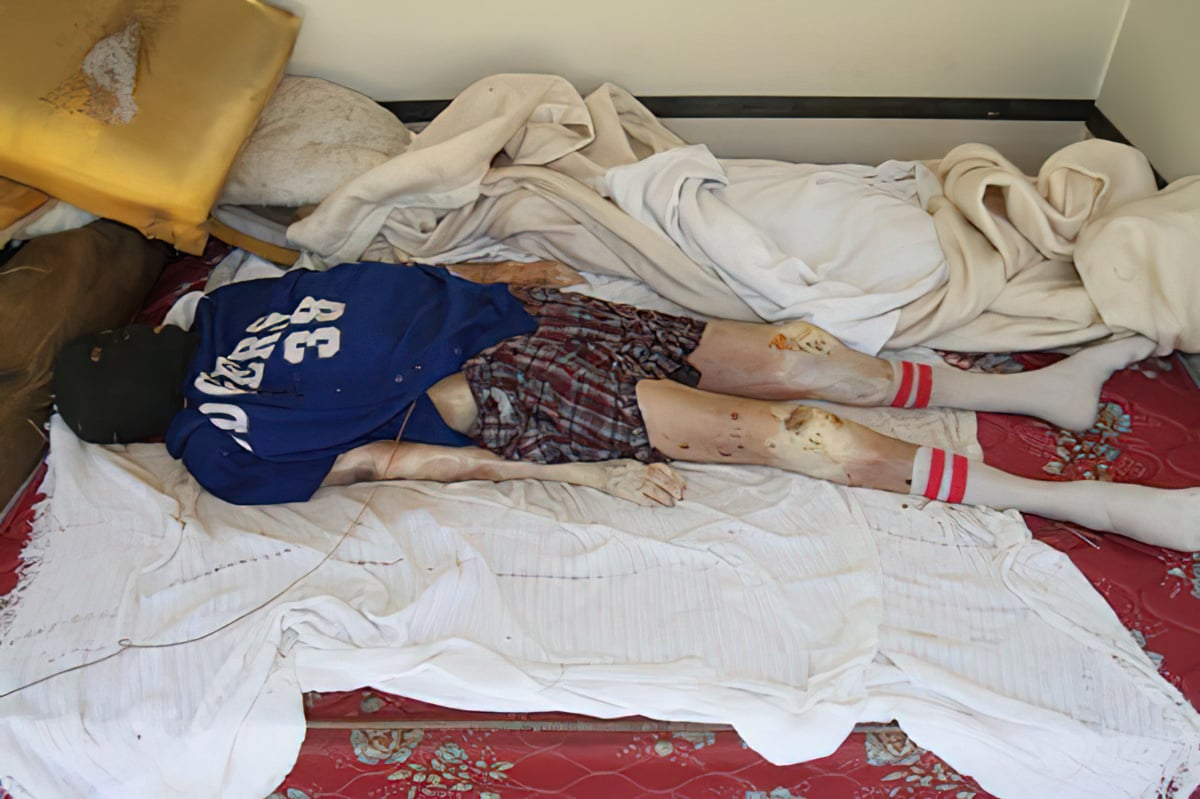 Fig.24 Test 7: Furnished cubicle – body in bed. Adult body on bed, supine position, legs straight, arms at sides. 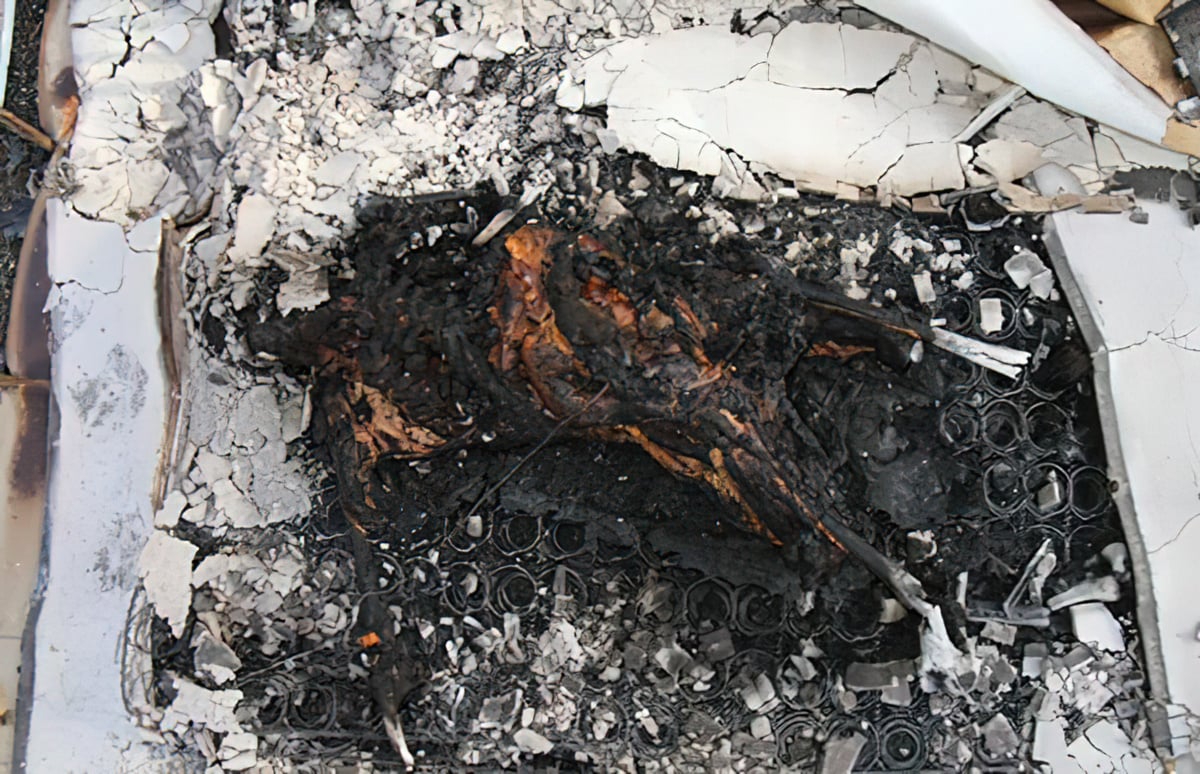 Fig.25 Test 7: 24min including post-flashover. Both arms extended well away from body and straightened. Legs spread but straight. Feet disarticulated. --- Test 8: Furnished cubicle. Bedroom fire (accelerated with gasoline on bed): murder- suicide. 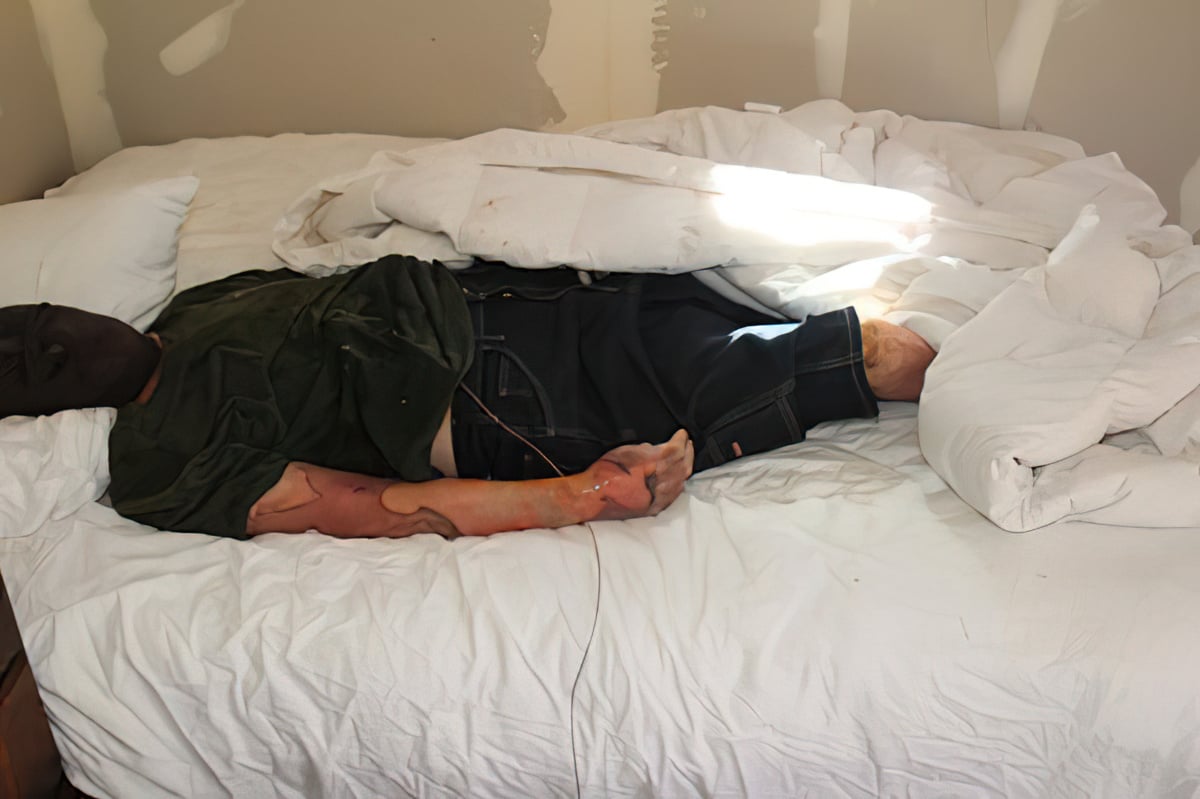 Fig.26 Test 8: Furnished cubicle. Bedroom fire (accelerated with gasoline on bed): murder- suicide. Test 8A: Adult male on bed, dressed and covered with comforter, arms and legs straight (skin slippage from minor post- mortem decomposition). Gunshot wounds to torso. --- Test 8A: Adult male on bed, dressed and covered with comforter, arms and legs straight (skin slippage from minor post-mortem decomposition). Gunshot wounds to torso. 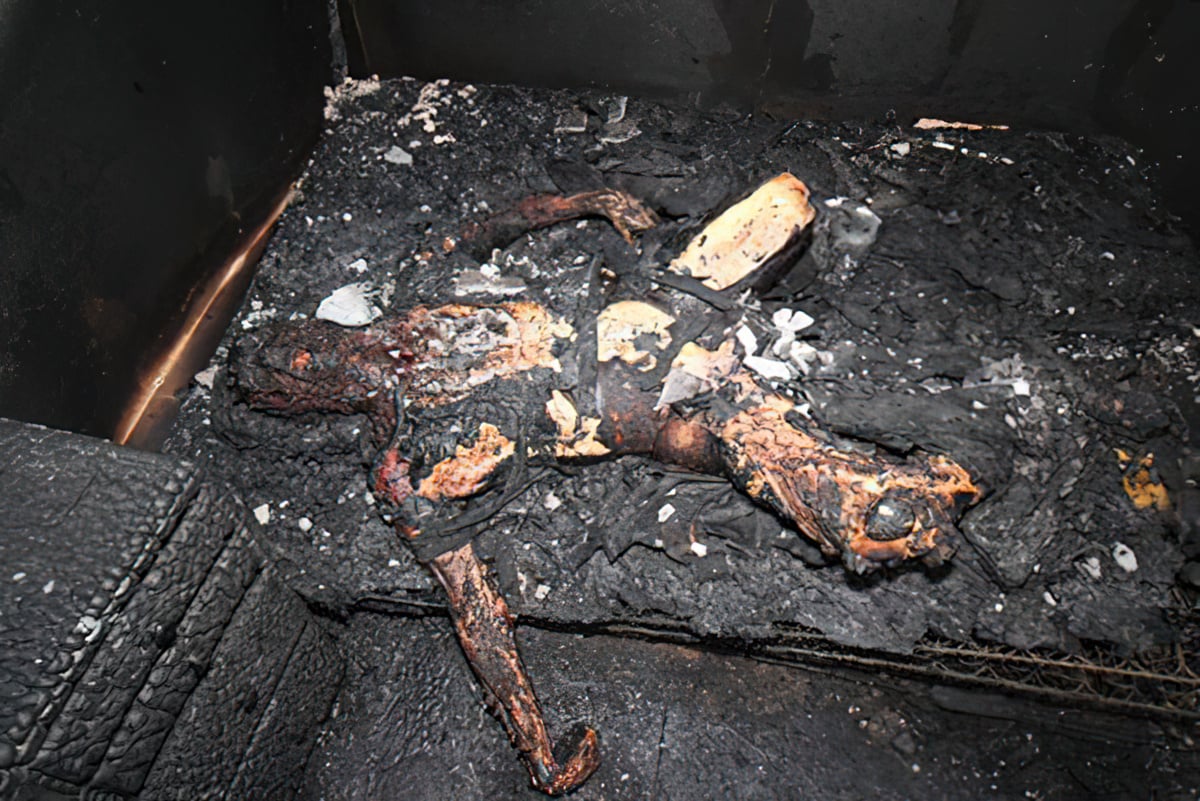 Fig.27 Test 8A: Duration 7.5min (3.5min post-flashover). Right arm extended out over edge of bed, right leg moved towards edge, both legs spread and flexed at knees. --- Test 8B: Clothed female body slumped in corner with gunshot wound to the head. Total duration: 7.5min, 3.5min post-flashover. 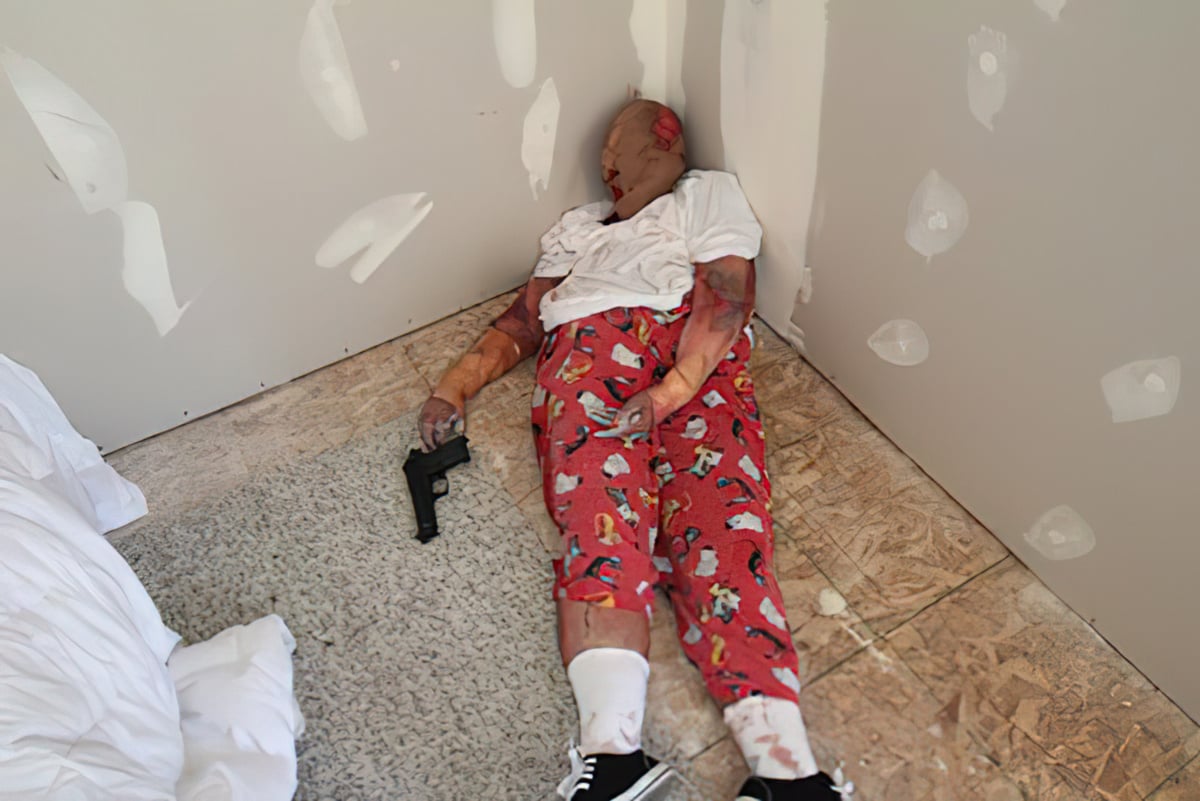 Fig.28 Test 8B: Same cubicle – female assailant (clothed). Gunshot wound to head. Initial position. 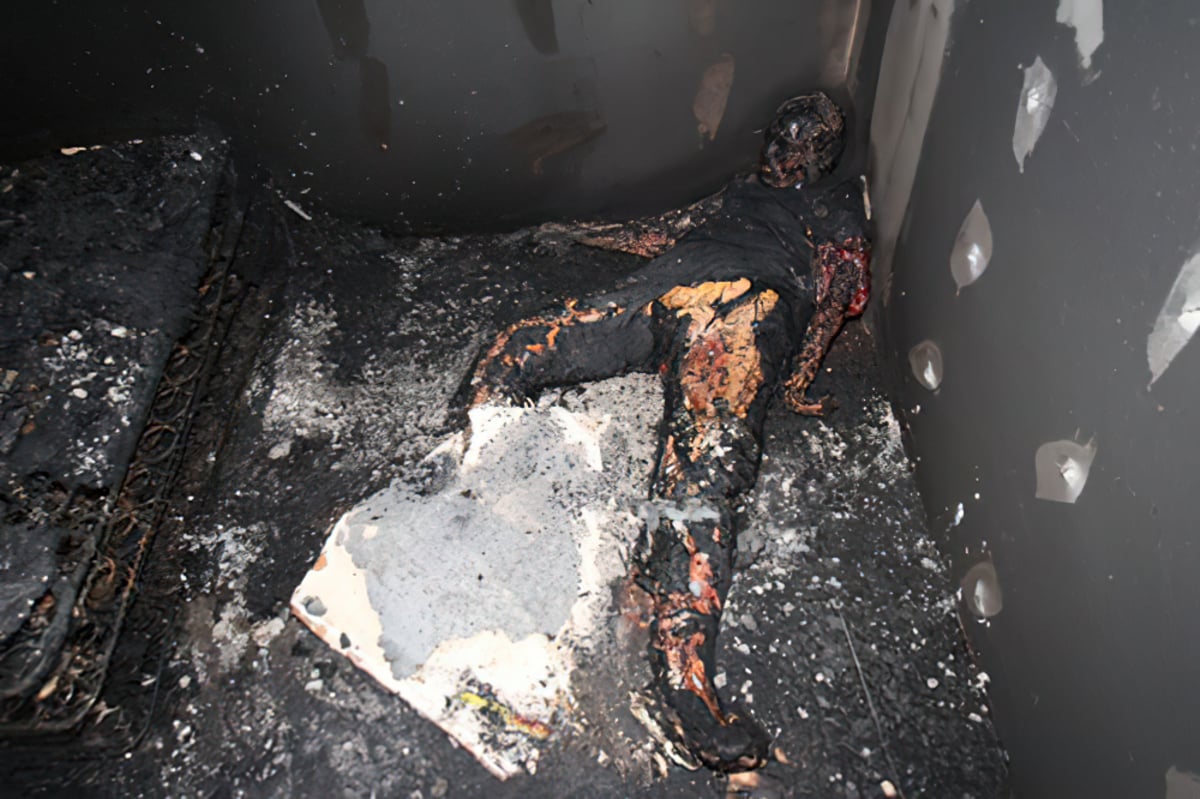 Fig.29 Test 8B: Corner of room ignited by flashover at 4min. Head and upper torso protected by corner position. Subcutaneous fat exposed on legs. Arms repositioned towards walls, legs spread. --- Test 9: Open cubicle with bunk bed. Clothed, adult female body on top bunk. Ignition by open flame to bedclothes. Flashover within 1min. Total duration: 9min. 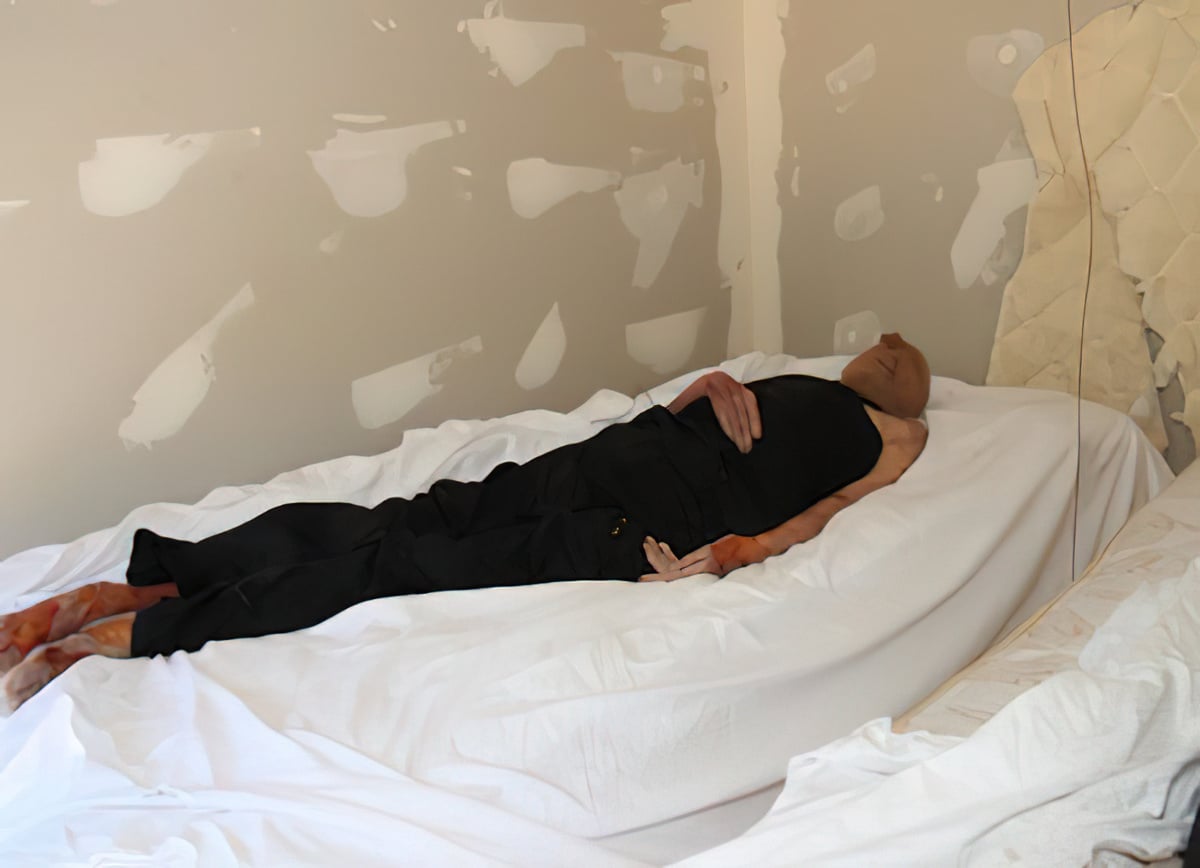 Fig.30 Test 9: Open cubicle – body on bed. Clothed, adult female body on top bunk. Ignition by open flame to bedclothes. Flashover within 1min. 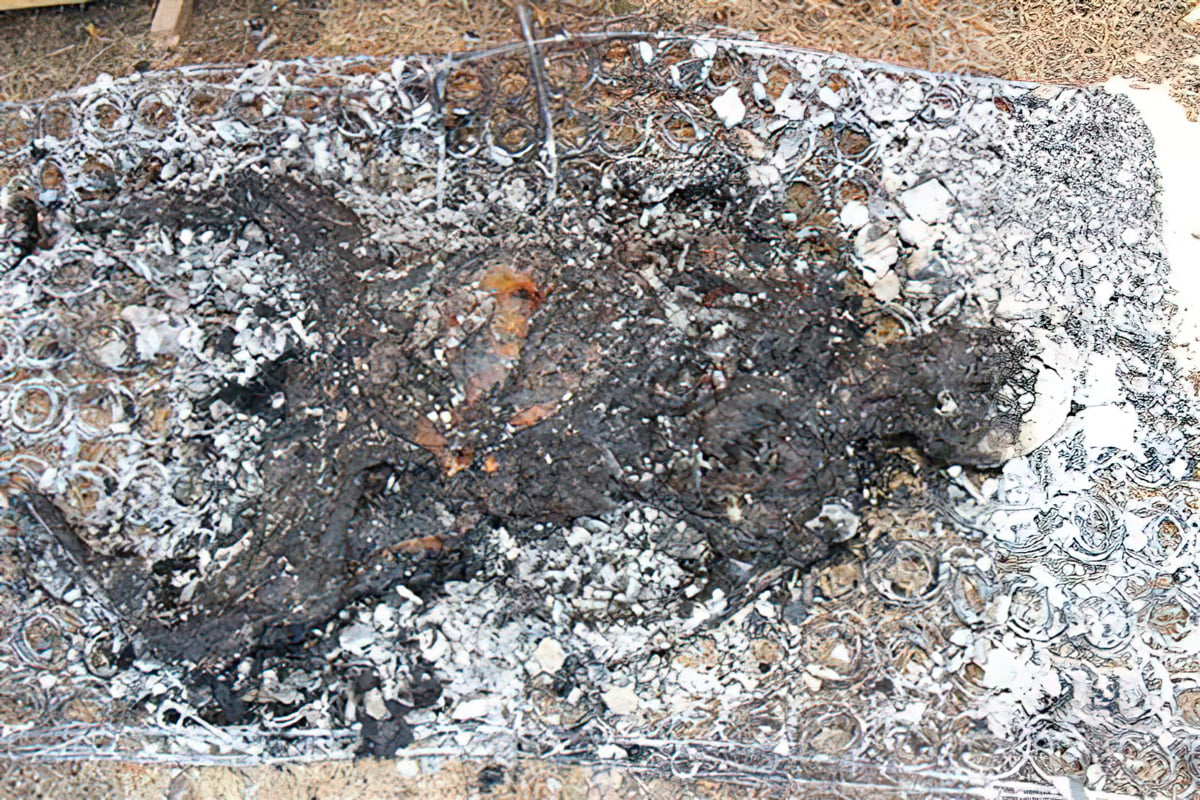 Fig.31 Test 9: Both legs flexed, both arms extended from shoulders and flexed. Neck arched back. --- Test 10: Open cubicle with latex foam mattresses. Body supine in bed. Fire ignited by open flame. Flashover within 1 min. Second clothed adult male body seated in recliner facing the fire. Recliner ignited by radiant heat from cubicle fire. Total duration: 7min.  Fig.32 Test 10: Body in recliner. Initial position: adult male, clothed. 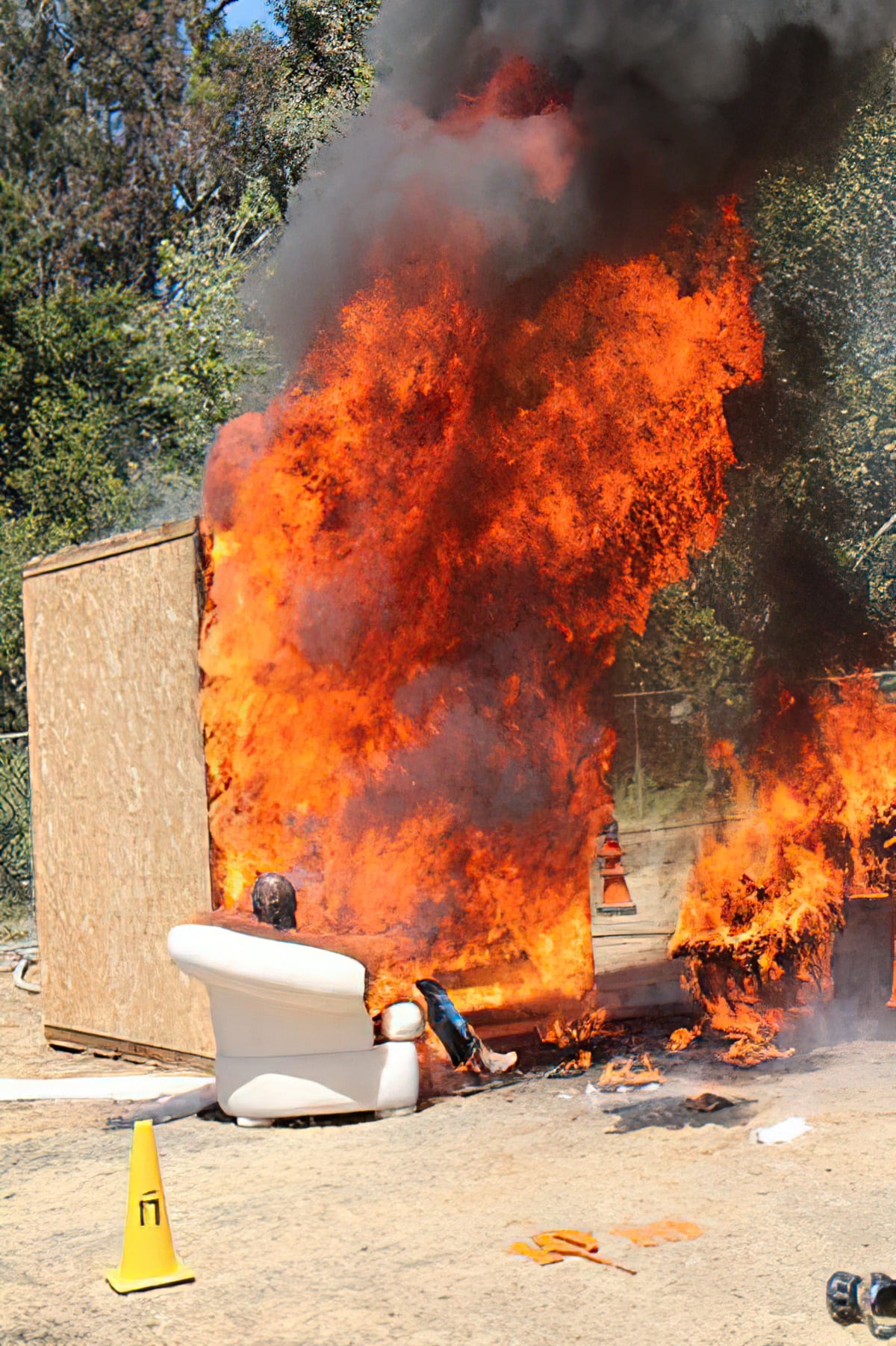 Fig.33 Test 10: Fire ignited on recliner by radiant heat from cubicle flashover fire at 1min. Head and arm rising and head turning towards the fire. 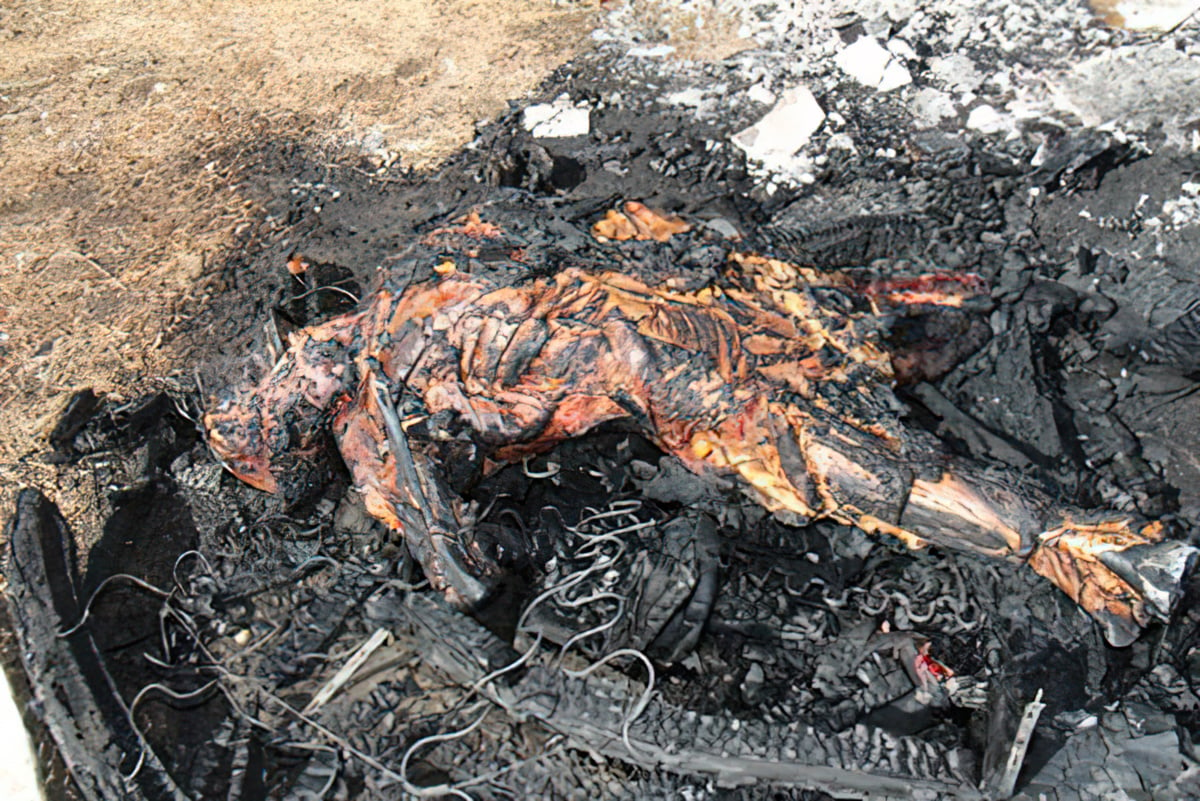 Fig.34 Test 10: Duration of recliner fire: 8min. Both legs and arms extended. Neck arched back. Mouth open. --- Test 11: Tent fire. Adult female body clothed in sweatshirt and pants, supine on innerspring mattress. Blankets, clothes, and towels on mattress in a plastic camping tent. Ignition was by cigarette on cotton bedding (at feet). Arms at sides, legs straight and together. Duration of flaming fire: 20min, with rapid consumption of tent material. 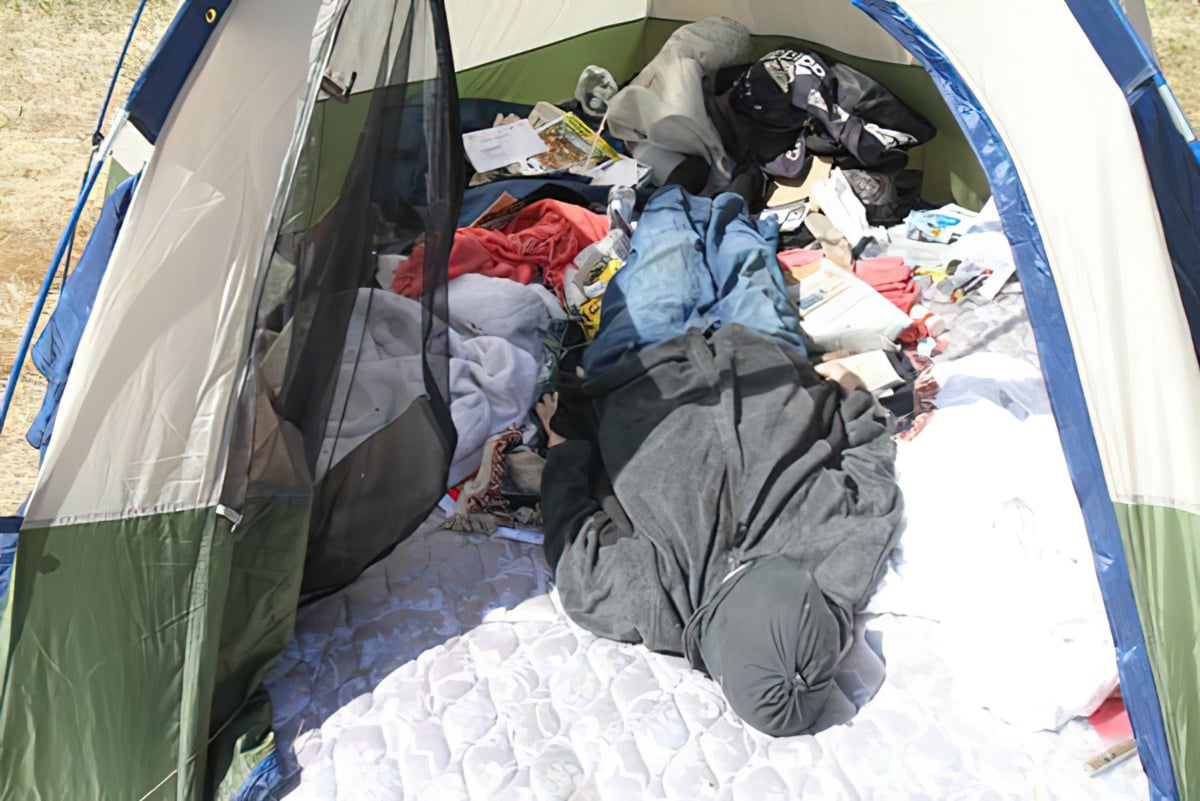 Fig.35 Test 11: Tent fire. Adult female body clothed in sweatshirt and pants supine on a spring mattress. Ignition by cigarette on cotton bedding (at feet). Arms at sides, legs straight and together. Duration of flaming fire 20min. 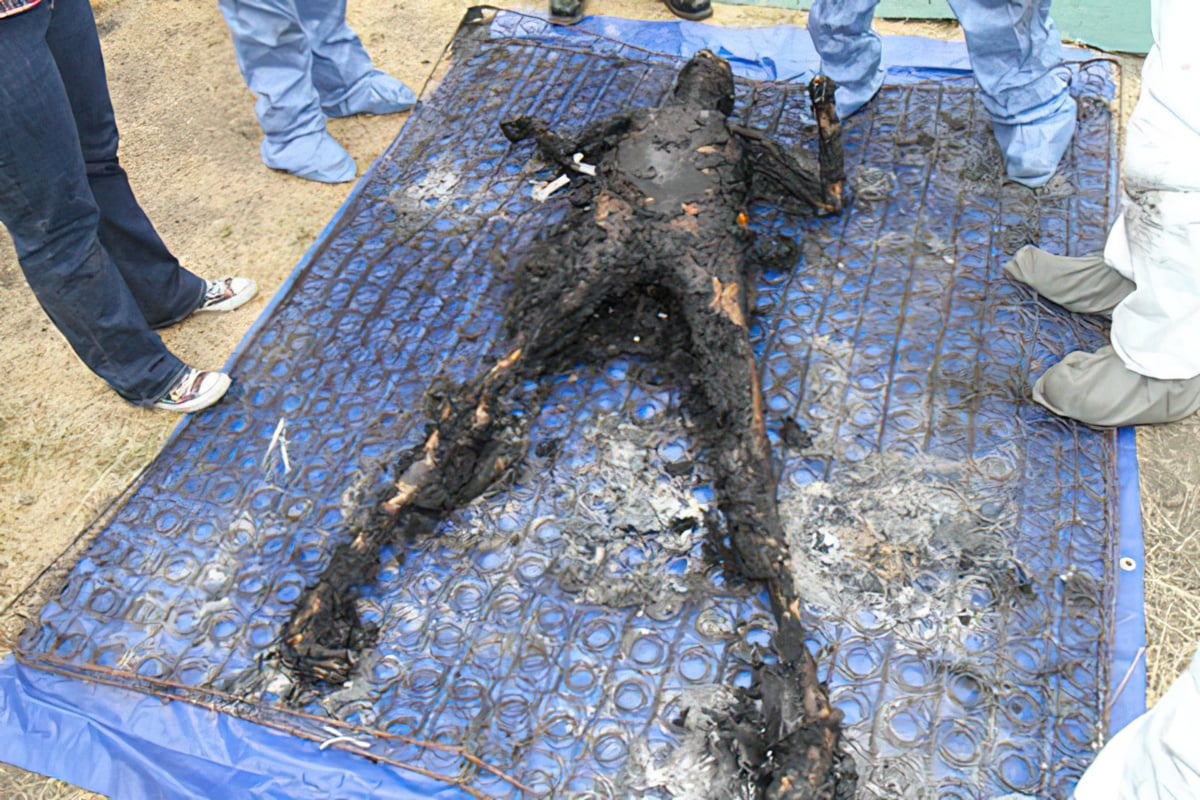 Fig.36 Test 11: After removal of tent and debris, body was left on inner spring mattress for removal. Arms flexed and rose. Legs straight but spread. Lower legs more badly damaged due to longer duration of fire in adjacent normal combustibles. --- Test 12: Open furnished cubicle. Adult male body, clothed, in supine position on innerspring mattress on improvised wood support. Ignition by open flame to combustibles. Duration of fire: approximately 12 min with sustained flashover. The wood support and mattress collapsed during the fire. After the fire, the body was found in supine position on floor, adjacent to the bed. 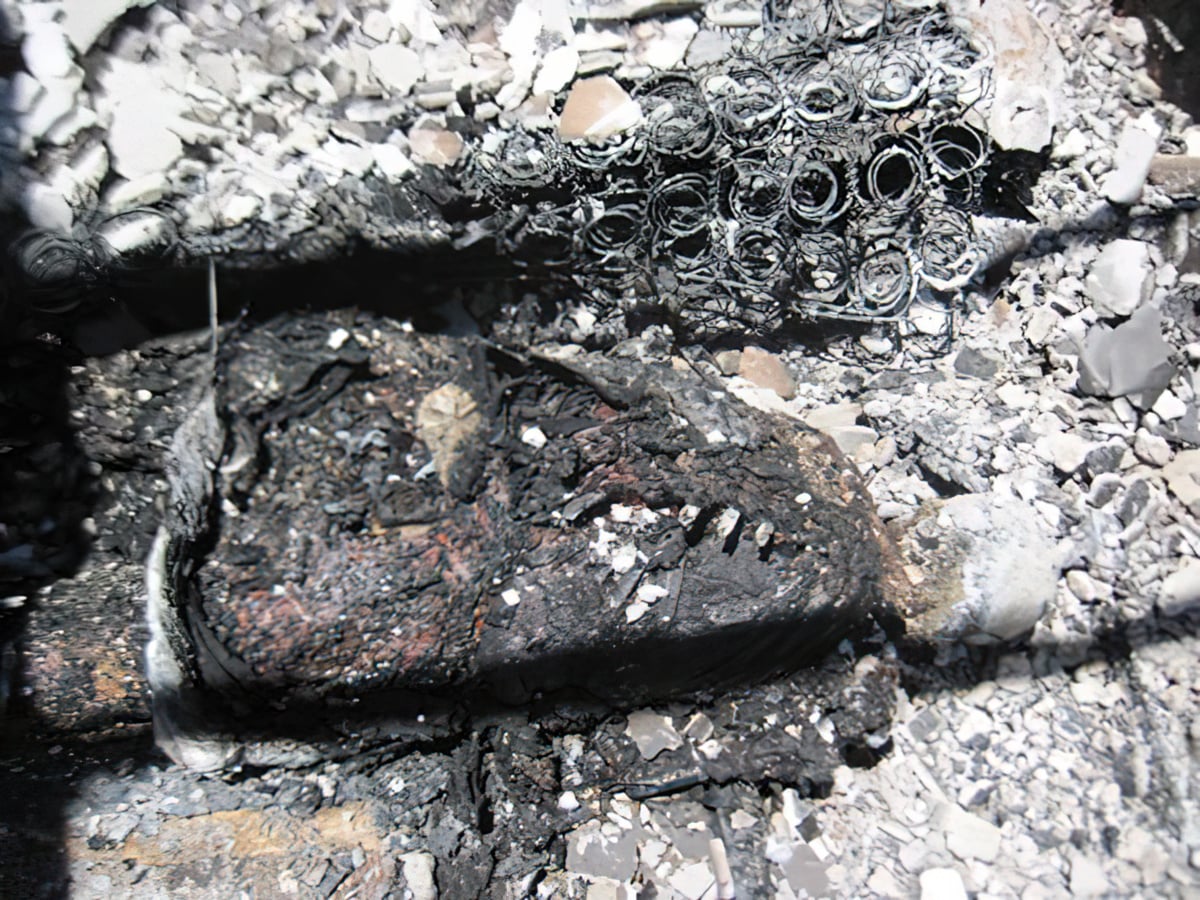 Fig.37 Test 12: This adult male body was in a supine position on the innerspring mattress during a demonstration fire in a furnished cubicle. During the fire, the mattress collapsed and the body ended up in a supine position on the floor adjacent to the bed. --- Pugilistic posturing in deceased bodies is the combined result of shrinkage and loss of connective tissues (muscles, tendons, and ligaments) at joints resulting from the thermal effects of heat and fire, not from ante-mortem actions of the victim. It can be extensive or very limited depending on the position of the body and the distribution of the heat applied. Flexion is dominated by shrinkage on the side facing the fire or radiant heat source. Hands and bare feet curl; wrists, hips, knees and ankles flex. Heads turn and necks arch. Such flexion may indicate the direction of fire spread if the fire is not prolonged. Limbs can rise, flex, and straighten during the fire, sometimes sequentially. Flexion of small joints with thin tissue coverings (fingers and wrists) can begin within five minutes of intense heat exposure. The thicker the protective layer of soft tissues, the longer the delay will be. Significant flexion can move entire limbs. If the movement of arms and legs is sufficient and is accompanied by collapse of chair upholstery or bedsprings, the body may be found in a very different position than it was when the fire began. Investigators must be aware of such movement before concluding the victim was responding voluntarily to the fire. - This post is for educational purposes only and is nonprofit. Under Section 107 of the US Copyright Act of 1976; Allowance is made for "Fair Use" for purposes such as criticism, comment, news reporting, teaching, scholarship, and research. OP is not a medical expert. No copyright infringement intended. This post does not encourage or glorify violence/harassment. Images might have been upscaled and enhanced. Text might have been shortened and simplified/reorganized for online view.
__________________ ⭐️ hermantheshocker.com ⭐️ |
|
#2
●
02-26-2023, 12:27 PM
|
 My Rank: FIRST SERGEANT Poster Rank:399 Join Date: Apr 2011 Posts: 3,046 3,046Posts 5,763Thanked 276Quoted 2Mentioned 0Contrib. |
|
Re: Post-Mortem Repositioning of Human Bodies in Fires
May I ask where exactly are all those shitty pics? I only see illustrative images of always reliable Herman quality, accompanied with detailed and interesting explanations  I don't think I've even heard about forensic fire investigation before, so I find all this information refreshingly new. I don't think I've even heard about forensic fire investigation before, so I find all this information refreshingly new.
|
|
#3
●
02-26-2023, 06:53 PM
|
 My Rank: LANCE CORPORAL Poster Rank:1979 Join Date: Apr 2010 Posts: 255
Contributions: 2
255Posts 424Thanked 68Quoted 0Mentioned 2Contrib. |
|
Re: Post-Mortem Repositioning of Human Bodies in Fires
Before the female bodies appeared to be roasted, I was honestly thinking this was some man hating, female arsonist posse, going round just flaming males to their little hearts content.
|
|
#4
●
02-26-2023, 09:12 PM
|
 ♚ Legacy Gold Member ♚ Poster Rank:28 ㅤㅤ真 Join Date: Apr 2021 Posts: 52,923 52,923Posts 52,853Thanked 41,105Quoted 372Mentioned 0Contrib. |
|
Re: Post-Mortem Repositioning of Human Bodies in Fires
I found it super interesting.
__________________ ᓚᘏᗢ |
|
#5
●
02-26-2023, 10:23 PM
|
 ♚ Legacy Gold Member ♚ Poster Rank:122 Happy Happy Happy Join Date: Dec 2009 Posts: 13,383 13,383Posts 25,651Thanked 4,367Quoted 23Mentioned 0Contrib. |
|
Re: Post-Mortem Repositioning of Human Bodies in Fires
I find everything you post interesting Don't be so critical of ya self champ |
|
#8
●
02-27-2023, 09:03 AM
|
| My Rank: FIRST SERGEANT Poster Rank:399 Join Date: Apr 2011 Posts: 3,046 3,046Posts 5,763Thanked 276Quoted 2Mentioned 0Contrib. |
|
Re: Post-Mortem Repositioning of Human Bodies in Fires
They all are already dead Those pictures show reconstructions of the events. But yeah, burning to death must be one of the worst ways to die  |
|
#9
●
02-27-2023, 03:21 PM
|
 My Rank: LANCE CORPORAL Poster Rank:1999 XX Join Date: Jun 2017 Posts: 251 251Posts 364Thanked 30Quoted 0Mentioned 0Contrib. |
|
Re: Post-Mortem Repositioning of Human Bodies in Fires
Seeing the muscles exposed in figs 16 and 34 is very interesting! Great post as always, H!
|
|
#10
●
02-27-2023, 06:09 PM
|
 My Rank: PRIVATE Poster Rank:10276 Join Date: Mar 2022 Posts: 14 14Posts 153Thanked 8Quoted 0Mentioned 0Contrib. |
|
Re: Post-Mortem Repositioning of Human Bodies in Fires
Fascinating! I wonder if many things that were quite innocent at time of death were later judged to be more suspicious than they actually were as the body moved so much as the result of fire. Strange how some of the scenes when the fire is extinguished look completely different to the starting point.  |