|
#1
●
04-24-2021, 02:08 PM
|
 ♚ Legacy Gold Member ♚ Poster Rank:914 Join Date: Jul 2020 Posts: 820
Contributions: 13
820Posts 27,649Thanked 173Quoted 13Mentioned 13Contrib. |
|
Mechanical Asphyxia by Accidental Compression of the Neck During a Theft
A 44 years old male was found dead in the storage area of a fashion workshop in Milan, Italy, where he had entered in order to make a theft. The area was composed of two closed-off rooms, one next to the other, and a loft above. The access to the loft, full of clothes and clothes hangers, was only provided by a ladder in the second lower room. The floor of the loft was composed of wood panels. The corpse was found by the owner of the workshop, hanging from the ceiling of the first lower room, with his head and the right arm above it and the remaining part of the body suspended half a meter from the ground. The neck was stuck and compressed between two panels of the loft’s floor (Figs. 1-2).  Fig.1 Suspension of the body with compression of the neck between the panels of the floor. A stool and a ladder were found overturned on the ground, near the body, as well as a flashlight that was still turned on. After the arrival of the police and the coroner, the corpse was freed and laid down on the ground for the forensic evaluations. The public prosecutor ordered a forensic autopsy, that was performed three days later at Milan University’s section of legal medicine. The police investigations, according to the circumstances, concluded he had entered the storage area in order to steal and had remained accidentally hanged at the ceiling, trying to reach the loft by climbing on a ladder and unhinging the panels of its floor. 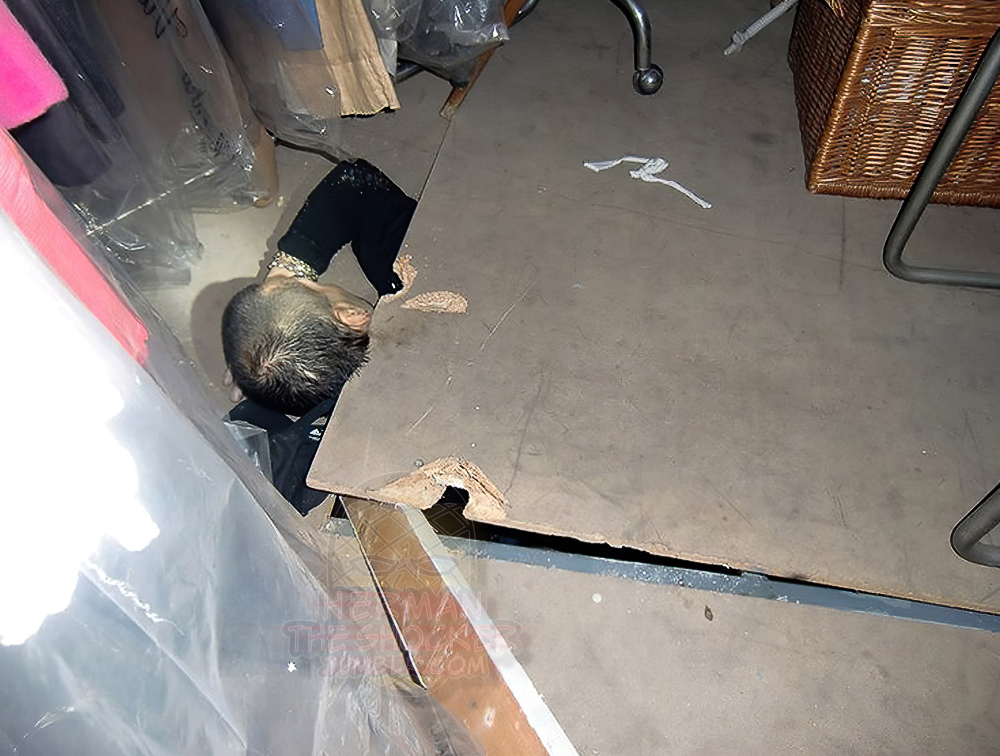 Fig.2 Suspension of the body with compression of the neck between the panels of the floor. The cadaver was in good condition of preservation, due to the cold storage, with a height of 179cm (5′11″) and a weight of 82kg (180 lbs); hypostasis was purple and located at the lower limbs, with only small traces on the back. On the neck, under the external projection of the inferior edge of the thyroid cartilage, there was a transversal discontinuous excoriation, coarsely band-shaped and dehydrated, composed by a major anterior area with a length of 6 cm and a width of 2 cm, and a laterocervical smaller area with a length of 2,5cm and same width; these areas were separated by a short segment of normal skin. Another rectangular excoriation was found under the mandibular body, extending from its left angle to the mental protuberance. On the external projection of the proximal part of the left collarbone, there was an oval-shaped excoriation, with a size of 7,5 x 4 cm (Fig. 3). Other smaller excoriations were found at the anterior wall of the left axilla, behind the right ear, and at the dorsal surface of the left hand. Upon dissection of the neck, the soft tissues in correspondence with the excoriations were found to be moderately blood-infiltrated. The hyoid bone and the thyroid cartilage were intact. Thyroid parenchyma was congested. Blood infiltration of the soft tissues was detected under the left collarbone, in correspondence to the aforementioned excoriation. Petechiae were present at the visceral pleura and the inner face of the scalp, along with other generic asphyctic signs such as increased blood fluidity and visceral congestion (cerebral, pulmonary, renal). At the end of the autopsy, the cause of death was determined to be mechanical asphyxia due to accidental external compression of the neck. Body fluids (cardiac and peripheral blood, urine, bile) gastric content, and viscera (brain, lungs, liver, kidneys) were sampled for toxicological investigations. Toxicological analyses were performed with gas chromatography on the body fluids and organs and the search for substances was negative. 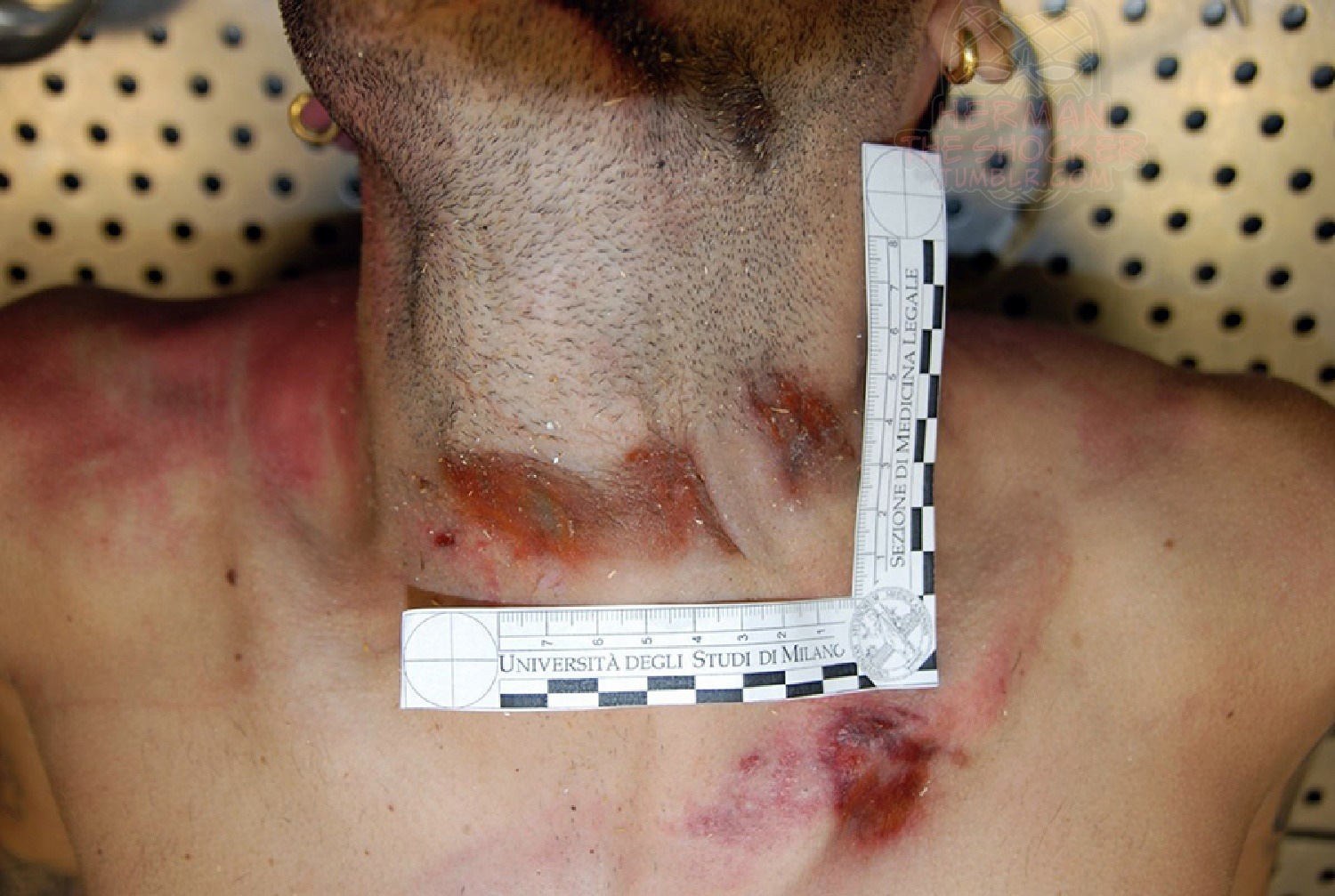 Fig.3 Excoriations of the neck, anterior view. Histopathological analysis were performed in order to confirm the presence of vital features in correspondence with the soft tissue of the neck. Different samples of the excoriated areas were collected, preliminarily treated with Sandison’s rehydrating solution, and then fixed in buffered formalin 10%. Laminar sections were stained with the standard Hematoxylin–Eosin coloration and with histochemical technique (Masson’s trichrome stain). Compression and dehydration of tissues were observed in every section, with separation of the epithelium, fragmentation of derma and hypoderma, and hypereosinophilia. Tinctorial affinity inversion of connective tissue was observed in the samples stained with Masson’s trichrome. Vital features such as blood extravasation with well-preserved blood cells were documented and were mainly identified in the hypodermic tissue (Fig. 4A, B). The distinctive trait of this case lies in the combination of fatal pressure on the neck, determined by solid unmovable structures (the panels of the floor), with the suspension of the body. 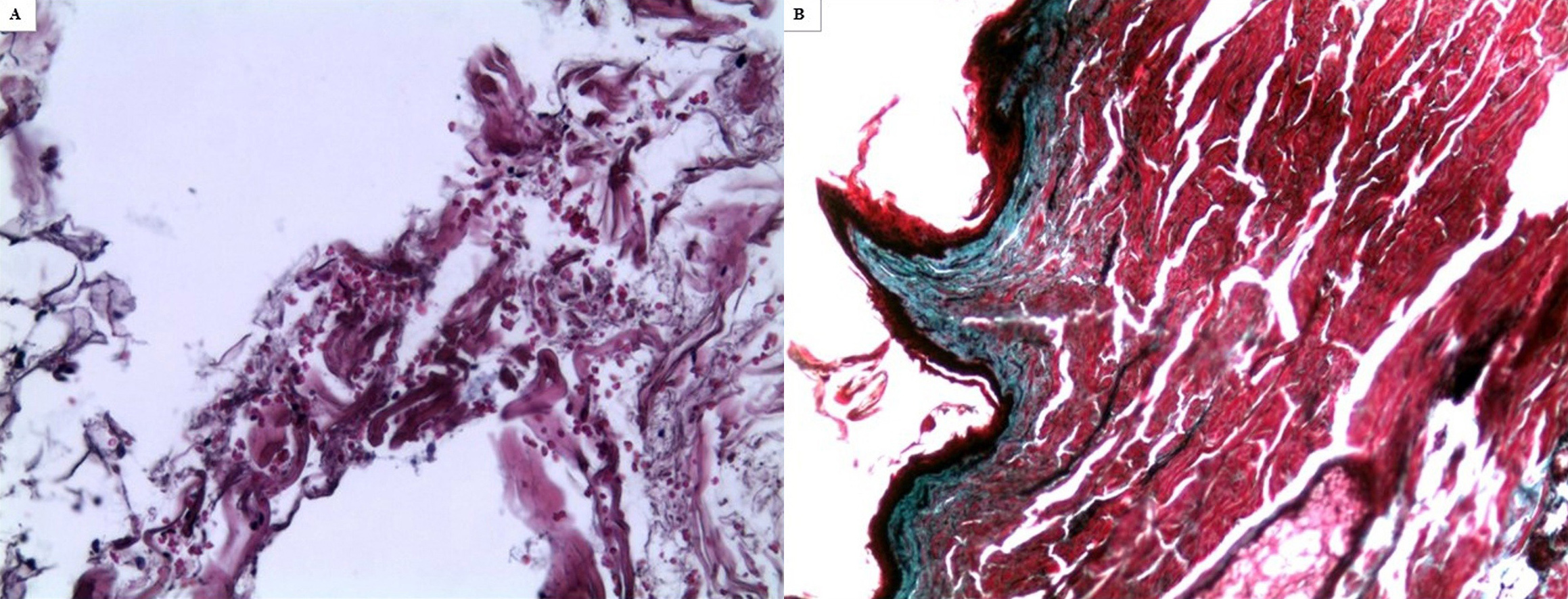 Fig.4 (A) Blood infiltration of hypodermic tissue (Sandison’s rehydrating solution and Hematoxylin–Eosin, 200x). (B) Tintorial affinity inversion (Sandison’s rehydrating solution and Masson’s trichrome 100x). Death by accidental mechanical asphyxia in adults is infrequent and usually results from choking/aspiration, entrapment, ligature strangulation by clothes catching in machinery (especially as occupational deaths), and, more frequently, sexual asphyxia. Except for autoerotic deaths, accidental hanging rarely occurs in adults, and compression of the neck by solid unmovable structures is also rarely reported. Reported here is an unusual case of death by mechanical asphyxia due to accidental compression of the neck in combination with the suspension of the body, observed in a thief who was found hanging from the ceiling of a room, having his neck compressed by the panels of the floor and his body suspended half a meter from the ground. - This post is for educational purposes only and is nonprofit. Under Section 107 of the Copyright Act of 1976; Allowance is made for "Fair Use" for purposes such as criticism, comment, news reporting, teaching, scholarship, and research. No copyright infringement intended. All the images have been upscaled and sharpened/enhanced. Some of the text might have been shortened and simplified, and/or reorganized for online view. Original case report by Ciprandi B., Andreola S., Bianchi M., Gentile G., Zoja R. - For. Sci. International 2017. |
|
#2
●
04-24-2021, 02:58 PM
|
 My Rank: CORPORAL Poster Rank:1732 Join Date: Feb 2017 Posts: 309 309Posts 1,034Thanked 70Quoted 0Mentioned 0Contrib. |
|
Re: Mechanical Asphyxia by Accidental Compression of the Neck During a Theft
Just hanging around looking for a bargain
|
|
#3
●
04-24-2021, 03:53 PM
|
 Hell is full! Poster Rank:664 Human. Join Date: Nov 2009 Posts: 1,310 1,310Posts 1,603Thanked 216Quoted 1Mentioned 0Contrib. |
|
Re: Mechanical Asphyxia by Accidental Compression of the Neck During a Theft
That's karma for ya. Good post, educational. |
|
#4
●
04-24-2021, 09:15 PM
|
| ♚ Legacy Gold Member ♚ Poster Rank:92 Male Join Date: Nov 2009 Posts: 17,231 17,231Posts 45,017Thanked 4,711Quoted 8Mentioned 0Contrib. |
|
Re: Mechanical Asphyxia by Accidental Compression of the Neck During a Theft
If I was the shop owner, I would have checked his wallet. For ID. Yeah, that's it! I was checking for ID. |
|
#5
●
04-25-2021, 01:39 AM
|
 My Rank: STAFF SERGEANT Poster Rank:858 Flesh and Blood Join Date: Apr 2012 Posts: 895 895Posts 4,588Thanked 352Quoted 3Mentioned 0Contrib. |
|
Re: Mechanical Asphyxia by Accidental Compression of the Neck During a Theft
Interesting, thanks.
|
|
#6
●
04-25-2021, 03:58 AM
|
 ♚ Legacy Gold Member ♚ Poster Rank:199 Female Join Date: Nov 2009 Posts: 7,749 7,749Posts 11,993Thanked 709Quoted 5Mentioned 0Contrib. |
|
Re: Mechanical Asphyxia by Accidental Compression of the Neck During a Theft
Wow. Well he won’t be doing that again. I wonder how long it took him to die, thinking “oh shit!” Love the information that comes with your posts. Thank you.  |
|
#7
●
04-25-2021, 09:59 AM
|
 ♚ Legacy Gold Member ♚ Poster Rank:206 Iceman Join Date: Aug 2017 Posts: 7,503 7,503Posts 12,805Thanked 3,630Quoted 19Mentioned 0Contrib. |
|
Re: Mechanical Asphyxia by Accidental Compression of the Neck During a Theft
In the US the shop owner would be sued by the thief's family for wrongful death.
|
|
#8
●
04-26-2021, 05:21 PM
|
 My Rank: FIRST SERGEANT Poster Rank:481 Male Join Date: Dec 2009 Posts: 2,252 2,252Posts 5,941Thanked 293Quoted 0Mentioned 0Contrib. |
|
Re: Mechanical Asphyxia by Accidental Compression of the Neck During a Theft
Here is a useful safety tip: Don't steal shit!
|