|
#1
●
03-14-2022, 04:37 PM
|
 ♚ Legacy Gold Member ♚ Poster Rank:914 Join Date: Jul 2020 Posts: 820
Contributions: 13
820Posts 27,652Thanked 173Quoted 13Mentioned 13Contrib. |
|
Man Found Dead with Half His Head Missing
A 39-year-old Hispanic male was discovered dead in his residence. The family stated that the subject had no history of depression or suicidal ideation. Interviews with co-workers and friends revealed that the subject had gone drinking with friends to several bars after work 1 week prior to the discovery of the body. The subject had met an older woman while out and made arrangements to see the woman the following Friday. That Friday he told his friend/co-worker that the woman had come to his house, drove him to work, and then continued to her place of employment. The subject and his friend went to happy hour after work that Friday and planned to meet the woman and two of her co-workers to celebrate her birthday. The subject’s friend left the bar and later that night received a call from the subject, who was very intoxicated and seemed to be in good spirits.  Fig.1 Scene photo: the gun can be seen next to the subject’s right leg. Blood spatter is on the wall above the bed. Police located contact information for the older woman through the subject’s mobile phone history. They made contact with her and she initially stated that she knew no one in the area where the subject lived, but during a later interview at police headquarters, she admitted to meeting the subject. She stated they kissed the day that she met him, but denied any further romantic relationship with him, although they exchanged mobile numbers that night. During the following week, the woman and the subject remained in touch via phone conversations and text messages. She admitted to picking the subject up at his residence the following Friday and dropping him off at work. She confirmed that she later met him out after work that day to celebrate her birthday. That evening his friend left and she went to another bar with the subject and her friends. The subject, who had been very polite previously, became intoxicated and then was rude, offensive, and tried to engage the subject and her friends in inappropriate conversations. The woman and her friends left the club at 11 p.m. She agreed to drive the subject home because he was intoxicated. He became verbally abusive to her on the drive home; she then refused to drive him any further and pulled over to let him out of the car. She stated that he called her afterwards and left her a message stating that he found his way home and they had no further contact, but mobile phone records confirmed a telephone call between the two that lasted almost an hour. It is not known what transpired during that call. 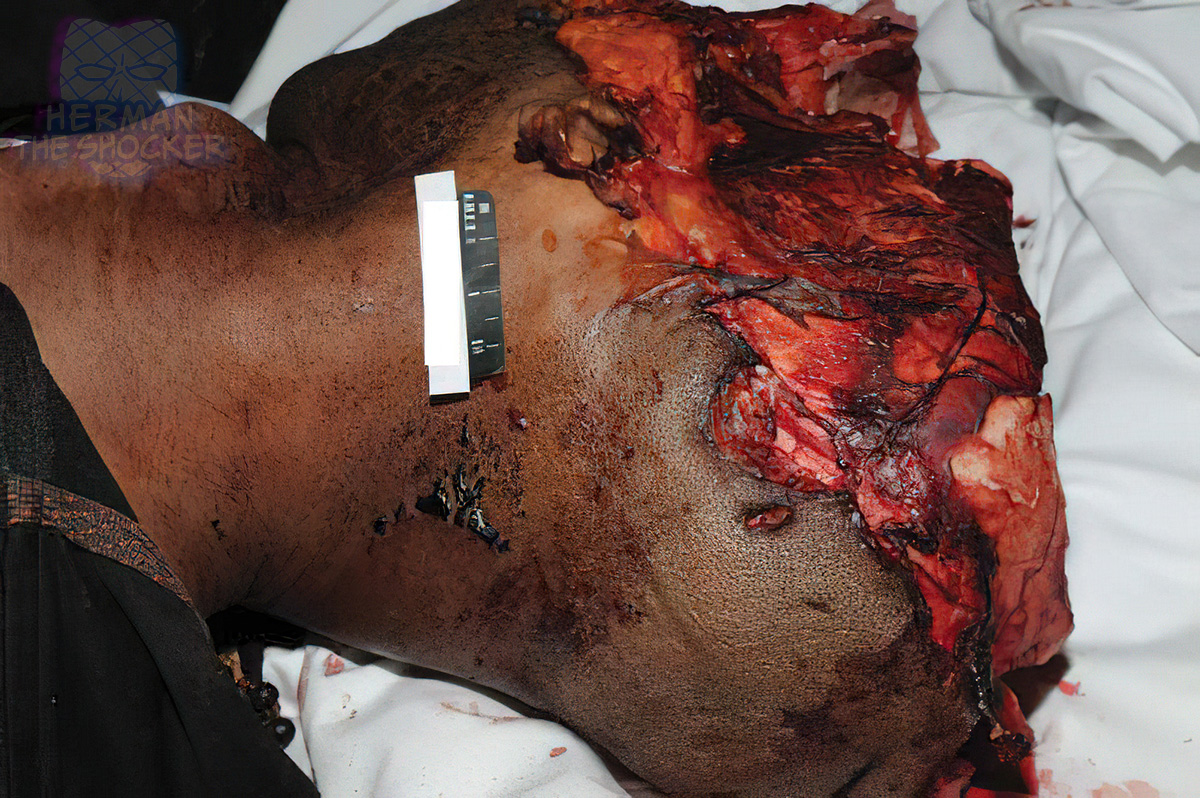 Fig.2 Bite marks visible on the scalp. The subject’s friend from work attempted to contact him numerous times over the weekend. He again attempted to contact the subject the following Monday when he was absent from work. After work, the friend went to the subject’s residence with the subject’s mother to check on him. The front door was locked but they looked through a window and could see the subject’s two dogs, a Pitbull and a Mastiff, roaming freely around the apartment. They went into the backyard of the apartment through a neighbor’s place and were able to see the subject’s body through a back window. They called the police, who forced entry into the apartment. Crime scene was notified and contacted the medical examiner’s office. A medicolegal death investigator responded to the scene. The subject was found in his bedroom, fully dressed and lying supine on his mattress. Extensive trauma was noted to the subject’s head and portions of the skull were found scattered around the residence, and it was believed that the dogs may have eaten some of the subject’s skull postmortem. A .357 revolver was found near the subject’s right knee. One spent shell casing was recovered in the revolver and a deformed projectile was found near the back door of the bedroom. Several live .357 rounds were on the bed near the subject. Blood spatter was present on the walls and ceiling near the body. 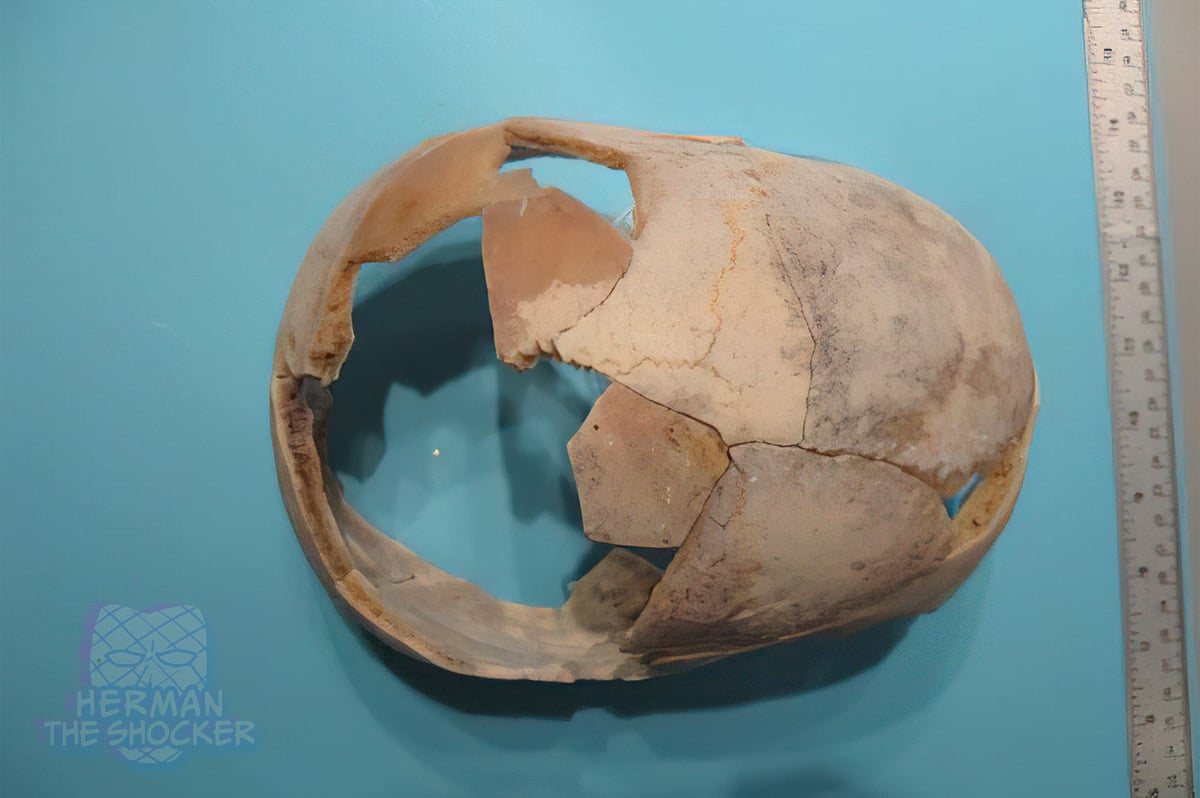 Fig.3 Reconstructed calvarium with missing parietal regions. A check of the subject revealed no firearms license or weapon registered to him. All entrances to the residence were locked and secured. There was no evidence of foul play. No suicide note was found in the residence. The pathologist performed the autopsy the following day. Detectives at the scene had initially believed that the top of the subject’s head had been destroyed by ballistics trauma, but it was suspected that postmortem damage may have been inflicted by the dogs that were locked in the residence with the subject for up to 2 days. The autopsy did not produce any definitive results as there was extensive damage to the head, including loss of the scalp, bones of the skull, and the brain. There was evidence of some bite marks to the remaining scalp. As a result of all the factors surrounding the death, the entrance wound path, and exit could not be determined at the time of autopsy. The pathologist removed the remaining calvarium and asked the anthropologist to reconstruct the skull with the fragments that had been discovered at the scene. 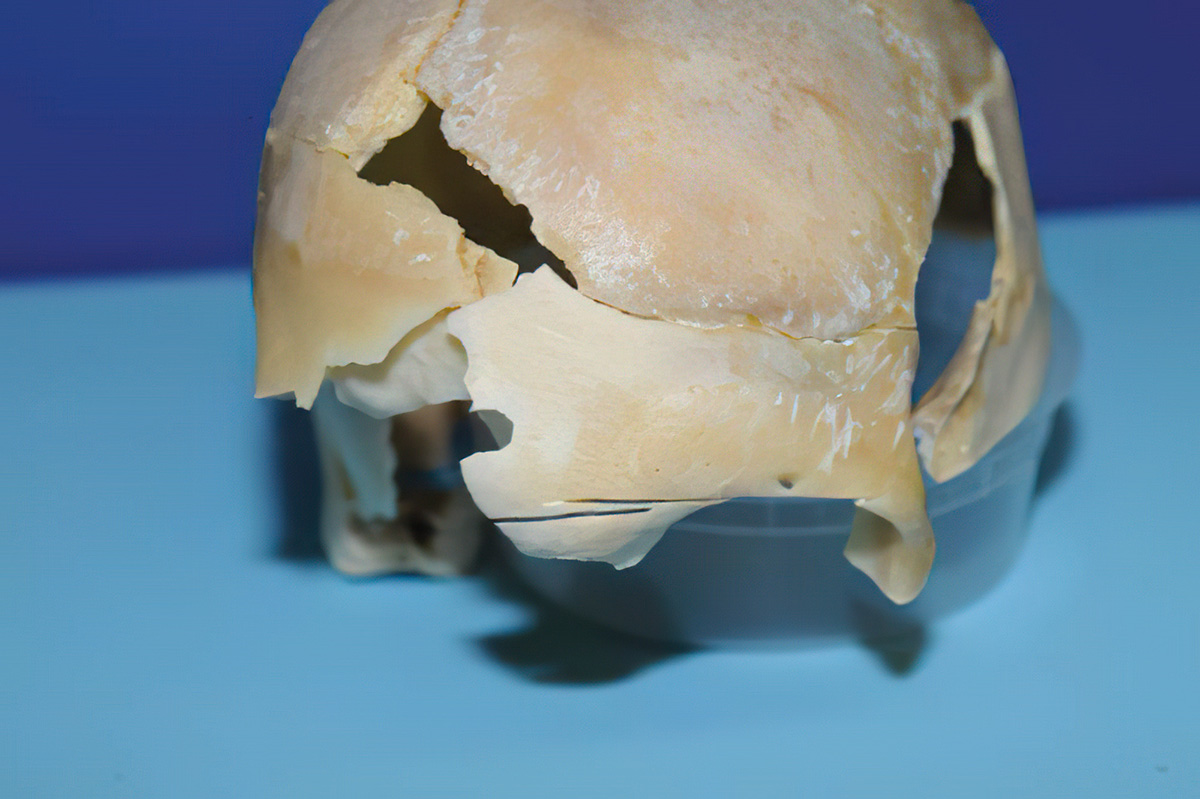 Fig.4 Carnivore scoring is visible here to the frontal bone and left temporalis region. All retained cranial elements were macerated using a solution of water and hydrogen peroxide. Cyanoacrylate adhesive was used to reconstruct the calvarium. Several portions of the skull had not been recovered at the scene and it is believed that these portions were consumed by the subject’s dogs. Several of the recovered bones show evidence of carnivore activity in the presence of punctures, pits, and scoring. Evidence of ballistics trauma can be seen on the right side of the skull with the presence of at least two generations of externally beveled concentric fractures, which are indicative of ballistics trauma due to known information on biomechanical principles. The probable impact site is missing due to the canine activity and lack of recovered bone, and it appears to have included the anterior portion of the right temporal bone and a portion of the sphenoid at the squamosal suture. It could not be determined if this was an entrance or exit. 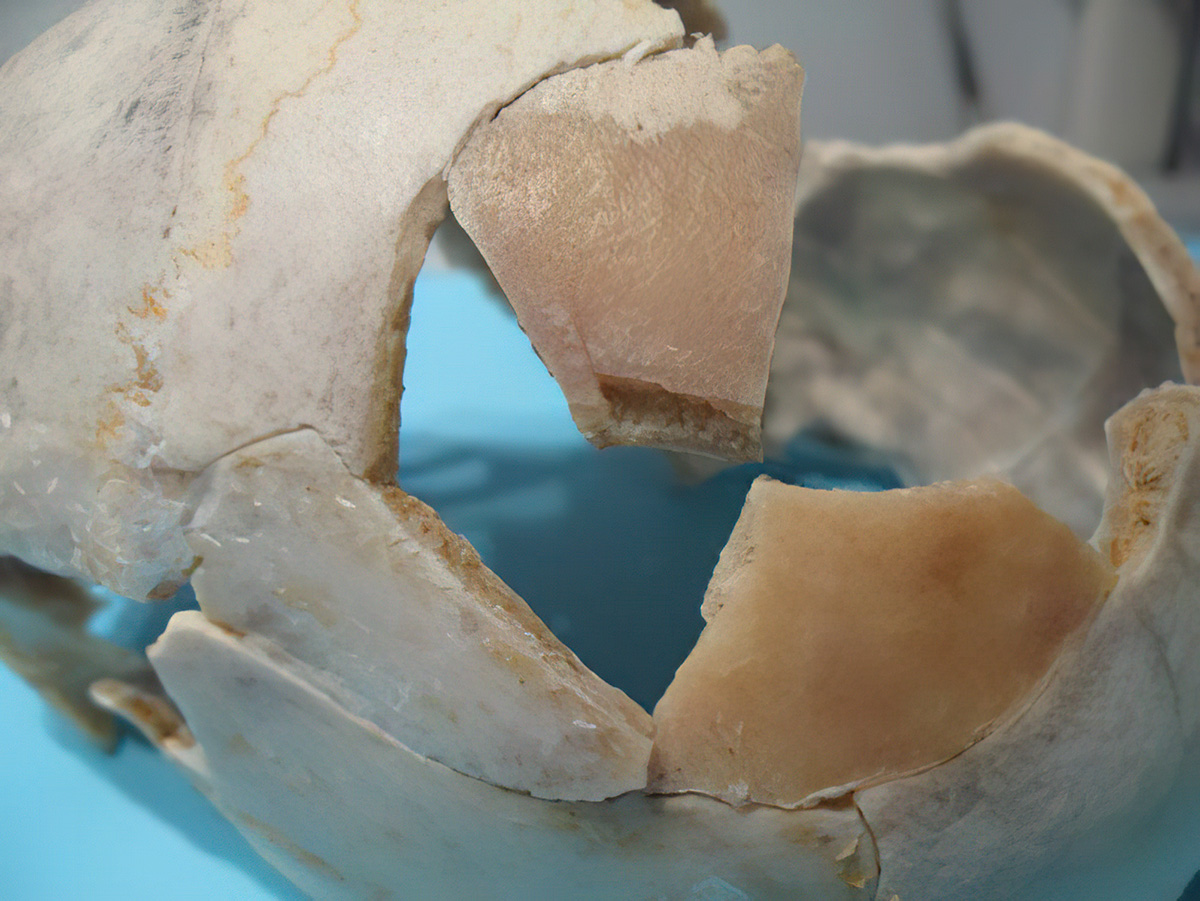 Fig.5 Injury to left parietal showing external beveling. There is evidence of a second impact site to the left superior-posterior parietal near the sagittal suture, with an externally beveled circular wound. The direction of the beveling in this particular impact site indicates that this was an exit wound. Additionally, a small plug of bone was recovered and it articulates with this exit wound. Concentric fractures surrounding the exit wound are also externally beveled, which further indicates that this was a result of ballistics trauma. Fracture sequencing of the linear fractures shows that the fractures on the left side of the head terminate at linear fractures on the right side of the head. This indicates that the injury to the right temporal region occurred first, showing that the projectile traveled from the right temporal through the left temporal. No additional evidence of any other ballistics trauma was noted on the recovered calvarium fragments. Sequencing of fracture patterning, as well as impact and concentric fracture beveling directions, indicated that that mechanism of trauma was ballistics trauma. The presence of bite marks to the remaining scalp as well as the bone itself indicates that the remaining portions of the skull were missing because of canine activity on the body after death. Autopsy findings from the soft tissue, the anthropological analysis as well as the police investigation indicated that there was no foul play suspected and the subject died from a gunshot wound to the head. Even though no note was found and no ideation was expressed by the subject, the manner was determined to be a suicide due to the circumstances. The unique role of the in-house anthropologist in a medical examiner/ coroner’s office provides a valuable opportunity for the anthropologist to use more tools than are available in the academic setting. Fleshed cases provide information that skeletonized remains cannot and police reports give more depth in cases where anthropologists rarely hear any details surrounding the death. This particular case would probably not have traditionally involved anthropological involvement, but it allowed the pathologist more information on the injuries present. This role will continue to be evolved as in-house anthropologists are more of an everyday appearance in larger metropolitan medical examiner’s offices. - This post is for educational purposes only and is nonprofit. Under Section 107 of the US Copyright Act of 1976; Allowance is made for "Fair Use" for purposes such as criticism, comment, news reporting, teaching, scholarship, and research. OP is not a medical expert. No copyright infringement intended. This post does not encourage or glorify violence/harassment. Images might have been upscaled and enhanced. Text might have been shortened and simplified/reorganized for online view.
__________________ ⭐️ hermantheshocker.com ⭐️ |
|
#2
●
03-14-2022, 06:39 PM
|
 ♚ Legacy Gold Member ♚ Poster Rank:28 ㅤㅤ真 Join Date: Apr 2021 Posts: 52,923 52,923Posts 52,853Thanked 41,105Quoted 372Mentioned 0Contrib. |
|
Re: Man Found Dead with Half His Head Missing
haha fucking fantastic. 
__________________ ᓚᘏᗢ |
|
#4
●
03-14-2022, 09:18 PM
|
 ♚ Legacy Gold Member ♚ Poster Rank:915 Join Date: Oct 2020 Posts: 820 820Posts 1,957Thanked 119Quoted 0Mentioned 0Contrib. |
|
Re: Man Found Dead with Half His Head Missing
That's a good report dude. They got that skull cleaned up quick. I guess they could have waited for the dogs to poop. Then sift the shit for the missing frags.
|
|
#5
●
03-14-2022, 09:45 PM
|
| So Fucking Banned Poster Rank:412 Join Date: May 2021 Posts: 2,952 2,952Posts 4,490Thanked 38Quoted 1Mentioned 0Contrib. |
|
Re: Man Found Dead with Half His Head Missing
~ I think he expected his life to go on in delusional bliss, like most people do, until he went thru some kind of sobering reality that snapped him out of it, & life itself. ~ He could have also been so sorry & felt so guilty for his bad behavior that he had to do himself off. ~ It also usually happens when people become religious fanatic perfectionists, per as they have now mortally sinned, by not meeting up to their own expectations of their faith. |
|
#6
●
03-14-2022, 10:15 PM
|
 My Rank: FIRST SERGEANT Poster Rank:446 Mal Join Date: Aug 2021 Posts: 2,597 2,597Posts 3,793Thanked 1,377Quoted 2Mentioned 0Contrib. |
|
Re: Man Found Dead with Half His Head Missing
Thanks Herman, I get so much out of these. I don't read so much books as I used to, but these posts read like a book. Very stimulating.
|
|
#7
●
03-14-2022, 11:11 PM
|
 My Rank: CAPTAIN Poster Rank:218 Join Date: May 2016 Posts: 6,886
Contributions: 22
6,886Posts 6,617Thanked 853Quoted 3Mentioned 22Contrib. |
|
Re: Man Found Dead with Half His Head Missing
great, detailed thread |
|
#8
●
03-22-2022, 02:02 PM
|
 My Rank: STAFF SERGEANT Poster Rank:876 Male Join Date: Jun 2011 Posts: 864 864Posts 2,301Thanked 227Quoted 0Mentioned 0Contrib. |
|
Re: Man Found Dead with Half His Head Missing
Herman, you NEVER fail to post something interesting. This was great! Thanks! Please keep up the fantastic work.
|