|
#1
●
02-26-2012, 12:35 PM
| ||||||||
 My Rank: MAJOR Poster Rank:12 Join Date: Jun 2009 Posts: 93,130
Contributions: 226
Mentioned: 91 Post(s) Quoted: 2009 Post(s)
| ||||||||
|
Human Adult Skulls
Interesting site if you are interested in skulls. Some are real skulls with interesting stories on how the person came to die and some are replicas. Few examples below but visit the site for more  http://www.boneclones.com/catalog-hu...ult-skulls.htm I would love to own one of these  The skull is that of a young African-American woman in her early 20's. The cranium was penetrated by two rounds from a .410 shotgun fired at close-range. The right jaw was hit by a third round, directed downward. The coronal and lambdoidal sutures were separated by the blast and the right half of the jaw was shattered. The cranium has been reassembled in order to show details of the wounds. Cracks radiate out from each wound, and slight internal beveling is present. The margins are scalloped by the concentrated blast of shotgun pellets. (Trace amounts of lead wipe residue are present in the margins of the original skull.) A few stray pellets penetrated only the outer table of bone, but most lodged in the brain. One complete indentation, 5 mm. in diameter, is visible to the right of the posterior wound. (A higher-powered hunting gun would have inflicted much greater damage and a greater muzzle-to-target distance would have resulted in a wider, less consistent wound.) 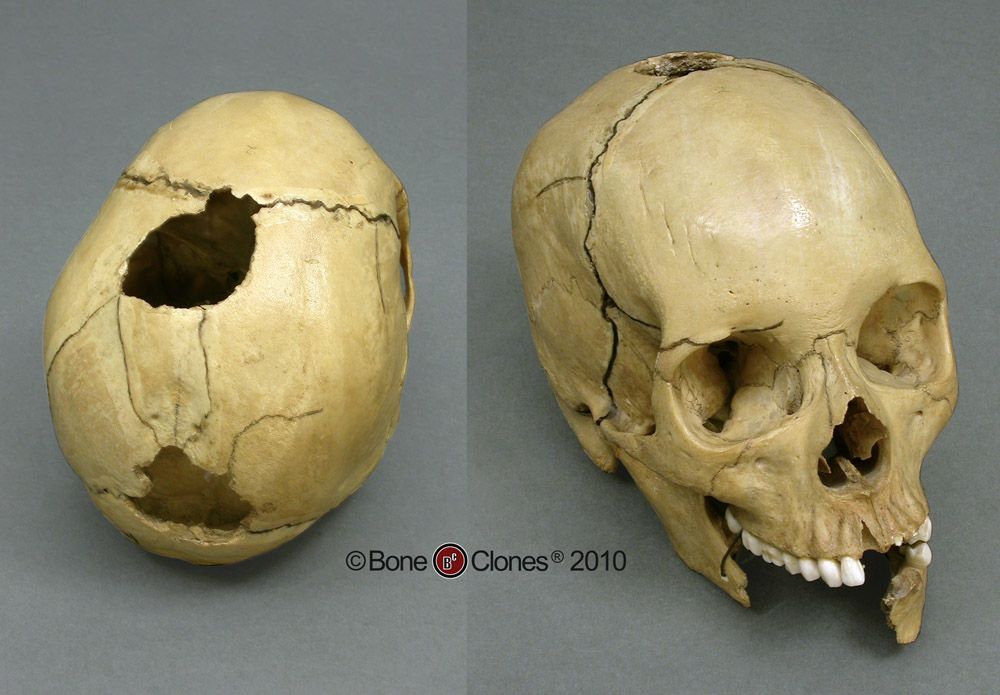 This female skull from the Tuanacen tribe in Bolivia is reported to be 1200 years old and was acquired in 1986. This particular skull is not only trephined, but elongated from the practice of wrapping the heads of young females. The skull is unusual as the trephination was done by scraping the bone until the brain was exposed. The patient clearly lived on as the bone shows healing. According to the literature at the University of Iowa, dated circa 1860, "trephining is a surgical operation that involves cutting out a small, button-shaped piece of the skull. The operation is done with an instrument called a trephine. The procedure is used in the treatment of certain head injuries. It relieves pressure on the brain caused by bleeding between the skull and brain. Also used to remove blood clots and to gain entry to the brain for other surgical procedures; trephining is the earliest known surgical treatment." 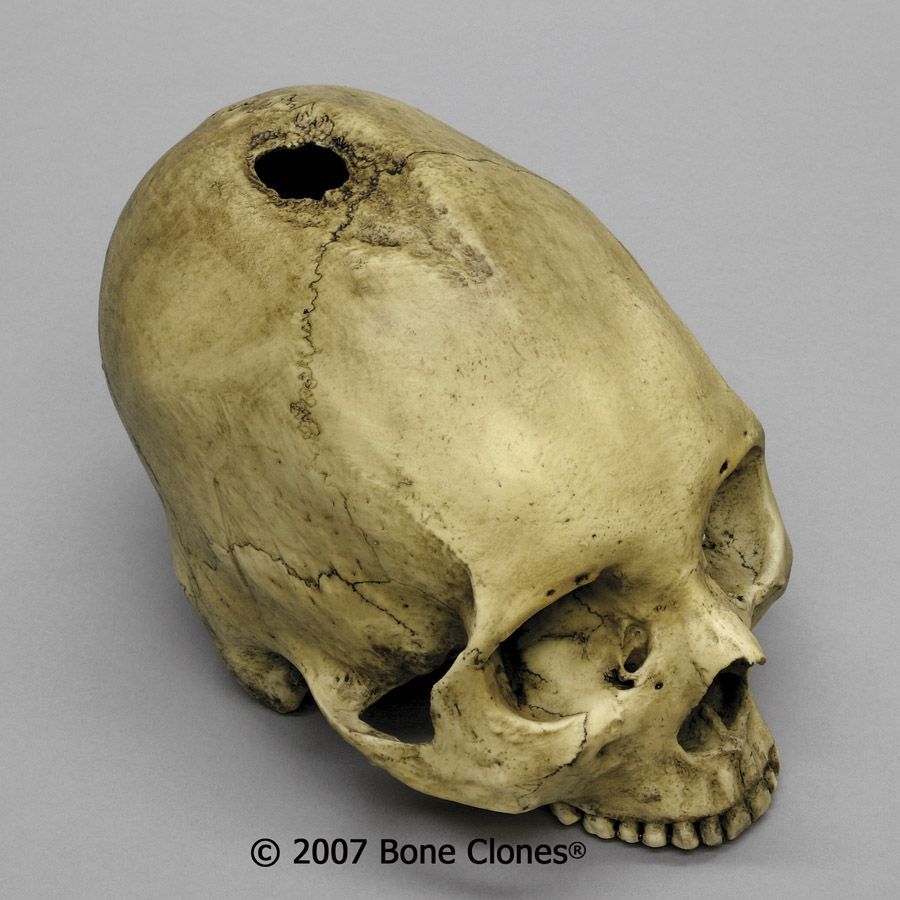 Human male skull with large caliber bullet wound to head. European male, 25 years of age, modern specimen, North America. Cast by us from an original skull that is in a North American medical school forensic osteology teaching collection. The appearance of projectile damage to bone is crucial to the differentiation of "entrance" and "exit" wounds. Typically, as a projectile like a bullet passes through a plate of bone (like that of the neurocranium), fragments of the bone follow. As such, there is a characteristic beveling (or open fanning) of the bone in the direction of projectile motion. Although not adequately visualized on the entrance wound of this specimen (without removing the calvarium), this phenomenon is beautifully illustrated in the exit wound of the left lateral occipital bone. Note also the radiating simple linear fracture which progresses obliquely and laterally away from the exit wound. Interestingly, the left orbital plate is not intact. This is important to recognize and consider for two reasons. Firstly, damage to bones in this region may be due to direct contact with the bullet, or the forces of gases expelled from the muzzle of a gun in hard contact with the head. Secondly, it may not be due to these factors at all, and may represent the violent secondary contact of the frontal lobes of the brain, thrust against this bony ridge when the brain is expanded and compressed by forces created with the rapid passage of a projectile through brain tissue. 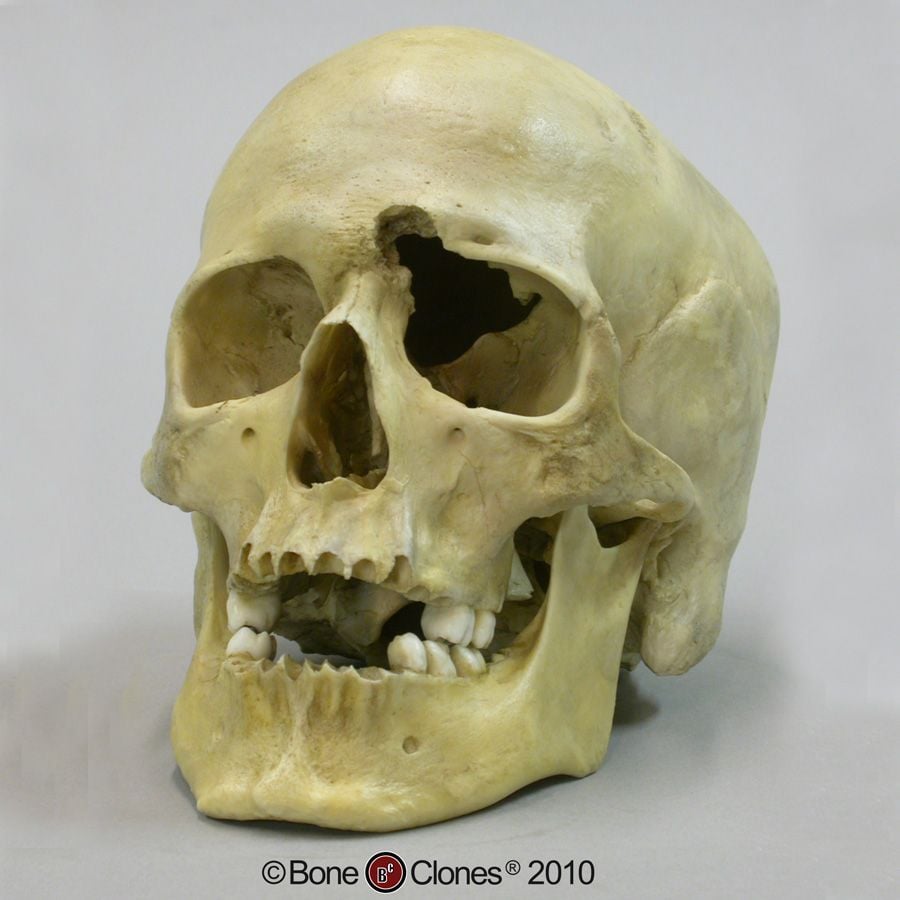 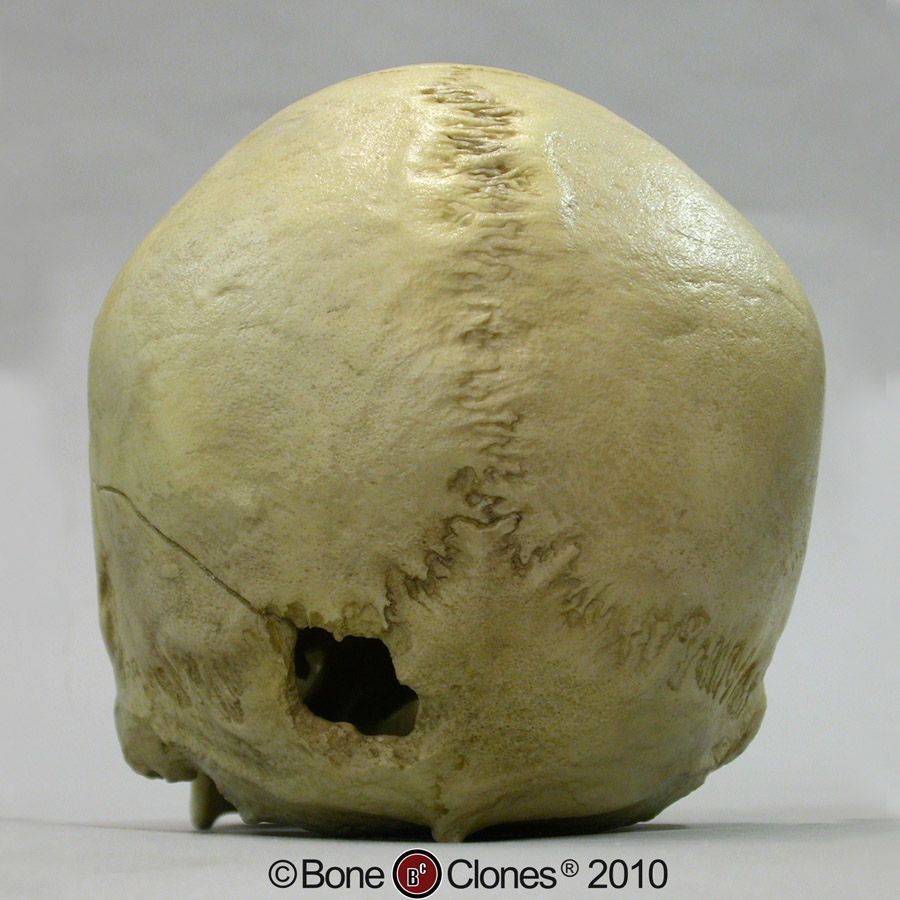 An atypical skull from a 68-year-old European female. It includes a mixture of sexual traits and appears to be an example of age-related "masculinization" (Walker, 1995). The forehead has two prominences (masculine); the supraorbital border is rounded and a moderate supraorbital ridge is present (intermediate); the mastoid processes are large (masculine) ; the chin is pointed, not squared (feminine); the gonial angle is flared (masculine); the nuchal lines are clearly defined (masculine). 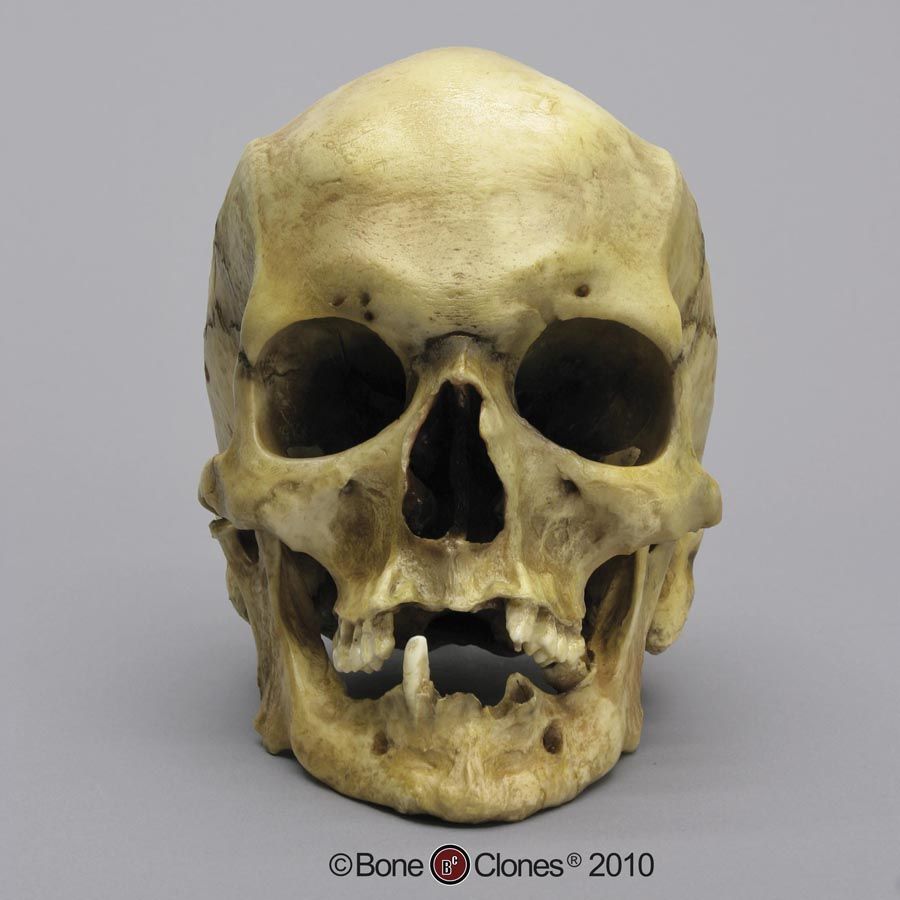 Aged somewhere between 72AD and 472 AD, this skull was unearthed near the Coliseum in Rome, Italy, which was built during the reign of Emperor Vespasiano. This skull is from a formal grave yard for known coliseum gladiators. By the coalition of the skull bones, experts infer the skull is from a large male in his 30's. This gladiator was a huge man for his time and due to his extraordinary size, he was most likely a popular attraction. This particular piece suggests to some that during this Roman period, men were selected by size, if not intentionally bred for fighting. This specimen shows unusual brachycephalic structure with a very high, near vertical forehead (frontal) and exaggerated occiputs. The exceedingly dense skull gives it weight and strength. Noteworthy on the skull is a large, healed "knot" of bone showing trauma. On the lower jaw is a green stain, which appears to be a wash of copper patina from metal that was in proximity to the skull after burial, perhaps a chinstrap. The original skull is in a private collection obtained from a turn-of-the-century phrenology institution collection in New York. 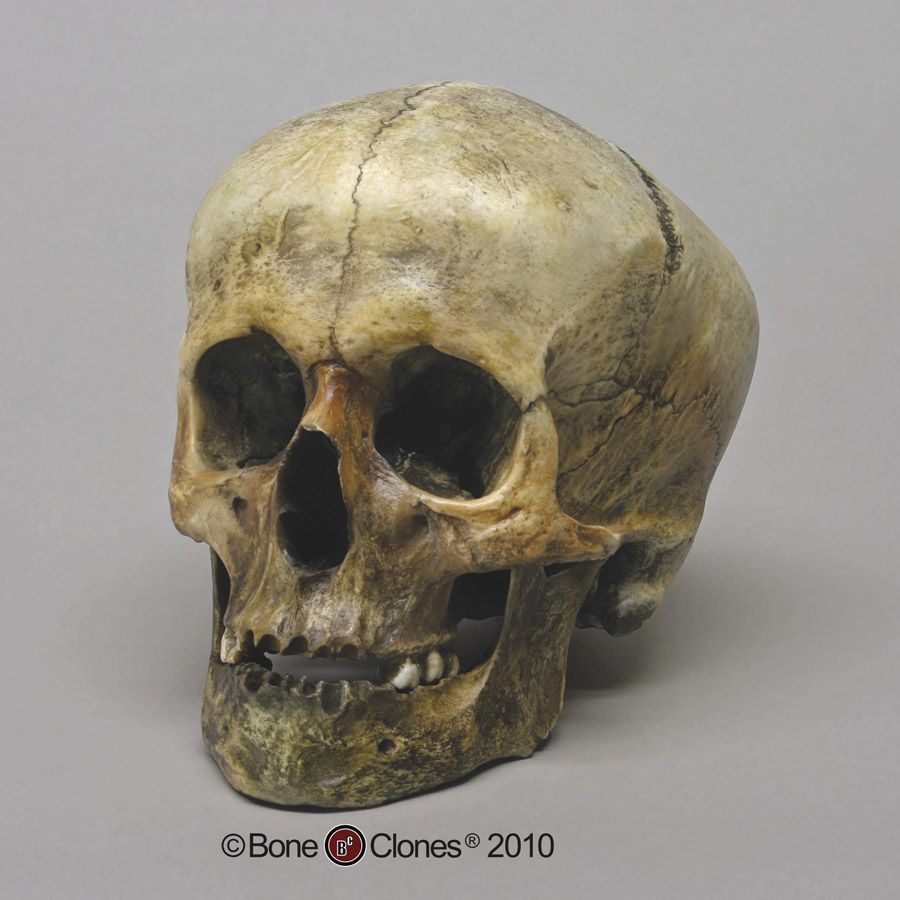 SPANISH SOLDIER'S SKULL SHOWING IN-PLACE WEAPON THAT STRUCK FATAL BLOW. Human Skull, Adult Male identified by physical anthropological traits to be European. Archaeological Context: Found exposed by road equipment on ranch in Chama, New Mexico. Skeleton was destroyed, but skull and artifact remained in place and intact. Ax head consistent with material culture of 16th-17th Century Spain. Association indicates that this burial site was not an intentional Christian burial, but rather a chance preservation in a remote area, and may likely be tied to the Pueblo Revolt of 1680. In 1598, Spaniards came north from Mexico to plant a permanent colony in what is today New Mexico in the heart of the American Southwest. Eight decades later, Pueblo Indians destroyed the colony and drove Spaniards out of their lands. In 1680, in a swift and bloody revolt, Pueblo Indians overthrew the Spaniards who had occupied their lands for more than eighty years.  |
|
#2
●
02-26-2012, 12:41 PM
| ||||||||
 My Rank: FIRST SERGEANT Poster Rank:394 Join Date: Apr 2011 Posts: 3,054 Mentioned: 2 Post(s) Quoted: 276 Post(s)
| ||||||||
|
Re: Human Adult Skulls
Great stuff! Thanks for sharing, now this dedicated fan of skulls is all happy-happy-joy-joy  |