Human decomposition begins approximately 4 minutes after death has occurred. The onset is governed by a process called autolysis –
or self-digestion. As cells of the body are deprived of oxygen, carbon dioxide in the blood increases,pH decreases and wastes accumulate which poison the cells. Concomitantly, unchecked cellular enzymes (lipases, proteases, amylases, etc.) begin to dissolve the cells from the inside out, eventually causing them
to rupture, and releasing nutrient-rich fluids. This process begins and progresses more rapidly in tissues that have a high enzyme content (such as the liver) and a high water content such as the brain, but eventually affects all the cells in the body. Autolysis
usually does not become visually apparent for a few days. It is first observed by the appearance of fluid filled blisters on the skin and skin slippage where large sheets of skin slough off the body. Meanwhile, the body has acclimated to ambient temperature (algor mortis), blood has settled in the body causing discoloration of the skin (livor mortis) and cellular cytoplasm has gelled due to increased acidity (rigor mortis). After enough cells have ruptured, nutrient-rich fluids become available and the process of putrefaction can begin.
Putrefaction is the destruction of the soft tissues of the body by the action of micro-organisms (bacteria, fungi and protozoa) and results in the catabolism of tissue into gases, liquids and simple molecules. Usually, the first visible sign of putrefaction is a greenish discoloration of the skin due to the formation of sulfhaemoglobin in settled blood. The process progresses into distension of tissues due to the formation of various gases (hydrogen sulfide, carbon dioxide, methane, ammonia, sulfur dioxide and hydrogen), especially in the bowels, but I have seen this in many parts of the body, including the face, lips and groin. This is associated with anaerobic fermentation, primarily in the gut, releasing by-products rich in volatile fatty acids, mainly butyric and propionic acids. Gas and fluid accumulation in the intestines usually purge from the rectum, but can be severe
enough to rip apart the skin causing additional post-mortem injuries. Shortly after the purging of gases due to putrefaction, active decay begins. Muscle, composed of protein, which in turn is composed of amino acids, readily yields to the formation of additional volatile fatty acids through bacterial action. Further protein and fat decomposition yields phenolic compounds and glycerols. Compounds, including indole, 3-methylindole (skatole), putrescine, cadaverine and various fatty acids have been detected and are significant decomposition products. At this point in the decay cycle electrolytes are rapidly leaching out of the body, both aerobic and anaerobic bacteria are present in large numbers, insect activity is very prominent and carnivores can contribute significantly to the decline of the corpse. Saponification (the formation of soap from fat under high pH conditions) or adipocere formation typically occurs after the onset of putrefaction in warm, moist, environments and is seen as deposits of a yellowishwhite,
greasy, wax-like substance. Adipocere develops as the result of fat hydrolysis with the release of fatty acids. Adipocere consistency varies with the type of material to which it is bound and gives some indication as to the rate of decomposition. Rapid decomposition is indicated by a hard and crumbly composition if bound with sodium (primarily from interstitial fluids), but a soft, paste-like complex is formed when bound with potassium
(from the breakdown of cell membranes), potentially Beyond the grave – understanding human decomposition Arpad A. Vass Eventually all human lives come to an end. Forensic anthropologist
Arpad Vass explains the role of microbes in our bodies after death.
MICROBIOLOGYTODAYVOL28/NOV01 191
indicating slower decay rates. Adipocere formation is
accelerated by the post-mortem invasion of tissues by
bacteria, especially putrefactive species such as
Clostridium and it takes from several weeks to months
to form.
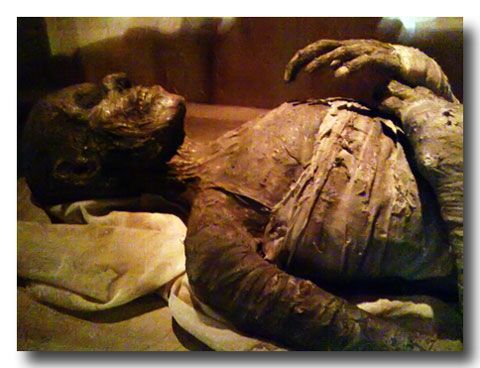
Mummification is typically the end result of tissue,
usually skin, with no nutritional value, which has
survived the active decay process and is formed by the
dehydration or desiccation of the tissue. Remaining skin
is converted into a leathery or parchment-like sheet
which clings to bone. Mummification most commonly
develops in conditions of dry heat or in areas that have
very low humidity, such as in arctic regions or deserts.
Bone goes through yet another complex process
called diagenesis. Diagenesis is a natural process
that serves to alter the
proportions of organic
(collagen) and inorganic
components (hydroxyapatite,
calcium, magnesium)
of bone exposed to
environmental conditions,
especially moisture. This
is accomplished by the
exchange of natural bone
constituents, deposition
in voids or defects,
adsorption onto the bone
surface and leaching from
the bone.
Historically, the progression
of human decomposition
has been described
as taking place in four
stages: fresh (autolysis),
bloat (putrefaction), decay
(putrefaction and carnivores)
and dry (diagenesis).
Current thinking is that it
should be segregated into
pre- and post-skeletonization,
since stages are
not always observed and
in fact may be totally
absent, depending on the
taphonomy of the corpse.
All these processes
together (autolysis, putrefaction
and diagenesis)
eventually result in complex
structures composed
of proteins, carbohydrates,
sugars, collagen and
lipids returning to their
simplest building blocks –
essentially dust to dust.
How long does decomposition take?
Decomposition is a complicated process, but is primarily
dependant on temperature and to a lesser extent on
moisture. In our studies we have worked out a simple
formula, which describes the soft tissue decomposition
process for persons lying on the ground. The formula is
y=1285/x (where y is the number of days it takes to
become skeletonized or mummified and x is the average
temperature in Centigrade during the decomposition
process). So, if the average temperature is 10 °C, then
1285/10 = 128.5 days for someone to become
skeletonized. Of course, this is a rough estimate since
many factors affect this rate and it is typically used at a
crime scene when investigators need some time frame
from which to begin their investigation. Buried
individuals and ones submerged in water have different
rates of decomposition. Injuries affect the rate as well
since damage to the skin increases blood loss, insect and
bacterial action. In severe environments, such as in the
arctic or in deserts, rapid desiccation occurs and this
makes any accurate determination extremely difficult.
Carnivore activity is yet another factor which can
radically affect decomposition. Exclusion of insects and
carnivores will slow down the process, whereas exposure
to many (or larger) carnivores will increase the rate.
Remember that decomposition does not end after the
soft tissue has disappeared. The skeleton also has a
decompositional rate that is based on the loss of organic
(collagen) and inorganic components. Some of the
inorganic compounds we use to determine the length of
time since death include calcium, potassium and
magnesium. As with soft tissue, these leach out of bone
at a rate determined primarily by temperature and
exposure to moisture. As a general rule, bones, within the
first year, will begin to bleach and one may see growth of
algae or moss on them. Within the first decade one will
expect to see exfoliation and the formation of large cracks
in the bone. Roots from nearby vegetation may grow into
the bone mass, significant rodent gnawing will be
present and the appearance of annual leaf falls is evident.
The role of microbes
When I began studying human decomposition over a
decade ago in an attempt to determine a more accurate
method for estimating the post-mortem interval, I began
by investigating bacteria. The concept was that since
insects can be used for this task, given that they arrive
in characteristic, identifiable waves, why shouldn’t
bacteria behave in a similar fashion? It only took 3
months to quickly abandon this concept. Even in
the very early stages of decomposition, I was inundated
by the sheer numbers of organisms isolated –
Staphylococcus, Candida, Malasseria, Bacillus and
Streptococcus spp. – just to mention a few. As
decomposition progressed, putrefactive bacteria were
thrown into the mix followed rapidly by anaerobes.
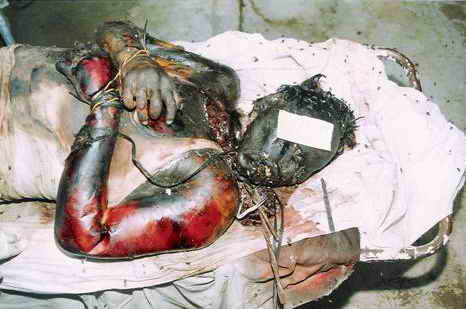
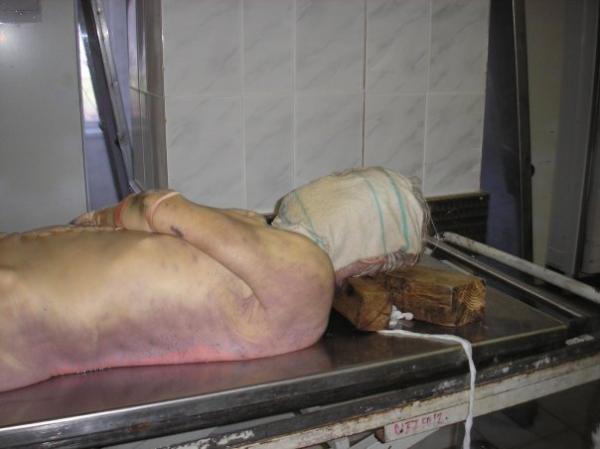
LEFT:
Examples of two stages of human
decomposition. The top photograph
shows a male subject in active
decay after 12 days. The lower
photograph shows the same
subject after 97 days in the dry
stage of decomposition where
only mummified skin remains. In
temperate regions of the United
States individuals can be
completely skeletonized in 30–40
days in the summer.
PHOTOS A. VASS
MICROBIOLOGYTODAY 192 VOL 28/NOV 01
These included micrococci, coliforms, diptheroids and
Clostridium spp. There was a preponderance of certain
organisms such as Serratia spp., Klebsiella spp., Proteus
spp., Salmonella sp. and even gliding bacteria like
Cytophaga – not to mention pseudomonads and
flavobacteria. As these mixed with environmental
micro-organisms such as Agrobacterium, amoebae and
many colourful varieties of fungi and, of course, those
brought to the corpse by flies and other insects, I
relented. I came to the conclusion, somewhat facetiously,
that with the exception of micro-organisms living in
deep-sea vents, every micro-organism known is involved
in some aspect of the human decompositional cycle
from Acetobacter to Zooglea. While many of the organisms
isolated come from the bowel and respiratory tract,
literally hundreds of species are involved in the
decompositional process and decomposition would
not progress without them.
One particular forensic case comes to mind that
illustrates this point. Workmen clearing limbs from a
roadside guardrail (in the summer) discovered a fully
clothed woman dead for an undetermined time. No
indication of decomposition and no insect activity
led investigators to initially believe this was a very
recent homicide. In actuality the woman had been
dead for nearly 4 months. She had been sprayed with
insecticide (and other chemicals) by the perpetrator to
mask the odour of decomposition so she wouldn’t
be found. Unwittingly, the murderer had essentially
sterilized the body and prevented flies from laying eggs.
Autopsy showed some internal decomposition, but it
was significantly reduced. Apparently, the chemicals
seeped into her lungs and then spread throughout her
body.
Taphonomic circumstances also play a role in the
response of micro-organisms. Several years ago, grave
robbers, searching for artefacts, unearthed the coffin of
an American Civil War Colonel (Col. Shy). The caretaker
of the cemetery called in the police who found a fresh
corpse in the grave. After significant investigation, it was
ascertained that the fresh corpse was indeed Col. Shy,
who ‘still had red meat on his bones’. At that time prominent
solders were buried in solid lead coffins – the lead had
‘sterilized’ the body by poisoning the microflora and
decomposition had not progressed past initial autolysis.
Why study human decomposition?
It is critical that the decomposition process be understood
because it impacts on forensic investigations in a
variety of ways. At every crime scene many questions
are asked, but to solve the crime the five ‘W’s (who, what,
when, where and why) must be answered. Studies into
human decomposition help answer four questions: who
is the victim, how did the victim die, where and when
did the victim die? In addition to being extremely useful
for ‘Time Since Death’ determinations, the identification
of decompositional products may also be relevant to
victim identification. The presence of melanin, for
example, may help establish the race of the victim,
especially when key skeletal elements are absent. The
quantity of various decompositional products, such as
fatty acids, may help determine the weight of an
individual, which can also be useful in determining the
victim’s identity. This would be crucial, especially when
articles of clothing are unavailable at the crime scene.
Knowledge of any trace amounts of chemicals, drugs,
medications or toxins present in decomposed tissue
may also be of help to investigators in attempting to
determine cause of death. Additionally, the study of
decompositional products may even be useful in locating
human remains or clandestine grave sites by improving
the training procedures for cadaver recovery dogs,
through the determination of the alerting scent
emanating from a corpse, or in the development of field
instrumentation for assisting in cadaver recovery
searches.
The future
Current techniques to determine the post mortem
interval using decompositional products (volatile fatty
acids) can range from ±2 days for soft tissue decay and
±3 weeks using inorganics for skeletonized material, up
to approximately 5 years. Currently we are looking at
specific organ biomarkers, which we hope will narrow
the estimated range down to less than 12 hours for the
first several weeks of decomposition. New, sophisticated
hand-held devices are being planned which can be used
by police at a crime scene to give them immediate
answers as to how long the victim has been dead and
to help locate clandestine graves. Novel fingerprint
and DNA recovery techniques will aid in both victim
and perpetrator identification – all of which are
made possible by an intimate knowledge of the
decompositional process.