|
#1
●
02-29-2012, 01:49 PM
| ||||||||
 My Rank: MAJOR Poster Rank:12 Join Date: Jun 2009 Posts: 93,128
Contributions: 226
Mentioned: 91 Post(s) Quoted: 2009 Post(s)
| ||||||||
|
Forensic Images And Info
|
|
#2
●
02-29-2012, 01:57 PM
| ||||||||
| My Rank: MAJOR Poster Rank:12 Join Date: Jun 2009 Posts: 93,128
Contributions: 226
Mentioned: 91 Post(s) Quoted: 2009 Post(s)
| ||||||||
|
Re: Forensic Images And Info
Velocities Of Blood Spatter 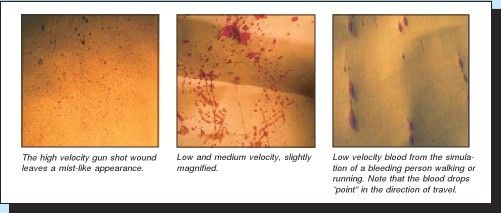 The velocity of the blood spatter when it strikes a surface is, within certain limitations, a strong and reasonably reliable indicator of the speed of the force that set the blood in motion in the first place.The classification of the velocity (whether high,medium, or low) is that of the initial force causing the blood to move, rather than the speed of the blood itself as it moves, and is measured in feet per second (fps). High velocity blood spatter, for in-stance, may have come from a gunshot wound inflicted by a bullet moving at 900 fps,whereas medium velocity may have resulted from a spurting artery or a blunt instrument striking the already bloody head or limb of a victim, and low velocity blood may have dripped from a wound or blood-soaked item. High Velocity High velocity blood spatter is produced by an external force greater than 100fps. The stains, sometimes referred to as a mist, tend to be less than 1 millimeter.Usually created by gunshots or explosives,high velocity patterns also may result from industrial machinery or even expired air,such as coughing or sneezing. In any case,the spatter tends to come from tiny drops of blood propelled into the air by an explosive force. High velocity droplets travel the shortest distance because of the resistance of the air against their small mass. Medium Velocity An external force of greater than 5 fps but less than 25 fps causes medium blood spatter. The stains generally measure 1 to 3millimeters. Blunt or sharp trauma, often from knives, hatchets, clubs, fists, and arterial spurts, can produce such stains.Most medium velocity stains found at crime and accident scenes form patterns created by blood flying from a body to a surface as a result of blunt or sharp trauma or the body colliding with rounded or edged surfaces. It may result from a punch,stabbing, or a series of blows or, in the case of an accident, the body striking surfaces inside or out-side a vehicle. Any object that blocks the blood from falling on the surface where it would have landed, including the victim or the attacker’s body or a piece of furniture moved to stage the scene,creates a void space in the stain. Low Velocity Low velocity blood spatter is created by an external force less than 5 fps (normal gravity) with the stains generally 3 millimeters and larger. It usually results from blood dripping from a person walking or running or from a bloody weapon.Dripping blood often falls at a 90-degree angle and forms a 360-degree circumference stain when it hits a flat surface, depending, of course, on the texture of the surface. Investigators also may find low velocity blood spatter in the trail of an individual who is bleeding with larger pools of blood indicating where the person paused. |
|
#3
●
02-29-2012, 02:27 PM
| ||||||||
 ★Wizard Of Gore★ Poster Rank:2 Join Date: Aug 2009 Posts: 127,761
Contributions: 1
Mentioned: 457 Post(s) Quoted: 30201 Post(s)
| ||||||||
|
Re: Forensic Images And Info
All of a sudden, I feel that I'm not ready to go just yet.  |
|
#5
●
02-29-2012, 03:16 PM
| ||||||||
 ★ Legacy Member ★ Poster Rank:7 What we've got here is failure to communicate. Join Date: Aug 2009 Posts: 103,583
Contributions: 3
Mentioned: 112 Post(s) Quoted: 43400 Post(s)
| ||||||||
|
Re: Forensic Images And Info
Interesting stuff Kel.  |