|
#1
●
04-24-2014, 09:15 AM
| ||||||||
 My Rank: MAJOR Poster Rank:12 Join Date: Jun 2009 Posts: 93,128
Contributions: 226
Mentioned: 91 Post(s) Quoted: 2009 Post(s)
| ||||||||
|
Forensic Examinations
Tape Saw Suicide: A young man committed suicide by decapitation with a tape saw used to cut metal. You can observe a clean, regular cut affecting the oropharynx up to the base of the tongue, with complete spinal cord section, half of the cerebellum and both occipital lobes, with greater involvement of the right lobe. 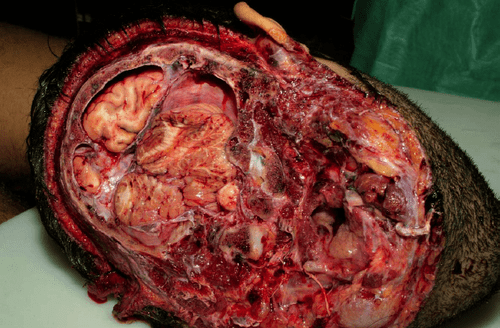 Removal of cranial vault: you can observe the dura with a bluish color due to extensive diffuse subarachnoid hemorrhage, as well as a deformed projectile located between the dura and the bone. Insert shows a fragment of left parietal bone partially detached, because there was no exit wound. 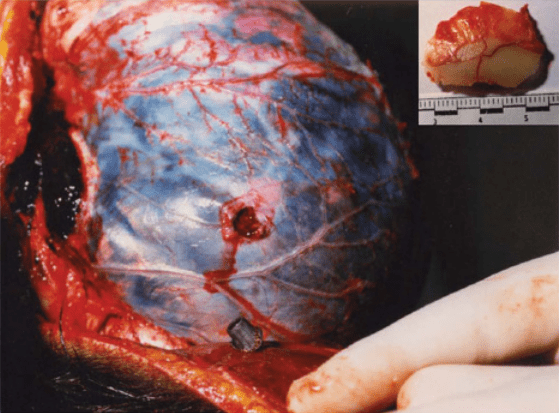 Pistol Shot to the Head: Gunshot to the head made at contact range with a pistol calibre 6.35 mm and due to the small calibre of the bullet, the lineal cavity left in the brain could be observed with clarity. 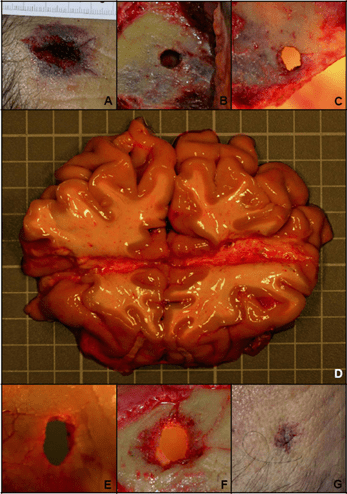 Petechiae on the eye of a strangulation victim: Petechiae on the eye of a strangulation victim. Petechia is a small (1 - 2 mm) red or purple spot on the body, caused by a minor hemorrhage (broken capillary blood vessels). The most common cause of petechiae is through physical trauma such as a hard bout of coughing, vomiting or crying, which can result in facial petechiae, especially around the eyes. Petechiae in this instance are harmless and usually disappear within a few days. 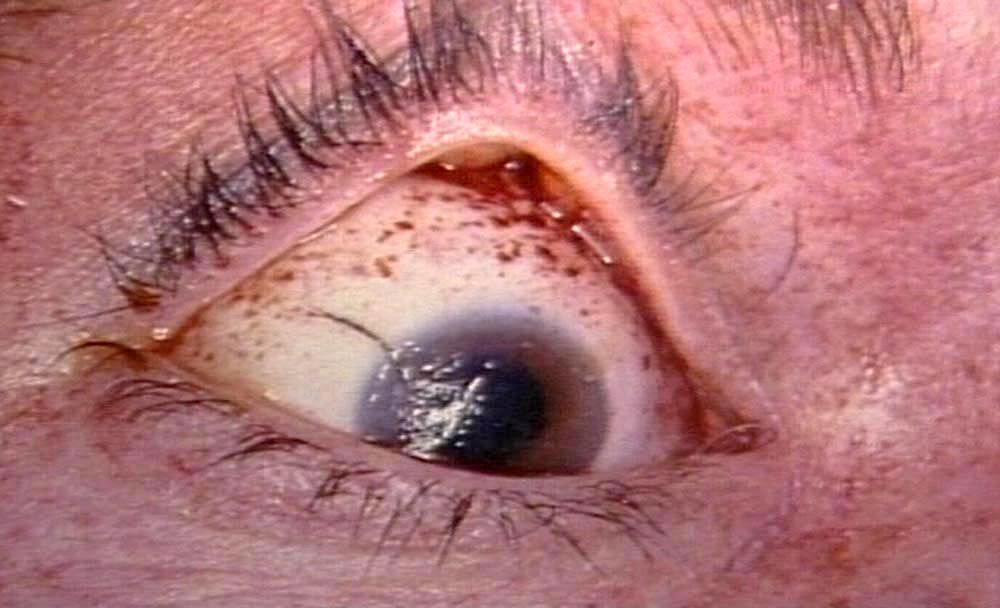 Extensive post-mortem injuries by ants: Post-mortem animal predation can lead to errors when interpreting forensic autopsy findings. Ants are the only insects that can attack human corpses after death and before the decomposition process starts. They have a predilection for the skin and their predatory action is carried out by bite. The morphology of the lesions are lineal superficial ulcers with wavy margins. Usually the lesions have dry and shriveled brownish appearance because of the desiccation of deep skin layers without any signs of vitality, which can be mistaken with abrasions or chemical injuries. This lesions are more common in the eyelids (with loss of the eyelashes), lips and knuckles. 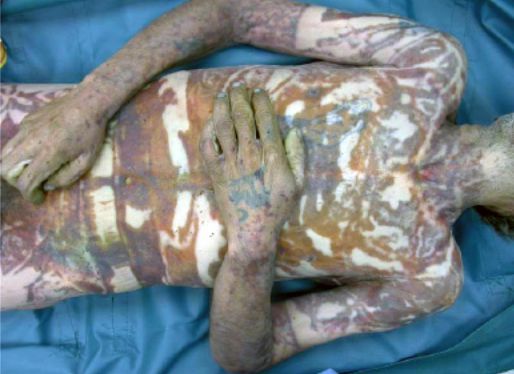 Maceration of the skin: One consequence of the permanence of the body in a liquid medium is skin maceration. It occurs mainly in the hands and feet affecting the palms and soles. Cadaveric imbibition causes the epidermis to become whitish, wrinkled and thickened (Picture 1); later it comes off as a “glove” or “sock” (Picture 2). This phenomenon will cause great difficulty in taking fingerprints and therefore the identification of the body. The time it takes to start this process and the epidermis detachment, depends on the time the body has been in contact with the fluid which may be useful in calculating the time of death. However, the temperature may change its evolution. 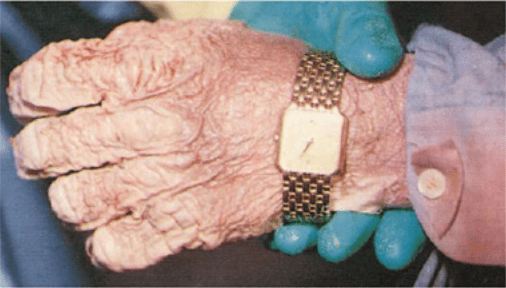 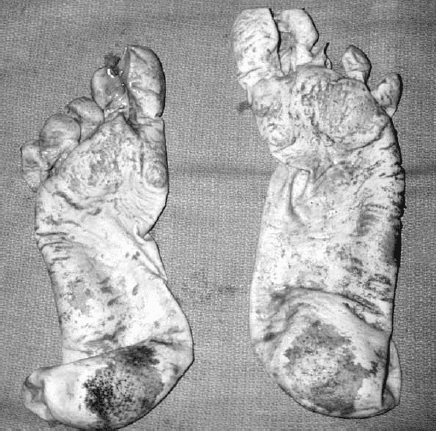 Gunshot to head: Right temporal region with a round wound with blackened and seared skin margins, typical characteristics of an entrance gunshot wound; you can also see right otorrhagia residues. 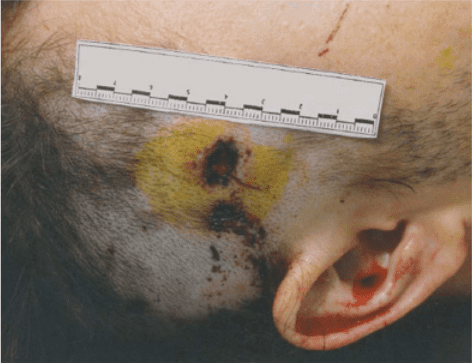 A stab wound of the inferior vena cava: As well as an associated total transection of the abdominal aorta. 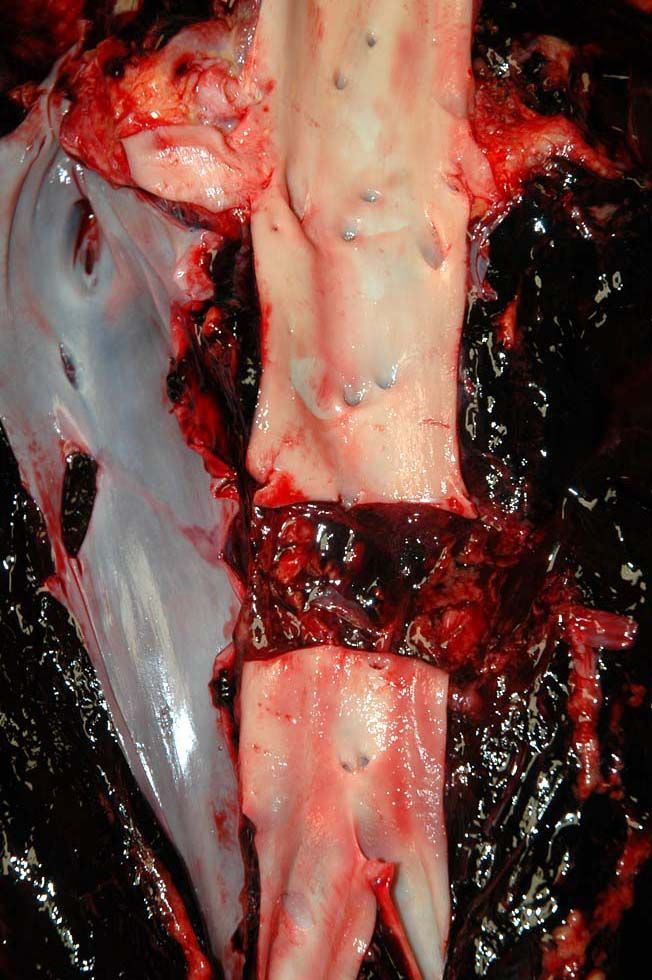 Peel Off Technique: The “peel off” technique during autopsy, in which the skin and soft tissues are dissected by layers to observe deeper lesions not visible to the external examination. 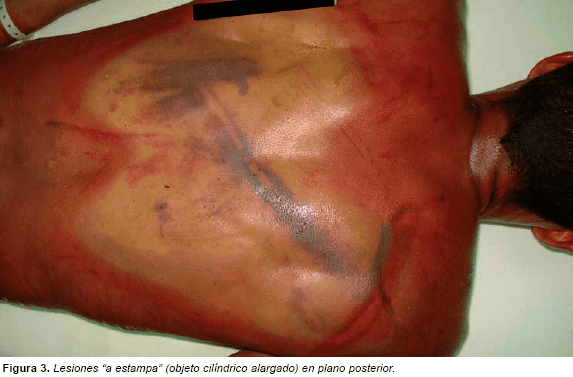 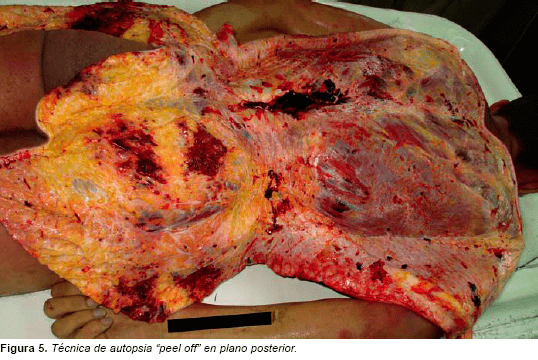 Smothering: Injuries of the inner aspect of the lower lip in a homicidal smothering death where pressure was applied to the mouth and nose. 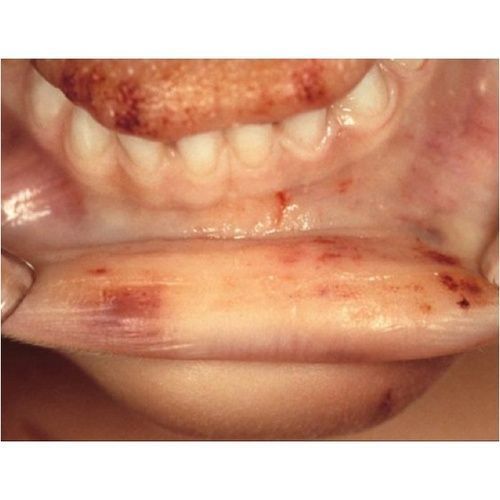 Ligature strangulation marks: 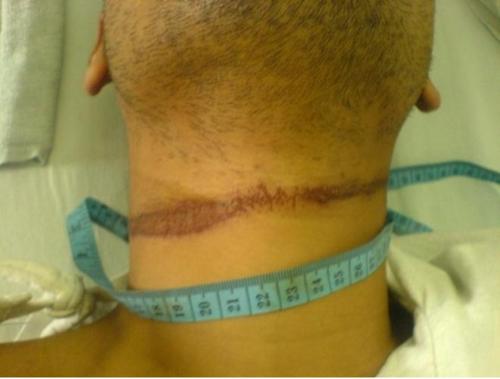 |