|
#1
●
12-16-2010, 01:57 PM
| ||||||||
 My Rank: GUNNERY SERGEANT Poster Rank:621 Male Join Date: Mar 2010 Posts: 1,472 Mentioned: 0 Post(s) Quoted: 3 Post(s)
| ||||||||
|
Days of September. The 2007 Burma/Myanmar Massacre
Japanese reporter Kenji Nagai lays dying after being shot, while the soldier who shot him stands nearby. Nagai is believed to be the only foreign casualty during the crack-down. In September 2007, public dissatisfaction with the continued rule of the SPDC manifested itself in the largest outward display of free speech in two decades as hundreds of thousands of men, women, and children from all walks of life took to the streets in protest in what quickly became known as the “Saffron Revolution”, so named for the thousands of monks who joined and lead the protests. More than 227 separate demonstrations were staged in 66 locations across Burma during August and September, some of which had amassed crowds of up to a hundred thousand protestors. The largest and best documented protests were those that were staged in Rangoon. The following incidents are all of those who were killed by the SPDC and their agents for their part in the protests. The SPDC maintains that only 15 persons were killed during the protests, while the UN Special Rapporteur on Burma, Paulo Sergio Pinheiro has stated that evidence has emerged that more than double this number died in Rangoon alone. As many as 84 persons remained unaccounted for at the end of January 2008, many of whom who were feared to have also been killed. This number represents only those who could be identified and as such this figure should be considered conservative. With protests staged in no fewer than 66 towns and cities across the country, many of which lack reliable information, coupled with the systematic removal of the dead and wounded from the site of each crackdown, and the disposal of the bodies during secret night time cremations, the number of fatalities may well be as high as a hundred. Sadly, though, just as had happened following the 1988 protests, we may never know the true human toll. On 27 September 2007, quite a violent crackdown took place just outside Tamwe Township State High School No.3. Several eyewitnesses have reported numerous deaths to have taken place at this time: “A lot of people died on the spot. When we were hiding, the dead bodies and injured people were dragged by their legs and thrown onto the trucks and driven away”. Similarly, another eyewitness testified that, “a lot of people died as a result of these shootings. A lot of people tried to climb the walls at the side of the road, but they were very high”. Some of those who tried to escape the carnage by climbing over the high walls surrounding the school were also shot. Yet another witness to the massacre told HRDU that, “Many people climbed over the wall to hide in the buildings [in the school]. … People were climbing the wall to escape. I watched a young man get shot in the back. He did not move or make any sound after he fell. He was bleeding a lot”. During the shootings, Maung Tun Lynn Kyaw, a student from the high school was shot in the head and killed in front of his mother, while 16-year-old Maung Thet Paing Soe, another student at the school, was also shot in the head at close range, killing him instantly.  · 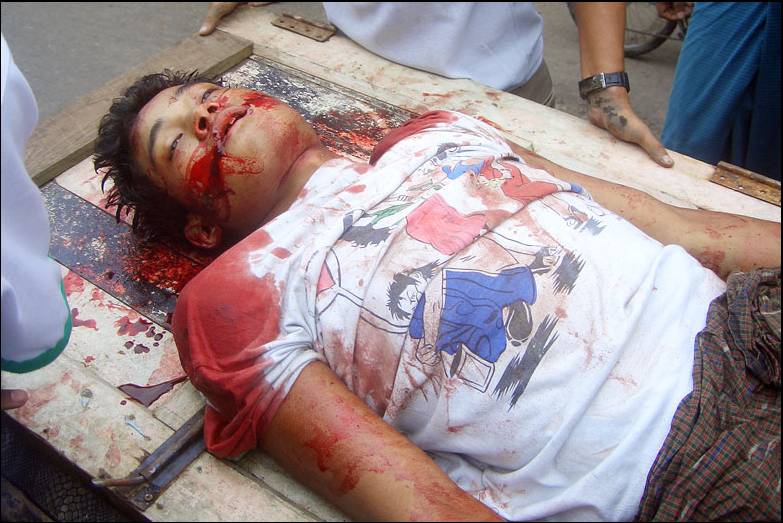 · 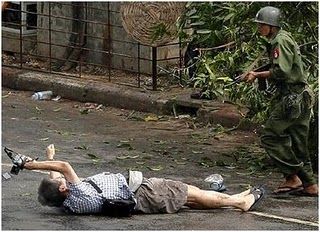 · 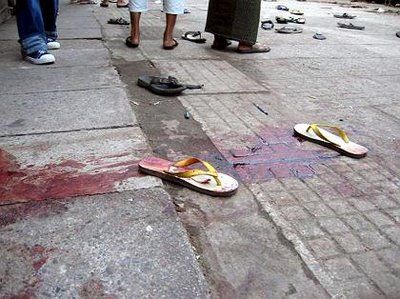 · 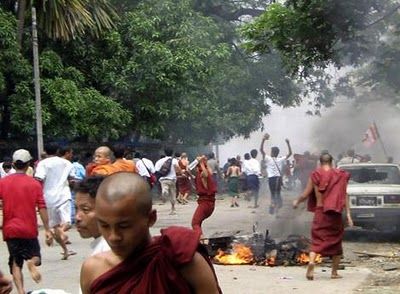 · |