|
Community Forum · Est. 2006
|
#1
●
08-02-2013, 04:36 PM
|
 My Rank: MAJOR Poster Rank:12 Join Date: Jun 2009 Posts: 93,062
Contributions: 239
93,062Posts 137,685Thanked 2,009Quoted 91Mentioned 239Contrib. |
|
The Boiling Technique: A Method for Obtaining Quality Postmortem Impressions
When friction ridge skin is compromised by various destructive influences, it often breaks down into flaccid skin with no discernible friction ridge detail. The boiling technique is a specialized procedure that uses boiling water to recondition friction ridge skin. This reconditioning process rehydrates the skin, enhancing and exposing friction ridge detail. As a result, quality impressions, even from the most distressed bodies, can be recorded and compared to a known antemortem standard or searched through an automated fingerprint or palm-print system to verify or establish identity. Obtaining friction ridge impressions from deceased individuals can be challenging, even for the most skilled forensic examiner. Recovered bodies and remains often exhibit damaged friction ridge skin due to various environmental influences resulting from the deadly event. These influences include: Fauna (animals or insects). Fire (charring). Water (maceration) 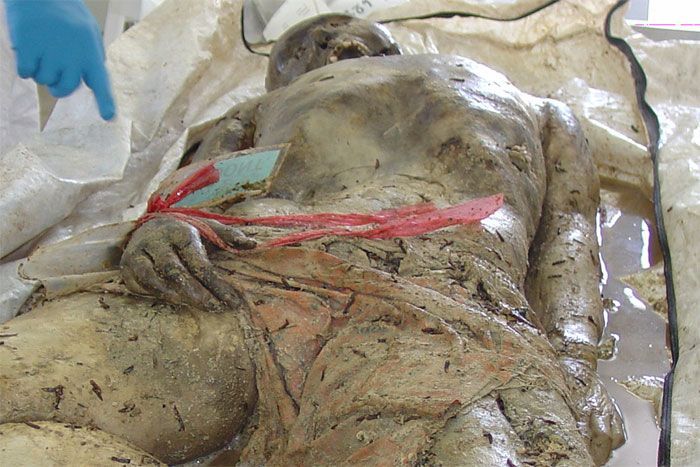 Weather (cold, heat, or humidity) (Miller 1995). When recording friction ridge prints from deceased persons, the examiner must (1) inspect and clean the friction ridge skin to determine whether and what type of damage has occurred, (2) use proper techniques to recondition the friction ridge skin when necessary, and (3) attempt to obtain identifiable postmortem impressions. This report introduces the boiling technique as a means of reconditioning friction ridge skin to obtain quality postmortem prints. The technique works best on damaged friction ridge skin resulting from advanced decomposition and maceration. This damage involves the degeneration of the skin, resulting in the destruction or disintegration of the epidermal (outer) skin, leaving exposed dermal (inner) skin with little or no visible friction ridge detail. Although the boiling technique has been used on epidermal skin, it is most effective in reconditioning the dermal skin, allowing the examiner to utilize friction ridge detail present on the dermis to record identifiable postmortem impressions. Universal safety precautions must be followed when handling all human remains. The following steps detailing the boiling technique should be used to recondition friction ridge skin: Step 1: Visually examine the friction ridge skin on the hands to determine whether and what type of damage may be present: 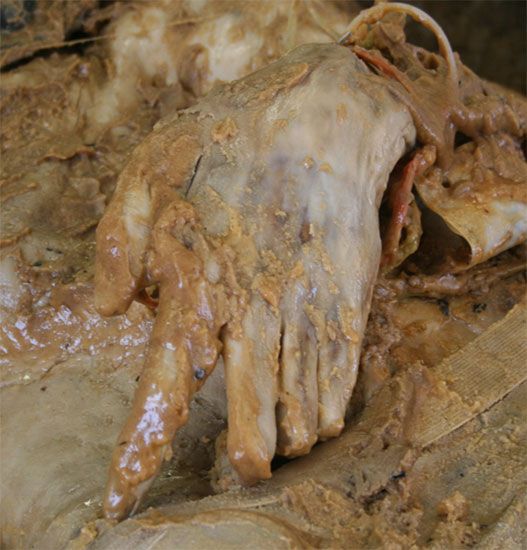 If excessive contamination (dirt, oils, etc.) is present on the skin, remove any loose contaminant from the hands using a sponge and warm, soapy water: 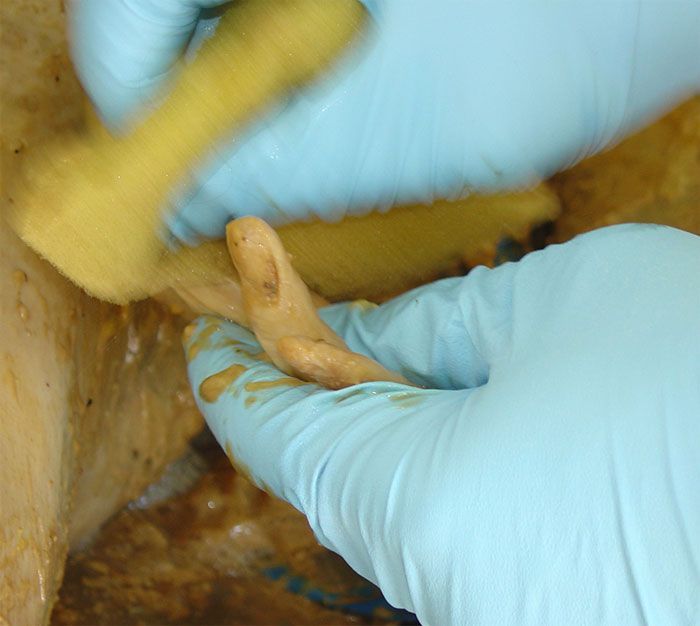 Minor contamination adhering to the hand that cannot be dislodged will be removed later in the procedure. When cleaning the hands, ensure that there is no further damage to the skin, keeping the friction ridge skin intact as much as possible. Decaying and macerated hands often will show no visible friction ridge detail. The absence of this detail should be expected and does not mean the hands are soiled but is often a sign that the examiner is working with dermal skin. Fill an electric hot pot approximately half full with tap water or with enough water to completely submerge the hand into the pot. The use of hot pots large enough to fit a whole hand is recommended to avoid water overflow. After filling the pot with water, plug it in and allow the water to boil. When the water starts to boil, unplug the hot pot and place the hand into the pot of water for 5 to 10 seconds. The authors suggest placing the hand into the boiling water for 5 seconds, then removing it to observe whether friction ridge detail is present. If no detail is visible, place the hand back into the water for another 5 seconds. This process should be repeated no more than three times because prolonged exposure to intense heat will harm the skin. The boiling water reconditions the friction ridge skin and removes any contaminant still present after Step 1. One examiner can perform this procedure by standing behind the head of the deceased, grasping the individual’s wrist, and bending the arm back toward the head as demonstrated: 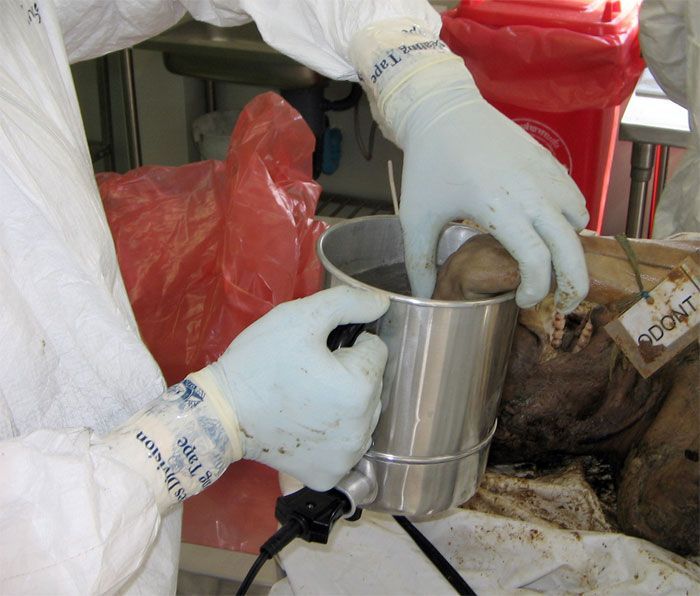 This allows the hand to be easily submerged into the pot of boiling water even when the body exhibits rigor mortis. If the arm is not bent as described, submerging the hand into the boiling water may require two examiners to perform the procedure safely. If the friction ridge skin on the hand contains abrasions or cuts, an alternate form of the procedure should be used. Placing a hand with skin lacerations into boiling water will increase the size of any cuts and may cause further damage to the friction ridge skin, rendering it unprintable. Instead of placing the hand into boiling water, the examiner should soak a sponge in boiling water and squeeze the sponge so the water washes over the friction ridge skin. This will have the same effect as placing the hand into the pot of boiling water but will allow the examiner to have more control over the reconditioning process. After the skin has been exposed to boiling water, it will be taut and should have friction ridges clearly visible on the hands. This observation indicates that the friction ridge skin has been sufficiently reconditioned. Left and right hands, both exposed in the same environmental conditions, from a body recovered after the December 2004 South Asian tsunami. The hands prior to boiling were macerated, exhibiting wrinkles and no visible friction ridge detail (left hand). The hands after boiling were reconditioned, exhibiting visible friction ridge detail and no wrinkles (right hand). 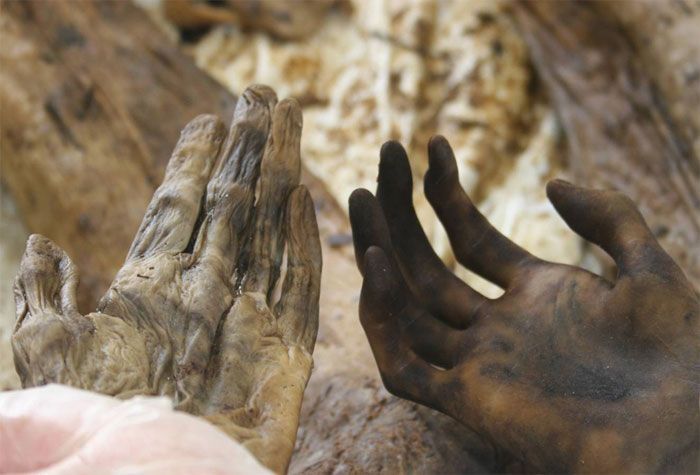 Before attempting to print, dry the friction ridges by using a blow dryer (warm setting) or by pouring isopropyl alcohol on the hands and blotting dry with towels. The examiner may use cloth or paper towels; however, paper towels may leave fiber traces on the hands, which may interfere with printing results. The preferred printing method for recording friction ridge impressions from bodies involves the use of black fingerprint powder and adhesive lifters. To record powder prints, use a fingerprint brush to lightly dust the fingers (including palms when necessary) with black powder. Place each finger on a contrasting adhesive lifter, such as Handiprint (mailing labels also can be used), to record the impressions: 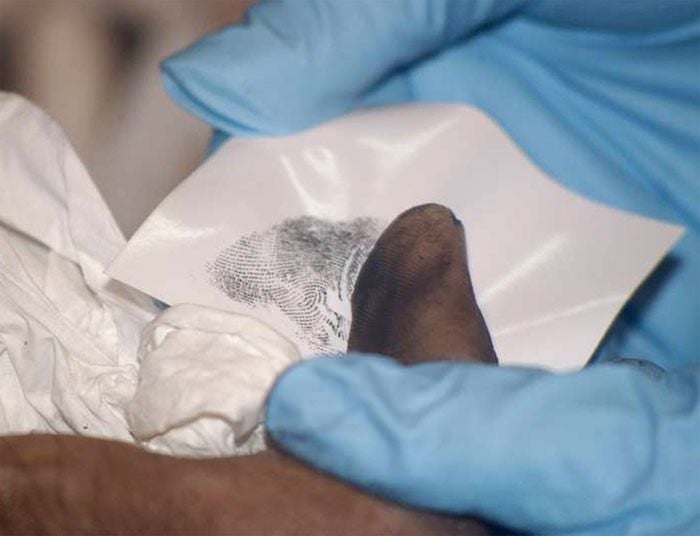 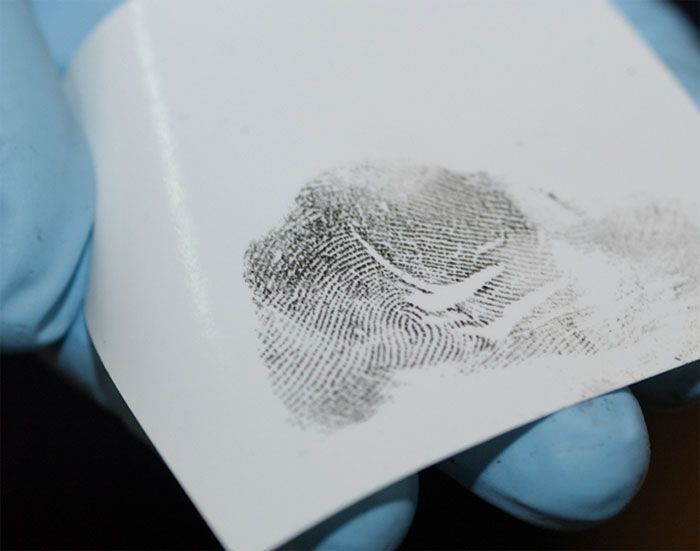 This printing method produces better results than the standard inking procedure and allows the examiner to easily record each finger while it is still attached to the hand. The boiling technique uses boiling water to elicit thermodynamic and osmotic responses that rehydrate the skin, raising friction ridge detail and eliminating body fluids associated with decomposition. This reconditioning process enhances detail present on the hands and exposes ridge detail not visible to the naked eye, allowing the examiner to obtain quality postmortem impressions from deteriorating friction ridge skin. Examiners should be aware that recordings of dermal prints will appear different than epidermal prints under a magnifier; 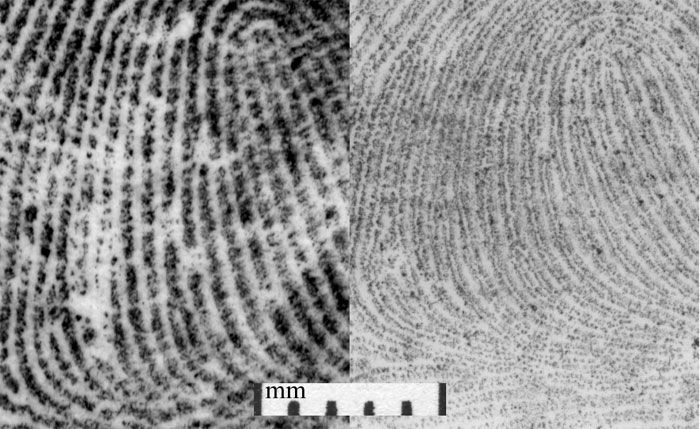 This difference often involves a slight variation in size, with the dermal recordings being smaller than the epidermal prints. In addition, dermal ridges consist of double rows of papillae pegs, which the examiner must follow in dermal impressions to ascertain ridge path for comparison. Palm print recorded without using the boiling technique: 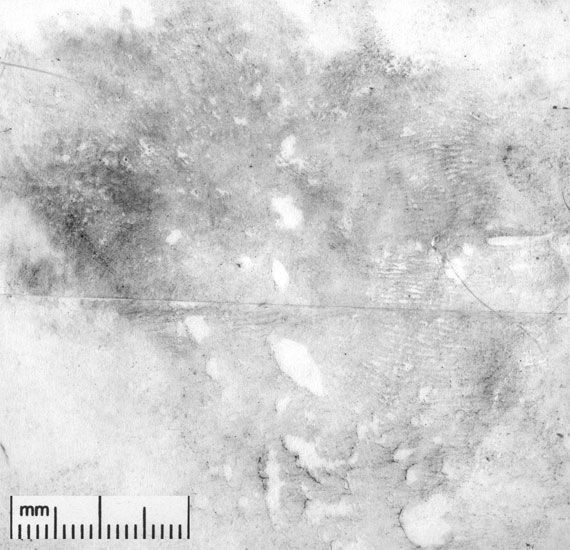 Same palm but recorded after using the boiling technique: 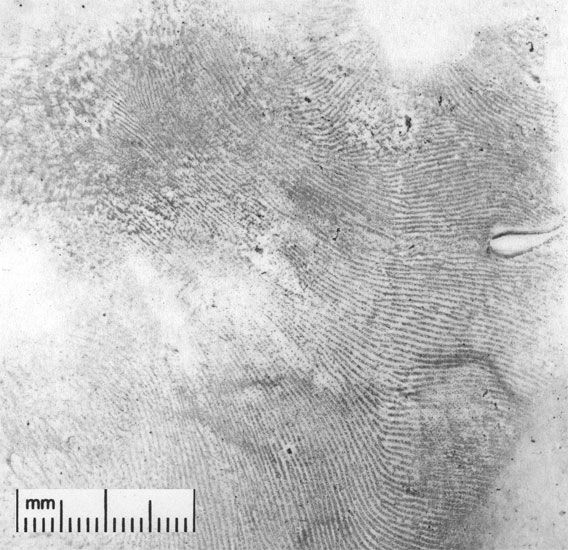 |
|
#5
●
08-02-2013, 05:35 PM
|
 My Rank: LANCE CORPORAL Poster Rank:1827 female Join Date: Jun 2011 Posts: 283 283Posts 994Thanked 39Quoted 1Mentioned 0Contrib. |
|
Re: The Boiling Technique: A Method for Obtaining Quality Postmortem Impressions
I've often seen something similar on CSI but never knew if it was a real process! Great post  |
|
#6
●
08-02-2013, 05:59 PM
|
 ★ Legacy Member ★ Poster Rank:375 I need a nap =| Join Date: Aug 2012 Posts: 3,195
Contributions: 43
3,195Posts 7,010Thanked 901Quoted 42Mentioned 43Contrib. |
|
Re: The Boiling Technique: A Method for Obtaining Quality Postmortem Impressions
I think that dead guy might be trying to get across a message from the other side with that flash card of his...
|
|
#8
●
08-03-2013, 05:54 AM
|
 My Rank: FIRST SERGEANT Poster Rank:426 Male Join Date: Dec 2012 Posts: 2,751
Contributions: 30
2,751Posts 4,318Thanked 387Quoted 6Mentioned 30Contrib. |
|
Re: The Boiling Technique: A Method for Obtaining Quality Postmortem Impressions
Interesting info. They also sometimes take the skin off the hands just gloves, slip their hands inside, ink them up and roll out some prints.
|