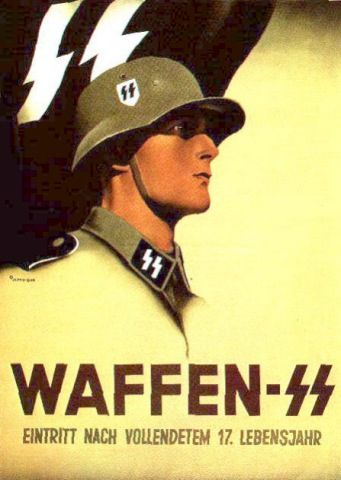
The Waffen-SS (German for "Armed SS", literally "Weapons SS") was the combat arm of the Schutzstaffel ("Protective Squadron") or SS, an organ of the Nazi Party. The Waffen-SS saw action throughout World War II and grew from three regiments to a force of over 38 divisions, which served alongside the regular army, but was never formally part of the Wehrmacht. It was Adolf Hitler's will that the Waffen-SS never be integrated into the Army: they were to remain the armed wing of the Party and were to become an elite police force once the war was over. For this reason, although operational control of the Waffen-SS units on the front line was given to the Army's High Command, in all other respects they remained under the auspices of Reichsführer Heinrich Himmler's SS organization, and behind the lines these units were an instrument of political policy enforcement, including the implementation of the Nazi's "Final Solution" to the "Jewish problem".
Although at first membership in the Waffen-SS was open to "Aryans" only in accord with the racial policies of the Nazi state, in 1940 Hitler authorized the formation of Waffen-SS units composed largely or solely of foreign volunteers and conscripts, and by the end of the war ethnic non-Germans made up approximately 60% of the Waffen-SS.
After the war, in the Nuremberg Trials, the Waffen-SS was condemned as a criminal organisation due to its essential connection to the Party and its involvement in war crimes and the Holocaust. As a result, Waffen-SS veterans were denied many of the rights afforded to other German combat veterans who had served in the Heer (army), Luftwaffe (air force) or Kriegsmarine (navy). The exception made was for Waffen-SS conscripts sworn in after 1943, who were exempted due to their involuntary servitude. In the 1950s and 1960s Waffen-SS veteran groups successfully fought numerous legal battles in the newly-founded West Germany to overturn the Nuremberg ruling and win pension rights for their members.