|
#1
●
10-31-2010, 12:55 PM
| ||||||||
 ♚ Legacy Gold Member ♚ Poster Rank:34 Female Join Date: Nov 2008 Posts: 43,403
Contributions: 204
Mentioned: 95 Post(s) Quoted: 2281 Post(s)
| ||||||||
|
Lightening's Effect On The Body
In the aftermath of a severe mid-summer thunderstorm, a rookie police officer is dispatched to the scene of a dead body. A citizen walking his dog has discovered the corpse of a young adult female in some bushes near a sidewalk. The woman appears to have been beaten and her clothing violently torn. The young officer believes he has encountered his first murder victim … but has he? Each year in the United States, more than 100 people die as a result of being struck by lightning. The initial death scene when viewed by either the uniformed officer or even the most seasoned homicide investigator can be perplexing and well…somewhat “shocking.” Those unfamiliar with lightning deaths are often completely taken aback by the crime scene and may not recognize it for what it is. To the untrained eye, the scene and body can more closely resemble a homicide than an accidental death. A single lightning flash can generate between 100 million and 1 billion volts, while producing between 10,000 and 200,000 amps. The average lightning flash can light a 100 watt bulb for three months. This enormous power can actually propel victims of a lightning strike several feet into the air. They may land on their heads, causing massive trauma that simulates or mimics blunt force trauma. The victims’ eardrums may burst. Blood pours from the ears and nose, creating the illusion that they have suffered a brutal beating. The death scene is further complicated by the intense heat created during a lightning flash. In less than a second, the air surrounding a lightning strike can easily reach temperatures of 50,000°F, which is hotter than the surface of the sun. When the air along the lightning channel is heated to this temperature, it rapidly expands then quickly contracts causing the familiar crack of thunder. The layer of air trapped between the clothing and the body of the victim can also become super-heated. This rapidly expanding, super-heated air can rip, tear and even shred clothing and shoes. In some cases, the clothes and shoes may literally “explode” from the body only to be discovered some distance away in tatters. Victims of lightning strikes are frequently found clad solely in their undergarments. In the case of a female victim, where there is also visible trauma, the initial erroneous assumption may be that a sexual assault has occurred. When individuals are found on or near a roadway in torn and shredded clothing, they are often mistakenly thought to be the victims of a hit and run driver. During a lightning strike, metal materials such as jewelry, pant zippers, belt buckles, brassiere under wire, and rivets on denim jeans may become red hot and burn the flesh of the victim. These distinctive patterned burns will confound the investigator until he or she is able to discover the corresponding metal item that created them. Some metal objects including coins, keys in a pocket or even earrings may become partially melted and display distinctive arc marks. Ferrous metal objects (iron and steel) will likely become magnetized. A victim’s wristwatch may be permanently immobilized -- time eerily frozen by the instant solidification of the internal parts. Lightning strike victims occasionally exhibit entry and exit holes (where the electrical charge has passed through the body), which bear some similarity to gunshot entrance and exit wounds. Those who are unfamiliar with these types of bullet wounds could be easily misled into assuming that the victim has been shot. While the initial contact point in an ordinary electrocution is normally found on the arms or wrists; lightning entry points are generally discovered on the head, neck and shoulders but can be located anywhere on the body. The position of the victim at the time of the strike can affect the location of the entry wound. Exit points may appear on the heels, buttocks or, in males, through the scrotum. A curious phenomenon known as “Litchtenberg figures” is symptomatic of high voltage electrocutions and is particularly prevalent in lightning deaths. Litchtenberg figures are “arborescent” or fern-like injuries of the skin that appear within minutes of the accident and typically fade within 24-36 hours. These red, branching patterns are most evident at time of the autopsy. As with most traumas, several hours in the refrigerated conditions of the morgue will enhance or heighten the visibility of the wound. Litchtenberg figures are named for Georg Litchtenberg, a German physicist who discovered the patterns in 1777 while experimenting with static electricity. To this day, their exact cause, and why they appear on the corpses of lightning victims, is unknown.  · 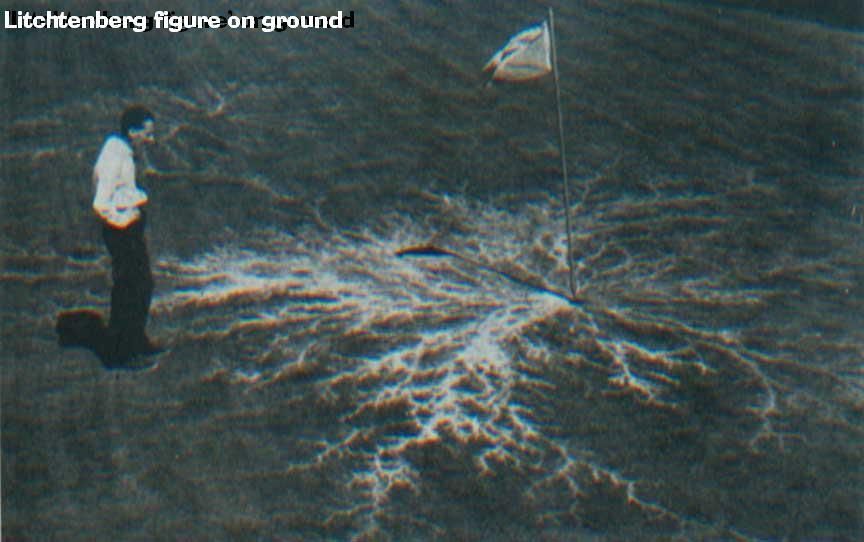 · 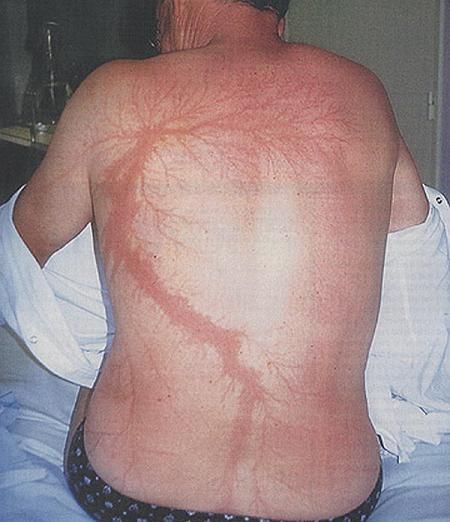 · |
|
#6
●
11-01-2010, 07:50 AM
| ||||||||
 Verräter An Gott Poster Rank:1000 Join Date: Feb 2010 Posts: 690 Mentioned: 0 Post(s) Quoted: 1 Post(s)
| ||||||||
|
Re: Lightening's Effect On The Body
Very interesting,I'd like to see the “Litchtenberg figures” mentioned! Reading this makes me wonder how people survive lightning strikes with sometimes 0 visible damage O_O |
|
#10
●
11-01-2010, 09:56 AM
| ||||||||
| Verräter An Gott Poster Rank:1000 Join Date: Feb 2010 Posts: 690 Mentioned: 0 Post(s) Quoted: 1 Post(s)
| ||||||||
|
Re: Lightening's Effect On The Body
Wow it looks so surreal!The one on the man almost looks like scarification-art  Definitely would never have thought those were the work of lightning if I ever saw em in person! |