|
#1
●
07-09-2014, 05:51 PM
| ||||||||
 ✖ The Antique Christ ✖ Poster Rank:105 Gonzo Punk Join Date: Jan 2009 Posts: 15,488
Contributions: 58
Mentioned: 23 Post(s) Quoted: 2046 Post(s)
| ||||||||
|
Warfarin-induced Skin Necrosis
A 47-year-old woman presented to the emergency department (ED) with a rash developing on her thighs, knees, and left buttock during the previous day, with significant pain throughout the affected areas (Figure 1, Figure 2) . She presented 1 day after discharge from the medical intensive care unit for hypertensive emergency, where she was diagnosed with bilateral lower-extremity deep venous thrombosis; she began receiving intravenous heparin and received an initial dose of warfarin 10 mg. Two days later, warfarin was decreased to 7.5 mg daily; she was discharged 4 days after initiation of therapy, with an international normalized ratio of 4.6. On presentation to the ED, international normalized ratio was 6.9.  Painful skin rash and discoloration appearing over lower extremity over previous day. 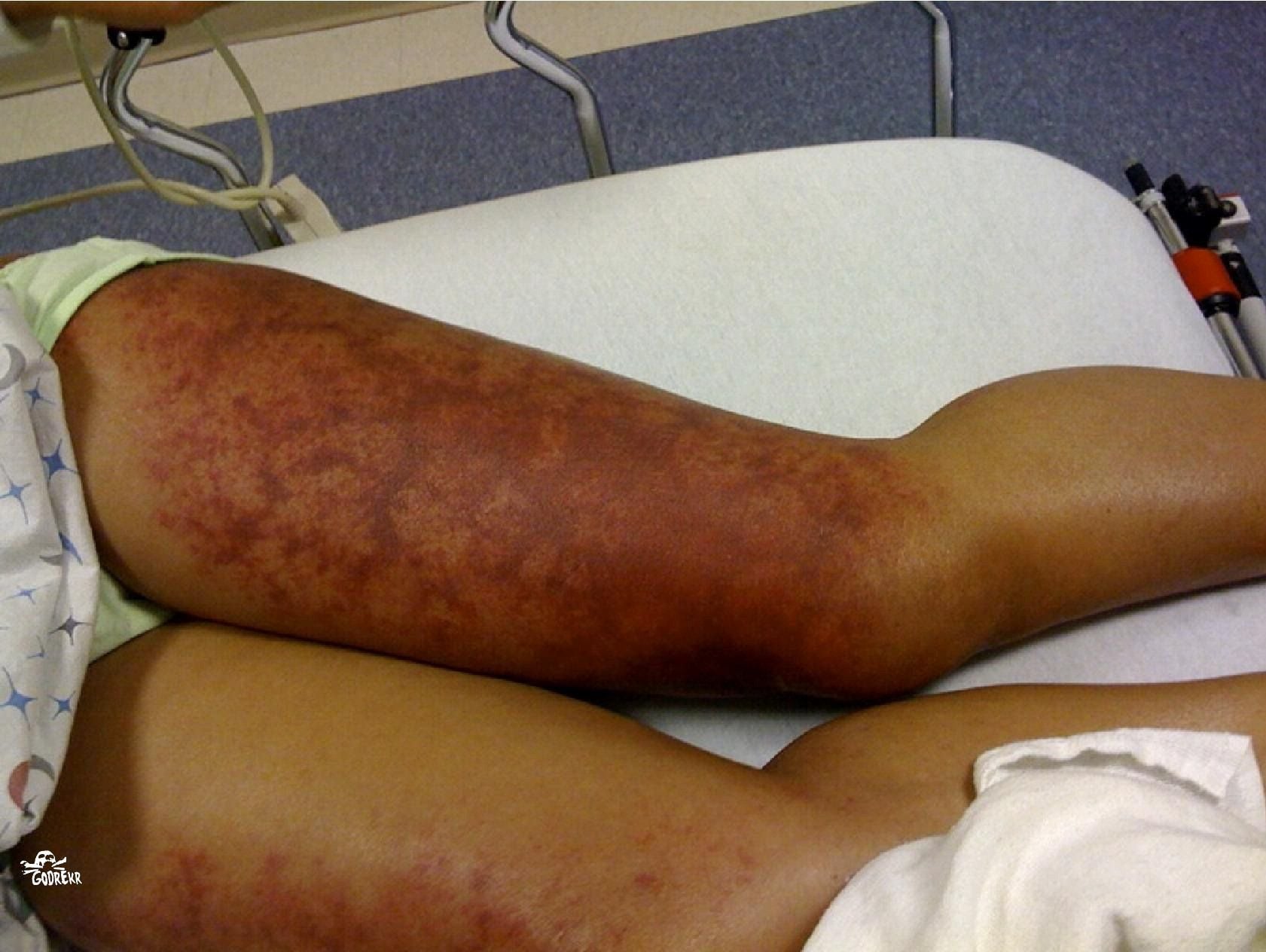 Extension of rash involving both lower extremities. Diagnosis Warfarin-induced skin necrosis Warfarin-induced skin necrosis occurs in 0.01% to 0.1% of patients who begin receiving warfarin therapy. In 93% of cases, symptoms begin 3 to 6 days after initiation of therapy, but cases have been reported as late as 18 months. Diagnosis is made clinically, with rash, usually appearing over fatty areas, most commonly over the breasts, followed by the thighs/buttocks (Figure 1, Figure 2). It is more common in middle-aged, perimenopausal women with venous thromboembolism. Seventy-five percent of patients with warfarin-induced skin necrosis who begin receiving treatment for deep venous thrombosis or pulmonary embolism may have baseline-depleted protein C and S activity caused by consumption by the thrombotic process. Pathophysiology may also involve large loading doses of warfarin, thrombosis of superficial dermal capillaries, and inherited protein C and S deficiencies. Treatment entails discontinuation of warfarin and replenishing vitamin K–dependent factors, accompanied with debridement, grafting, or amputation as needed for skin necrosis. Heparin should be used for long-term treatment of thromboembolic disease. |
|
#2
●
07-09-2014, 06:01 PM
| ||||||||
| ✖ The Antique Christ ✖ Poster Rank:105 Gonzo Punk Join Date: Jan 2009 Posts: 15,488
Contributions: 58
Mentioned: 23 Post(s) Quoted: 2046 Post(s)
| ||||||||
|
Re: Warfarin-induced Skin Necrosis
A 53-year-old man presented with a painful skin lesion on his left lower leg, without trauma. The lesion was initially pruritic and had appeared spontaneously 2 weeks earlier. The patient had been evaluated 1 week earlier and was prescribed clindamycin for presumed cellulitis. Despite this, the lesion continued to grow. The patient had a history of peripheral vascular disease and had resumed receiving warfarin sodium for this 1 week before appearance of the lesion. On physical examination, the patient was afebrile, with a 5-cm-×-7-cm nonraised area of ecchymosis with an erythematous border on the anterior left lower leg .  Ecchymotic leg lesion. Diagnosis Warfarin sodium skin necrosis Necrotic skin lesions develop in 0.01% to 0.1% of patients receiving warfarin sodium, with the majority of cases in women. The lesions most commonly occur on the breast, buttock, or thigh. The majority of cases of warfarin sodium skin necrosis occur within 3 to 6 days of starting therapy, though it may occur after months or even years. The lesions are typically painful, localized, abrupt in onset, and the result of thrombosis of the underlying microvasculature. The first sign is an evanescent flush, followed by petechial hemorrhages that coalesce into a well-demarcated ecchymosis. Within hours, hemorrhagic bullae may form. Warfarin sodium skin necrosis may be confused with necrotizing fasciitis or purpura fulminans. Treatment of warfarin sodium skin necrosis is supportive, with wound care, debridement, and occasionally skin grafting. Warfarin sodium is typically withheld, with the use of heparin as bridging therapy for those patients who require long-term anticoagulation. |
|
#6
●
07-10-2014, 12:59 PM
| ||||||||
 ★ Legacy Member ★ Poster Rank:192 All woman Join Date: Jun 2012 Posts: 7,782 Mentioned: 22 Post(s) Quoted: 1420 Post(s)
| ||||||||
|
Re: Warfarin-induced Skin Necrosis
Never say never, there might come a day when you'd have to be put on blood thinners for something.
|
|
#7
●
07-10-2014, 08:29 PM
| ||||||||
 My Rank: FIRST SERGEANT Poster Rank:406 Male Join Date: Nov 2009 Posts: 2,960 Mentioned: 18 Post(s) Quoted: 447 Post(s)
| ||||||||
|
Re: Warfarin-induced Skin Necrosis
The newest things, replacing Warfarin. Pradaxa "The prescription blood-thinner Pradaxa was considered an upgrade from warfarin because it limited strokes. However, in May 2014 the manufacturer settled more than 4,000 lawsuits for $650 million." http://www.drugwatch.com/pradaxa/ And Xarelto "Bayer's blood thinner Xarelto prevents blood clots and lowers the risk of stroke. The drug may also cause uncontrolled bleeding that can lead to hospitalization and death." http://www.drugwatch.com/xarelto/ Links I posted seem more the type to advocate a lawyer to collect bank.. but the quotes are true. (A blood thinner will cause bleeding? really? ya' don't say?  ) )
|
|
#8
●
07-11-2014, 01:07 AM
| ||||||||
| ★ Legacy Member ★ Poster Rank:192 All woman Join Date: Jun 2012 Posts: 7,782 Mentioned: 22 Post(s) Quoted: 1420 Post(s)
| ||||||||
|
Re: Warfarin-induced Skin Necrosis
I've seen commercials for both of them, and I've also seen commercials for "If you've taken Pradaxa and suffered this that and the other, you may be entitled to compensation". Still, for ridiculously dangerous side effects, nothing beats Humira, or any of those drugs being marketed to treat rheumatoid arthritis and Crohn's disease.
|
|
#9
●
07-11-2014, 02:16 AM
| ||||||||
| My Rank: PRIVATE Poster Rank:9144 Join Date: Feb 2010 Posts: 17 Mentioned: 0 Post(s) Quoted: 3 Post(s)
| ||||||||
|
Re: Warfarin-induced Skin Necrosis
I'm a surg resident, pradaxa and xarelto are the devil. Spontaneous GI bleeds and no reversal agent as of yet. Basically, you need emergent surgery, you're going to bleed. A lot..
|