|
#1
●
04-25-2014, 11:38 PM
| ||||||||
 My Rank: CORPORAL Poster Rank:1451 Join Date: Apr 2010 Posts: 400 Mentioned: 0 Post(s) Quoted: 17 Post(s)
| ||||||||
|
Maxiofacial Tumor *Update*
Girl from Haiti shipped to VA Beach CHKD (Children's Hospital) to receive surgery. I hope the best for her. I stop and think about how today's youth constantly complains about being offended and bullied, yet this girl is 15 and is still going and still hopeful, despite her obvious deformity. Walk a mile in her shoes and see what you have left to bitch about on facebook Original Article By Elizabeth Simpson The Virginian-Pilot © April 26, 2014 The right eye of Hennglise Dorival is a thing of beauty, a deep brown jewel set against the coffee-colored skin of the 15-year-old from Haiti. But some might never notice because of the other side of her face. Four years ago, a tumor began growing in one of her sinus cavities. It’s now the size of two grapefruits, almost as big as her head. It has pushed her left eye out of its socket, so far out that scar tissue has formed over it, making her blind in that eye. The tumor has also forced her nose and mouth to one side, stretching out her features and forcing her to use a straw because she can’t drink from a glass. She can still smile, and does, but the deformity led to stares and bullying from classmates. Last year, she stopped going to school. Even relatives refused to visit, saying they could not bear to set eyes on her. Left on its own, the tumor could grow to the point of cutting off her airway, according to plastic surgeon Dr. William Magee, co-founder of the international charity Operation Smile. That’s why on Monday, Magee and a team of surgeons at Children’s Hospital of The King’s Daughters in Norfolk will remove the tumor, which they believe is benign. They’ll rebuild her cheekbone, eye socket and jaw, and trim some of the stretched-out skin, in hopes of restoring her face to match the right eye that observes the world around her. The operation will take eight to 12 hours and will involve brain, eye, craniofacial and plastic surgery specialists. Through a translator, Hennglise says she is not afraid. She is happy and excited. She looks forward to the day “when I can see my face again,” she said in Haitian Creole. It’s been a long four years. It started as a toothache, according to her mother, *Yvrose Charles, who traveled with Hennglise from their village of Bahon. The 36-year-old single mother of three sells sugar and other food to make a living and stays in a house without electricity. Charles first took Hennglise to the dentist to have a tooth pulled. Soon, a bump formed on her cheek, and that steadily grew to the point where Charles sought medical help. In August 2011, a team of doctors from Boston tried to remove the tumor at a hospital in Milot, Haiti. But it returned, even more aggressively than before. Soon, Hennglise couldn’t see out of her left eye. She became more and more isolated. Neighborhood children wouldn’t come over. Friends and teachers from her school would visit, but only sporadically. Her only playmates were her 11-year-old sister and 14-year-old brother. A humanitarian health worker with Project HOPE learned about Hennglise and tried to find a place for her to have surgery, first in Haiti. The organization worked with Gabrielle Vincent, who works in nearby Cap-Haïtien for a humanitarian organization called Sonje Ayiti, which means “Remember Haiti.” The outreach workers first considered hospitals in Haiti but worried that power outages, lack of intensive care facilities and specialists would make it a risky venture. Then they tried Costa Rica but could not get a visa for the length of time Hennglise would need to be there. Project HOPE reached out to Virginia Beach-based Operation Smile, formed in 1982 to repair facial deformities of children. Operation Smile agreed to sponsor Hennglise as a World Care patient. Most of Operation Smile’s work is done in 60 countries using volunteers and medical professionals they train in partner countries. Patients with conditions too serious to treat in their own countries, though, can become World Care patients and come to the U.S. Working together, the two organizations brought Hennglise, her mother and Vincent, who is serving as the family translator, to Virginia Beach. They traveled two hours from Bahon to Cap-Haitien, then seven more hours to Port-au-Prince. At the airport there, people stared, and several gawkers even took photos of Hennglise without asking permission. ___ While the mother and daughter have grown somewhat used to stares, it was upsetting, and Vincent confronted the picture-takers, telling them to stop. The group then flew to Fort Lauderdale and on to Washington. They took a car service to the Virginia Beach home of Ann Campbell, a pediatric nurse who works for Operation Smile, on April 16. Since then, Hennglise has had MRI scans, X-rays, examinations and bloodwork during long days at CHKD. She’ll arrive at the children’s hospital at 5:30 a.m. Monday. Magee said he believes the tumor is a rare ameloblastoma, which while benign can be very aggressive. It’s the biggest of this type he’s operated on in the upper jaw of a patient. Although the tumor is near the base of the brain, which makes removal tricky, he thinks it’s encapsulated enough to remove without damaging the brain or important vessels and nerves in the area. It’s a risky procedure, like any surgery, but Magee says most of the work can be done Monday. Another operation may be needed to repair her left eye, in hopes of restoring sight. Monday’s surgery will bring many answers. “Time will tell,” Magee said. “It’s hard to predict.” After the surgery, she’ll stay with another host family, Joe and Iris Feduniewicz in Virginia Beach, for at least six weeks. Campbell said Hennglise, while shy, has been good-natured and curious as she explores this new world. Campbell has taken the girl and her travel companions to the Virginia Zoo in Norfolk, to Doumar’s drive-in, and to the ocean, which Charles wanted to see. Campbell said the reaction from others has been one of curiosity, but kindness. Friday, Hennglise sat on a sofa, looking at games and exploring an English-as-a-second-language app on an iPad Campbell loaned her. Asked how she felt about the upcoming surgery, her answer related more to the people who would be helping her than about fear or excitement: “They accept me.” 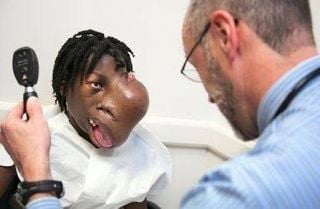 · |
|
#2
●
04-26-2014, 01:03 AM
| ||||||||
 My Rank: FIRST SERGEANT Poster Rank:434 Comrade Join Date: Aug 2013 Posts: 2,636 Mentioned: 14 Post(s) Quoted: 1167 Post(s)
| ||||||||
|
Re: Maxiofacial Tumor *Update*
Holy crap! She looks like a living Piasco painting! I hope she gets all the help she needs. God...I first thought the photo was goofed up.
|
|
#5
●
04-26-2014, 04:55 AM
| ||||||||
 My Rank: FIRST SERGEANT Poster Rank:406 Male Join Date: Nov 2009 Posts: 2,960 Mentioned: 18 Post(s) Quoted: 447 Post(s)
| ||||||||
|
Re: Maxiofacial Tumor *Update*
Couple of girls (and boys) sent to the states with tumors like this, they get repaired free by donation.. Was one a few years back worse than this from Africa.. rebuilt her whole face..  2 hour show of her on Discovery. |
|
#6
●
04-26-2014, 05:19 AM
| ||||||||
 ★ Legacy Member ★ Poster Rank:17 MAN Join Date: Nov 2009 Posts: 61,097 Mentioned: 825 Post(s) Quoted: 37482 Post(s)
| ||||||||
|
Re: Maxiofacial Tumor *Update*
Looks like the elephant girl.  |