|
#1
●
10-13-2014, 06:41 AM
| ||||||||
 My Rank: LANCE CORPORAL Poster Rank:1822 Female Join Date: Nov 2013 Posts: 282 Mentioned: 0 Post(s) Quoted: 105 Post(s)
| ||||||||
|
Cephalic Disorders
Congenital defects of the head are often members of a class of mutation called neural tube defects. Here is a list of some cephalic disorders. Hydroencephaly: We're all familiar with hydrocephalus, wherein cerebrospinal fluid builds up within the dura mater to swell the newborn's head, but the brain itself is not malformed, and thus, is not a neural tube defect. In babies, the fontanelle has yet to fuse, and thus, the head can expand. In children and adults, hydrocephalus is much more dangerous, because the skull is a closed vault. However, it is possible for the two conditions to coexist. While related, hydroencephaly is absence of parts or all of the cerebral hemispheres with cerebrospinal fluid filling the rest. Symptomatically, this condition would be similar to anencephaly. Essentially, the brainstem is the only true function. Such a child would have autonomic functions (i.e. blood pressure, respiration, etc.), some simple emotions and very little, or no, pain.  Severe hydrocephalus, distinct from hydroencephaly.  Transillumination of newborn cranium. See how the head is "see-through" because of the fluid.  Magnetic resonance imaging of a hydroencephalic patient. The black area is fluid. Colpoencephaly: Lengthening of the occipital horns of the lateral ventricles (elongation of the fluid-filled parts of the brain in the back). Causes seizures, and is often comorbid with agenesis of the corpus collosum (joins the two hemispheres).  MRI of colpoencephalic case. Porencephaly: This defect is characterized by cysts or holes in the place of brain matter, as well as encephalomalacia (softening of brain matter).  Cyst replacing part of brain. Schizencephaly: This one is characterized by twisted, chaotic development of the hemispheres (root 'schiz' to mean disordered).  Disorganized formation of brain matter. MRI of schizencephaly. Megalencephaly: This is when the brain is too large, and several of the tissues in the face (and other body areas) grow too much. Sometimes, this manifests as macrocephaly (big head), but that has other causes, as well.  Two children with megalencephaly. Note the enlarged facial bones, in addition to large brains.  Four MRIs of patients with megalencephaly. Microcephaly: Small heads, underdeveloped brains.  Microcephaly. Lissencephaly: Characterized by smooth brain. The gyri of the cerebrum is missing, because the brain didn't fold properly.  Specimen.  MRI comparison between normal brain and lissencephalic brain. Now, we get to the slightly more interesting cases. Anencephaly: Anencephaly is when parts of the brain, skull and scalp fail to form. Anencephalic children suffer very little, the less brain that has developed. 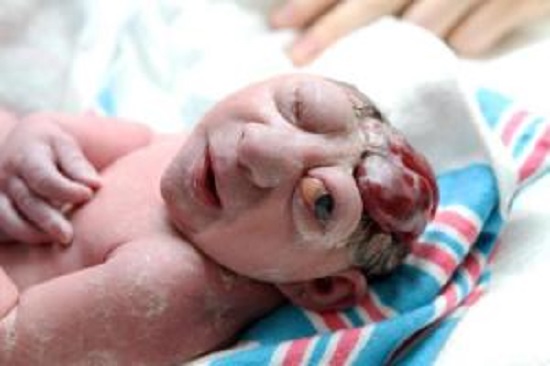 Anencephalic baby named Grayson. His photo was removed from his parents' Facebook wall. Holoprosencephaly: Holoprosencephaly is the occurrence of the failure of the neural hemispheres to separate. In its most severe form, it results in cyclopia. In more moderate forms, it is the cause of hypotelorism (eyes close together). Subsets of holoprosencephaly include ethmoencephaly (small eyes, no nose) and cebocephaly (flattened nose, one nostril, absent or underdeveloped eyes).  Severe. These children usually die within the hour because they do not have a nose or a mouth to breathe. This one also has otocephaly. 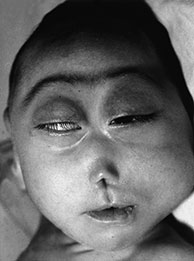 These ones live longer, often. Otocephaly: Absence of lower jaw. Ears misplaced.  Craniosynostosis: Premature fusion of the cranial sutures. Manifests as many different shapes.  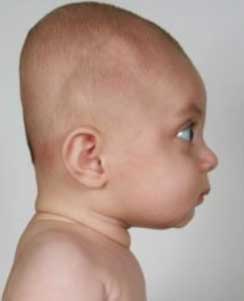 When I lived in China, I got a job teaching, and one of my favorite students had this, brachycephaly.  Oxycephaly, the most severe subset of craniosynostoses. Polycephaly: More than one head, in a manner of speaking. Examples would be craniofacial duplication and a parasitic head twin.  Conjoined twins.  Craniopagus parasiticus. The "head" is a child with no body whose brain is fully-developed. The other child's vascular system cannot usually support the both of them.  Diprosopus (craniofacial duplication). This arises from the same etiology of the conjoined twins above, except this is a single child, with one brain. And, to finish this post... Acephaly: Congenital absence of head.  Entire upper half missing. 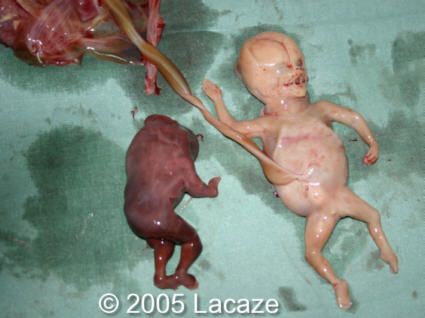 Twin reversed arterial perfusion syndrome (TRAPS) can occur in twin pregnancies, whereby one twin fails to form a brain, or sometimes a heart (or both), and the other is formed normally. They share the same placenta. This was my very first post (the other two I made were repeats, so they didn't count). I hope you all enjoy. |
|
#2
●
10-13-2014, 08:14 AM
| ||||||||
 ✝Mudderator from Hell✝ Poster Rank:10 e-mail Join Date: Oct 2006 Posts: 95,074
Contributions: 817
Mentioned: 472 Post(s) Quoted: 10095 Post(s)
| ||||||||
|
Re: Cephalic Disorders
Acephaly  that's some sad shit all over. |
|
#3
●
10-13-2014, 09:26 AM
| ||||||||
| Your Mothers Nightmare... Poster Rank:411 Male Join Date: Oct 2012 Posts: 2,856 Mentioned: 4 Post(s) Quoted: 1036 Post(s)
| ||||||||
|
Re: Cephalic Disorders
There is something uncomfortable about seeing infants suffer...  |
|
#6
●
10-13-2014, 01:42 PM
| ||||||||
| My Rank: LANCE CORPORAL Poster Rank:1822 Female Join Date: Nov 2013 Posts: 282 Mentioned: 0 Post(s) Quoted: 105 Post(s)
| ||||||||
|
Re: Cephalic Disorders
Definitely. But you'd be glad to know that most of them have minimal suffering because of a lack of awareness and absence of many pain pathways. Still a shame, though. Take your folate, people.
|
|
#7
●
10-13-2014, 03:35 PM
| ||||||||
 ★ Legacy Member ★ Poster Rank:192 All woman Join Date: Jun 2012 Posts: 7,782 Mentioned: 22 Post(s) Quoted: 1420 Post(s)
| ||||||||
|
Re: Cephalic Disorders
Damn, I think we've had various posts over the years demonstrating the cephalic disorders, but I think this is the first showing one with a completely absent head!
|
|
#8
●
10-13-2014, 04:42 PM
| ||||||||
| So Fucking Banned Poster Rank:556 Join Date: Jul 2014 Posts: 1,762
Contributions: 123
Mentioned: 4 Post(s) Quoted: 722 Post(s)
| ||||||||
|
Re: Cephalic Disorders
extremely disturbing for me, but ultra awesome post. very interesting !!!  |
|
#9
●
10-13-2014, 06:19 PM
| ||||||||
 ★The Queen★ Poster Rank:67 Female Join Date: Jun 2011 Posts: 23,498
Contributions: 120
Mentioned: 95 Post(s) Quoted: 3083 Post(s)
| ||||||||
|
Re: Cephalic Disorders
This is a post I had in Current News about a local couple who chose to carry their anencephalic baby to term. http://www.documentingreality.com/fo...update-147412/ |