|
#1
●
11-27-2009, 07:37 AM
| ||||||||
 My Rank: LANCE CORPORAL Poster Rank:1928 Join Date: Nov 2009 Posts: 262 Mentioned: 0 Post(s) Quoted: 8 Post(s)
| ||||||||
|
Moro Crater Massacre (aka Battle of Mount Dajo) Pictures
In December 1898, after signing a peace treaty with Spain, the United States bought the Philippines for $20 million. The Filipinos, however, didn’t want to be bought, and they waged a war against their new occupiers. After three and a half years of fighting, on July 4, 1902, President Theodore Roosevelt declared the war over. But he may have been savvier than his successor 101 years later, because when he proclaimed that “the insurrection against the authority and sovereignty of the United States is now at an end, and peace has been established in all parts of the archipelago,” he was sure to add “except in the country inhabited by the Moro tribes, to which this proclamation does not apply.” While United States administrators began the business of nation-building in Manila, more than 200 miles south, a group the Spanish had never been able to subdue was proving scarcely more amenable to American control. In the islands of the Sulu archipelago, the invading Spanish had found tribes of Muslims in the 1500s. They called them Moros, after the Moors they had just finished expelling from northern Africa. For 300 years, the Moros resisted Spanish efforts to convert them to Christianity. Spain, hesitant to commit the arms and men necessary to pacify the tribes, left them alone. When the Americans arrived on their civilizing mission in 1898, they found a population of 300,000—less than 5 percent of the country’s total, but controlling 40 percent of its land—who seemed even more backward than the rest of the “savages” in the Philippines and completely untouched by Spanish society. New to imperialism, the United States in its very first effort was up against a group of people it knew nothing about. Busy with the war in the northern islands, the U.S. initially adopted the Spanish stance toward the Moros, avoiding any actions that might inflame more insurrection. After Roosevelt declared the war over, though, American officers had to figure out some way to integrate the Moros into the colonial government. In 1903 policy makers created the Moro Province, comprising southern Mindanao and the Sulu islands. Given the perceived backwardness of the Moros, this province was set up differently from the others. Not only would the natives have less say in their own government, but in the interests of keeping order, all civil posts would be staffed by U.S. Army officers. Their job would be to train the Moros in civilization and democracy, preparing them to take part someday in the colonial government. The Army had its work cut out for it. Moro Province was four times larger than the next biggest province and, with only narrow dirt trails through the jungle, largely inaccessible. Hundreds of miles from Manila, the Army was given “a very large measure of discretion in dealing with the Moros and in preserving as far as possible, consistent with the fundamental act, the customs of the Moros, the authority of the datus [clan leaders], and a system of justice in which Moros could take part.” In short, the Army was given free reign. Unlike the Spanish, the Americans were not concerned with converting the Moros. They outlawed some practices they found repugnant—slavery, piracy, and the harsh punishments of the traditional legal code—and left the rest up to the datus. But many Moros refused to trade three centuries of Spanish subjugation for violations of their liberty by some new horde of Western colonizers. They resisted, raiding American encampments and organizing armed ambushes. The Americans, none of whom spoke any of the 13 Moro languages, did their best to make the Moros recognize the Commission’s authority, usually by force. As Maj. Gen. Leonard Wood, the first governor of the Moro Province, said, “Firmness and the prompt application of discipline measures will maintain order, prevent loss of life and property and permit good government and prosperity among these people . . . lack of firmness will result in a carnival of crime and an absolute contempt for all authority in this region.” Wood had been appointed in 1903 by President Theodore Roosevelt, with whom he had founded the Rough Riders back in 1898. His standing orders were to eradicate Moro resistance “wherever found.” Eager to prove that the province could be pacified, he showed a willingness to use what he called “stern military power.” His men torched homes and crops and killed hundreds of Moros, including women and children brought into fortified positions by their male relatives for protection. To subdue one group, Wood later wrote, he “decided to go thoroughly over the whole valley, destroying all warlike supplies, and dispersing and destroying every hostile force, and also to destroy every cota [fort] where there [was] the slightest resistance.” He forced most Moros to submit by these methods, but some, incensed by the destruction of property and death of women and children, fought even harder. The Moros’ bravery and skill made them formidable opponents. Americans were particularly alarmed when they heard about juramentado, the Moro belief that dying while killing Christians ensured one a place in paradise. This, the Americans thought, explained the Moros’ tenacity, their tendency to keep attacking even after being seriously wounded. They seemed not to fear death. Even so, they were never in much danger of overthrowing the American rule. Contrary to their Spanish designation, the Moros were not one uniform group but a disparate band of feuding tribes. American officers capitalized on their disunity, paying some datus monthly salaries to cooperate against rival clans. The Americans also learned from Spain’s mistakes. The Army avoided interfering in the tribes’ religion whenever possible, to prevent them from unifying around Islam. The Americans also organized forces of Christian Filipinos—who didn’t get along with the Moros—and cooperative Moros into a constabulary force. As Secretary of War William Taft said, “It has never been difficult to enlist them in our service to fight against their own kind, probably owing to the number of factions in the islands.” Even after three years of Wood’s brand of persuasion, though, the leader of the tribes on Jolo island refused to recognize U.S. sovereignty. In early 1906 hundreds of Jolo Moros, fearing American retribution, fled to the 15-acre wooded crater of Bud Dajo, an extinct volcano where they believed the spirits of their ancestors would protect them. A delegation of datus sent in the first days of March by Col. Hugh Scott, the garrison commander at Jolo City, failed to persuade them to depart. In the meantime, Wood arrived in Jolo with two infantry companies and a naval detachment. On the morning of March 5, he took 800 men to the base of Bud Dajo, and after another aborted attempt at negotiation, he positioned his forces for an attack. Wood later wrote, “It is impossible to conceive of a stronger natural position than that attacked,” but it ended up more like shooting fish in a barrel. Of 600 Moros, 150 had guns; the rest were armed with only spears or bolos. The Americans, joined by the Filipino constabulary force, chased retreating Moros over lava ridges up three narrow trails on the steep, densely wooded slopes of the 2,100-foot volcano. “At the top were 600 fanatical Moros armed with rifles and knives and supported by native artillery,” the New York Times reported, although the “native artillery” seems to have been a shower of rocks and jagged lava pieces hurled at the Americans. The Americans rigged a block and tackle to hoist their artillery up the last 300 feet, and, as the Moros fled over the lip, the Americans opened a barrage into the 50-foot-deep crater. With orders from Wood to “kill or capture the six hundred,” the American forces descended into the crater in an ever-shrinking circle. Wood wrote, “The action resulted in the extinction of a band of outlaws.” Fifteen Americans were killed in the fighting; all six hundred Moros died. The first reports to reach America, four days later, met with cheers. The Washington Post called the battle a “Thrilling Story of American Valor.” Roosevelt congratulated Wood on “the brilliant feat of arms wherein you . . . so well upheld the honor of the American flag.” But by the next morning, the casualty numbers began to look fishy. “Women and Children Killed in Moro Battle,” ran a New York Times headline, while a now-subdued Post reported, “No Moro Survived—Battle on Mount Dajo Was One of Extermination-Criticism of Gen. Wood—Siege of Crater, It Is Declared, Would Have Forced Surrender.” Taft cabled Wood asking for an explanation. Wood replied that “a considerable number of women and children were killed” because they “wore trousers and were dressed and armed much like the men, and charged with them. The children were in many cases used by the men as shields while charging troops.” Wood admitted that “these incidents are much to be regretted, but it must be understood that the Moros, one and all, were fighting not only as enemies but religious fanatics.” Taft sent Wood’s message to the President, with an addendum that “the well-known treachery of the Mohammedan” and “the fanatical and savage desire that their women and children should perish with them” made the killing “unavoidable.” Roosevelt found the explanation “entirely satisfactory.” The Democrats in Congress were not so easily convinced. Calling the battle “a great blot on the American name,” and “the most revolting exhibition of ‘valor’ our soldiers ever gave,” William Jones of Virginia denounced both Wood and Roosevelt to hearty Democratic applause on the House floor. He was followed by the minority leader, John Sharp Williams, who to more applause read “The Charge of the Wood Brigade.” (“Chased them from everywhere,/ Chased them all onward,/ Into the crater of death,/ Drove them—six hundred!/’Forward, the Wood Brigade;/ Spare not a one,’ he said./ ‘Shoot all six hundred!’”) Perhaps the most vitriolic response came, not surprisingly, from the highest-profile member of the Anti-Imperialist League: Mark Twain. That week, he wrote: “to pen six hundred helpless and weaponless savages in a hole like rats in a trap and massacre them in detail during a stretch of a day and a half, from a safe position on the heights above, was no brilliant feat of arms. ’Slaughter’ is a good word.” Amid the criticism, a new explanation seemed to come out of Manila every day. On March 18 the Army reported that some women and children had been saved, and then that those who were killed had died in the long-range shelling. (“Get together and agree upon a story,” suggested the editorialists at the Post.) With the President behind Wood, though, dissenters were shouting into the wind. Relations eventually stabilized between the Moros and the Americans, but only because Wood, promoted in 1906 to command the Division of the Philippines, was replaced by Brig. Gen. Tasker Bliss and then Brig. Gen. John J. Pershing, who both took a more diplomatic approach. Only when Pershing ordered the Moros to disarm did fighting flare up again, culminating in another rout—500 Moros killed, including 50 women and children—in another volcano. In 1913, the Province’s government was turned over to civilians, and overt hostilities stopped, although the Moros would go on to rebel against the Marcos regime. If there is a lesson in all this sad tale, it is a by now familiar one, that war is absolutely always unpredictable and uncontrollable—and war in a distant and unfamiliar place with a genuinely foreign culture may be the most unpredictable and uncontrollable of all. In 1906, the Taosugs were quite disenchanted with their Sultan and prominent datus. They hated the Americans and their man-made laws. When the US military patrols come to collect tax, they ran for cover. Bud (Mt.) Dajo is a lava cone of an extinct volcano at an altitude of 2100 feet. The crater in the summit has a circumference of 1800 yards. The crater was a natural fortress; hence, a favorite shelter or hide-away for Moro "tax evaders", who were mostly poor people. Soon families were staying in the crater. By March 1906, more than a thousand Moros -- men, women and children, made their way to the crater. Gen. Wood would not have any of their nonsense. He ordered his officers to gather in Jolo. Col. Duncan with about 800 officers and men from the 6th and 19th infantry, the 4th Cavalry, the 28th Artillery Battery, the Sulu Constabulary and sailors from the gunboat Pampanga, with mountain guns, rifles, bayonets, fast-firing pistols and grenades launched the assault on March 5. The thousand or so Moro men, women and children were armed with kris, barungs and spears. By March 7, the smoke of battle has cleared. The people in the crater fought bravely, to the last Moro. There were no survivors. The Americans lost two dozen men and some seventy wounded. It was a complete massacre. Gen. Wood reported to the Secretary of War the success of his mission -- the Moros losing 600 men, women and children while the US lost only 18 men and 52 wounded. President Roosevelt immediately sent a note to Wood: "I congratulate you and the officers and men of your command upon the brave feat of arms wherein you and they so well upheld the honor of the American flag." But there were protests. The New Orleans Times-Democrat called the event "a frightful atrocity". The Boston Post exclaimed: "..if this is imperial expansion….heaven save us from anymore!" The Democrats called the affair a "horrible massacre" and "an assassination." Vic Hurley, an American who stayed in Mindanao for seven years and wrote a book on the Moros in 1936(5), tells a more detailed account of the encounter, apparently based on "acquaintances of elders of many Moro barrios" and various histories of the Philippines then extant. He writes: A large band of Moros fortified Bud Dajo and defied the authorities to subject them to any law. The American garrison at Jolo was reinforced by the addition of two battalions of infantry and preparations were made for a decisive assault on the Moros. The battle began on March 5. Mountain guns were hauled into position and forty rounds of shrapnel were fired into the crater to warn the Moros to remove their women and children. Three columns of American troops moved up Bud Dajo from different sides and encountered fierce resistance from barricades blocking the approach to the crater. When overwhelmed with heavy bombardment and sniper fire, the Moros "sallied forth into the open with kris and spear." On the second day, in the approach taken by a certain Major Bundy, "(t)wo hundred Mohammedans died here before the quick-firing guns and the rifles of the attackers." On the third day, After the heavy bombardment had accomplished its purpose, the American troops charged the crater with fixed bayonets. The few Moros left alive made hand grenades from sea shells filled with black powder and fought desperately to stem the charge. But the straggling krismen were no match for the tide of bayonets that overwhelmed them and hardly a man survived that last bloody assault. After the engagement the crater was a shambles. Moros were piled five deep in the trenches where they had been mowed down by the artillery and rifle fire. The American attack had been supported by two quick firing guns from the gunboat Pampanga and examination of the dead showed that many of the Moros had as many as fifty wounds. Of the 1,000 Moros who opened the battle two days previously, only six men survived the carnage. Hurley's judgement of the event is significant. He states: By no stretch of the imagination could Bud Dajo be termed a "battle." Certainly the engaging of 1000 Moros armed with krises, spears and a few rifles by a force of 800 Americans armed with every modern weapon was not a matter for publicity. The American troops stormed a high mountain peak crowned by fortifications to kill 1000 Moros with a loss to themselves of twenty one killed and seventy three wounded! The casualty reflects the unequal nature of the battle. The Moros had broken the law and some punishment was necessary if America was to maintain her prestige in the East, but opinion is overwhelming in the belief that there was unnecessary bloodshed at Bud Dajo. Two very interesting links, related to this massacre: http://jibrael.blogspot.com/2007/10/...-bud-dajo.html http://www.oovrag.com/essays/essay2003b-1.shtml  · 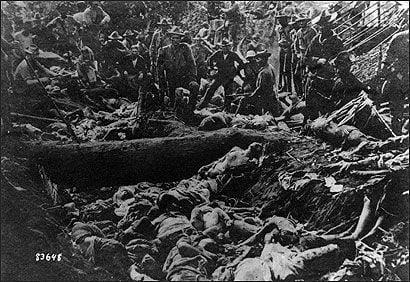 ·  · 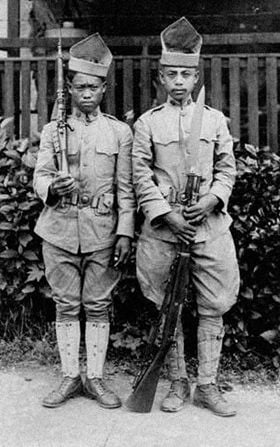 · 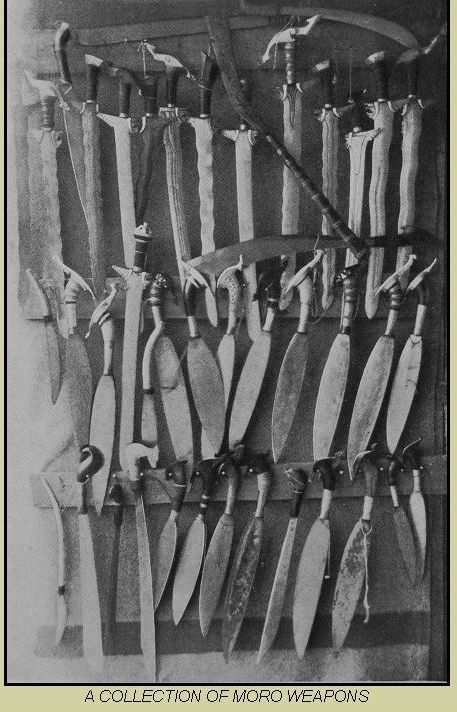 · 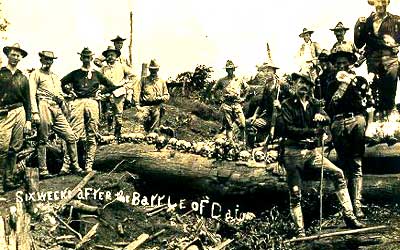 · 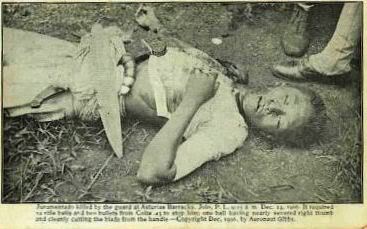 · 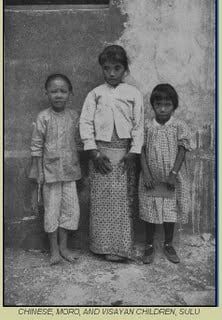 · |
|
#3
●
11-27-2009, 08:10 AM
| ||||||||
| My Rank: LANCE CORPORAL Poster Rank:1928 Join Date: Nov 2009 Posts: 262 Mentioned: 0 Post(s) Quoted: 8 Post(s)
| ||||||||
|
Re: Moro Crater Massacre (aka Battle of Mount Dajo) Pictures
Who's interested in that??? - Nobody's forcing you to do.
|
|
#4
●
11-28-2009, 06:29 AM
| ||||||||
 I POOP ON U Poster Rank:126 Female Join Date: Oct 2009 Posts: 12,645
Contributions: 3
Mentioned: 12 Post(s) Quoted: 1263 Post(s)
| ||||||||
|
Re: Moro Crater Massacre (aka Battle of Mount Dajo) Pictures
Thanks so much for this post! I really enjoyed it. Mark Twain was a founder of the American Anti-Imperialist League, established to battle the American annexation of the Philippines. This is a portion of what he had to say about the Moro Massacre: "There, with six hundred engaged on each side, we lost fifteen men killed outright, and we had thirty-two wounded-counting that nose and that elbow. The enemy numbered six hundred -- including women and children -- and we abolished them utterly, leaving not even a baby alive to cry for its dead mother. This is incomparably the greatest victory that was ever achieved by the Christian soldiers of the United States." |
|
#5
●
11-29-2009, 02:49 PM
| ||||||||
 My Rank: PRIVATE Poster Rank:6481 Join Date: Jul 2009 Posts: 33 Mentioned: 0 Post(s) Quoted: 2 Post(s)
| ||||||||
|
Re: Moro Crater Massacre (aka Battle of Mount Dajo) Pictures
Blackdaddy say, days looks just like niggras. lets us hopes dat da u.s. army dont waste no more bullets den da job done take. tru dat
|
|
#8
●
11-29-2009, 08:13 PM
| ||||||||
 My Rank: SERGEANT Poster Rank:1194 Male Join Date: Oct 2009 Posts: 527 Mentioned: 0 Post(s) Quoted: 6 Post(s)
| ||||||||
|
Re: Moro Crater Massacre (aka Battle of Mount Dajo) Pictures
wow long as post but nice i liked it and learned something at the same time i feel smarter,ima brag to my friend lol
|