|
#1
●
08-01-2013, 04:10 PM
| ||||||||
 ♚ Legacy Gold Member ♚ Poster Rank:34 Female Join Date: Nov 2008 Posts: 43,403
Contributions: 204
Mentioned: 95 Post(s) Quoted: 2281 Post(s)
| ||||||||
|
An Indian Exhumation
The word Exhumation comes from Latin words ex meaning "out of", and humus, meaning "ground". Thus the word literally means "out of ground". It means authorized digging out the coffin of a dead person from his grave, in order to establish his cause of death, or to decide upon some other relevant fact, such as the person's identity. 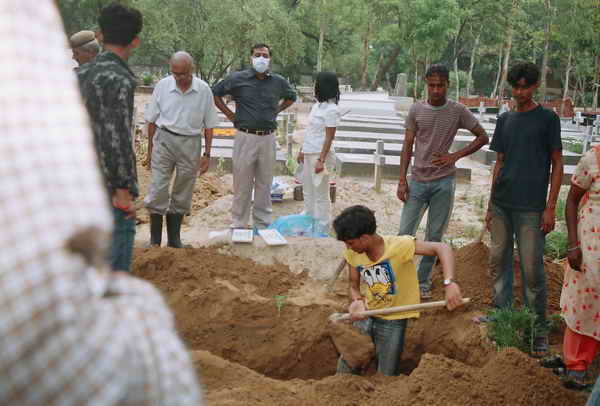 An exhumation under progress. A board of forensic specialists is supervising the operations 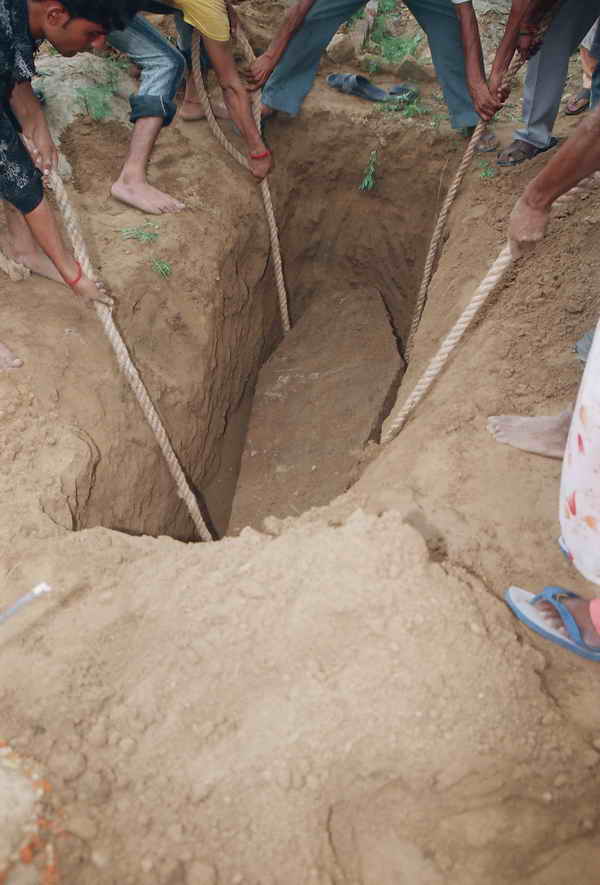 Pulling the casket out of the grave  Collecting soil from beneath the casket, after it has been taken out 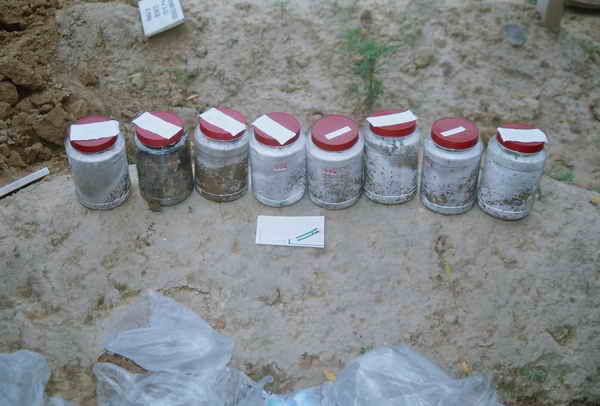 Eight jars with soil from top, bottom, front, back, left and right side of the casket. Two jars contain soil from about 25 yards away from the grave This is very necessary in some poisoning cases. One example would make the situation clear. If the person is alleged to have been killed by administration of arsenic, and arsenic is found in the body after exhumation, the defense may take the plea that the arsenic found in the body leached in the body from the surrounding soil. It is well known that soil may contain traces of arsenic. An examination of soil recovered from around the grave would reveal whether there was arsenic in the surrounding soil or not. Even if arsenic is present in the surrounding soil, it does not necessarily mean that the defense would become very strong. If the concentration of arsenic found in the body is more than that found in the soil, it clearly indicates that arsenic could not have passively diffused from the soil to the body. 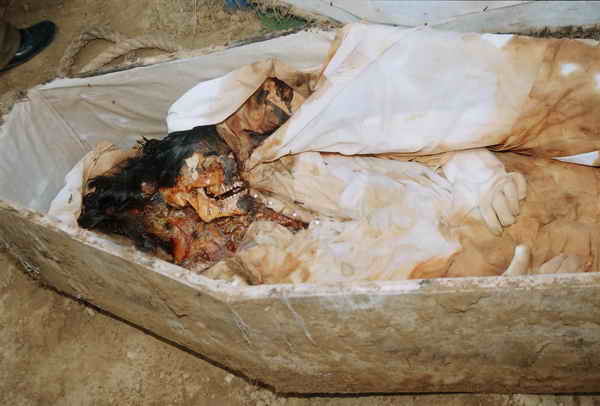 Lid of the casket is opened to let gases escape and to make a preliminary examination. Examination-in-situ It is customary to open the lid of the coffin once it is brought out of the grave. It not only allows foul gases to escape in open air (rather than be released in the mortuary later), but also enables the pathologist to make a quick examination of the remains. When the coffin is opened, the medical officer in-charge should first of all examine the body in situ, and preferably take photographs. Bones may be friable, and may break during subsequent handling, so in situ examination is often quite helpful. Post-mortem After an in situ examination is done, the body is transferred to the mortuary for a post-mortem. If there are worms or other insects over the body, it might be tempting to sprinkle insecticides over the body, but it should never be done, as it might interfere later with the determination of poison in the body. If the smell is too offensive, it is advisable to wear a gauze mask dipped in a solution of potassium permanganate. Samples of viscera should be taken for detection of poisons. Many poisons, such as metallic poisons remain in the body for several years. Hair, nails and bones such as femur may also reveal metallic poisons like arsenic. Exhumed Bones If only bones are recovered in exhumation (as in very old graves), the bones must be boiled before examination. Maceration by this process may reveal diagnosis not available otherwise by ordinary examination. Maceration by this process is recommended not only in medico-legal autopsies, but also in historical material. 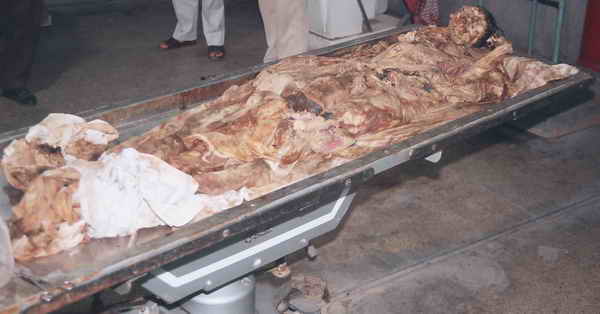 Remains lying in the mortuary just prior to postmortem examination |
|
#2
●
08-01-2013, 04:47 PM
| ||||||||
 ✖ The Antique Christ ✖ Poster Rank:105 Gonzo Punk Join Date: Jan 2009 Posts: 15,488
Contributions: 58
Mentioned: 23 Post(s) Quoted: 2046 Post(s)
| ||||||||
|
Re: An Indian Exhumation
Humus is also the perfect addition to your snack or meal.  |
|
#3
●
08-01-2013, 04:48 PM
| ||||||||
| ♚ Legacy Gold Member ♚ Poster Rank:34 Female Join Date: Nov 2008 Posts: 43,403
Contributions: 204
Mentioned: 95 Post(s) Quoted: 2281 Post(s)
| ||||||||
|
Re: An Indian Exhumation
Love the professional attire - Donald Duck t-shirt and bare feet  |