Auroras are created when charged solar particles slam into Earth's magnetic field and get funneled poleward. The particles collide with molecules in our atmosphere, transferring energy and making the air molecules glow.
Late last week an active region of giant sunspots—each many times larger than Earth—rotated into view.
"The active section of the sun right now is really a pretty big region, and anyone who still has whatever they watched the recent transit of Venus with would easily [spot the active area]—particularly the sunspots," said Mike Solontoi, an astronomer at the Adler Planetarium in Chicago.
Space scientists believe the sunspots flung at least two clouds of charged particles—called coronal mass ejections, or CMEs—toward Earth, setting off the intense auroral display. Northern lights were seen rippling down from the Arctic and dancing into Canada and the United States, with sightings as far south as Wisconsin, Minnesota, and Maryland.
When solar particles reach Earth, they're directed toward both Poles, simultaneously creating the aurora australis in the Southern Hemisphere and the aurora borealis in the North.
In general, auroras have been on an uptick lately, as the sun approaches what's known as solar maximum—a peak in activity during our star's roughly 11-year cycle of magnetic fluctuations.
"This would rank as the best display of this current solar cycle for us down here," photographer Stephen Voss said in an email to National Geographic News.
While this weekend's solar storms put on a great display in more southerly latitudes than usual, the geomagnetic disturbances weren't intense enough to cause more than sporadic radio blackouts in high-latitude regions.
As the sun's activity ramps up, though, scientists caution that more intense solar storms could require airlines to reroute polar flights and might cause major disturbances to ground- and space-based equipment. (See "As Sun Storms Ramp Up, Electric Grid Braces for Impact.")
"In addition to exciting atmospheric gasses and making the auroras, CMEs can also dump enough energy into the electronics that we depend on for so many tasks these days that assets like satellites in space and power grids on the ground are vulnerable to disruption by a particularly strong and well-aimed CME," Adler's Solontoi said.
"By monitoring and studying the sun and its CMEs, we can assess the danger to our instruments and plan accordingly."
The colors in auroras depend on which atmospheric gases get hit by solar particles. The most common auroras are green—created by oxygen atoms being struck more than 60 miles (96 kilometers) above Earth's surface.
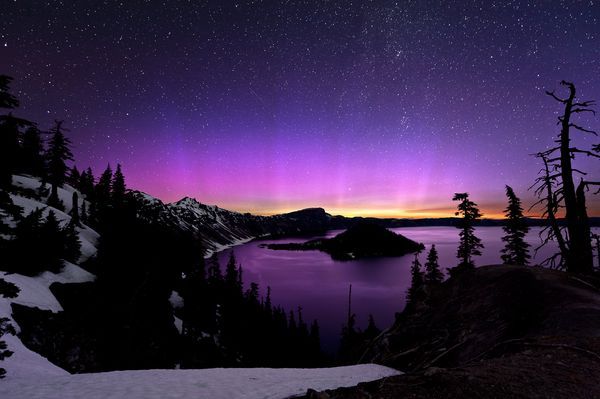
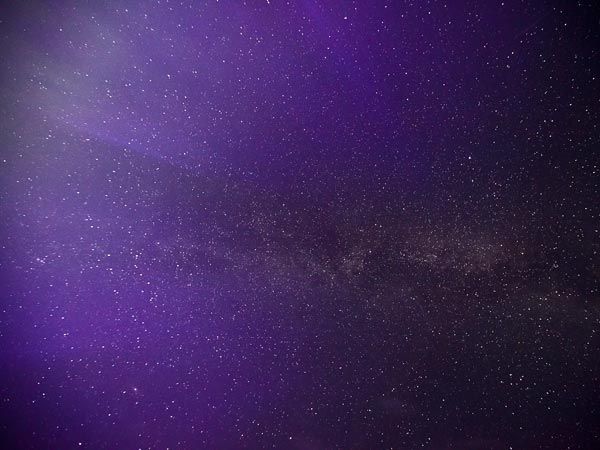
When the solar wind from the sun washed over Earth's magnetic field, the charged particles penetrated deeper into the atmosphere, hitting nitrogen atoms in lower altitudes, producing the rarer pinkish-purple lights.
"Magenta is a really weird 'extraspectral' color, meaning that you won't find it anywhere in the rainbow," Solontoi said.
"We get magenta by combining light from opposite ends of the visible spectrum, and what was being seen was blue and red light from nitrogen being combined by our eyes and brains to appear magenta."
Often auroras can be as faint as starlight, which can make them invisible near cities with light pollution. To see fainter sky shows, space-weather experts suggest heading toward the countryside and facing the northern horizon near local midnight, when skies are darkest.
With a host of sun-watching satellites currently in orbit, aurora-chasers can usually get a few days advance warning when a solar storm seems headed our way. This weekend, for instance, photographer Stephen Voss, who's been shooting auroras for a decade, was at the ready well before the main event.
"The first three to four hours of darkness on 17 June revealed only a faint arc of color on the southern horizon," Voss said in an email.
"However, at around 11:15 p.m. local time the aurora burst into life with a mixture of vertical rays and shimmering curtains that persisted for almost the next hour."
 During a particularly intense solar storm—triggered by titanic eruptions on the sun Friday—a kaleidoscope of auroral colors paints the sky over Crater Lake, Oregon, early Sunday.
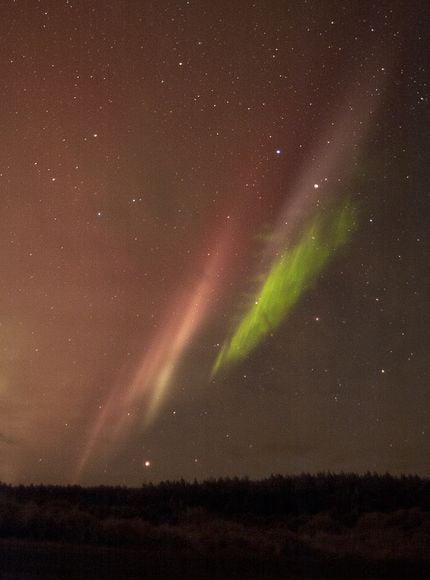
  Green and pink javelins of light cut through the night sky above southern New Zealand late Saturday.
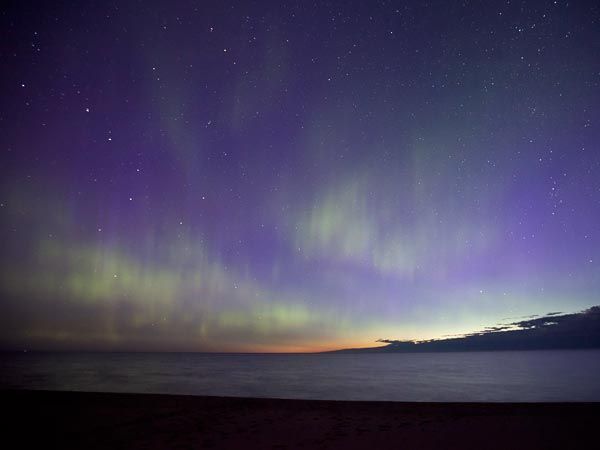
  Multihued auroras shimmer over Lake Superior in Michigan on Sunday.
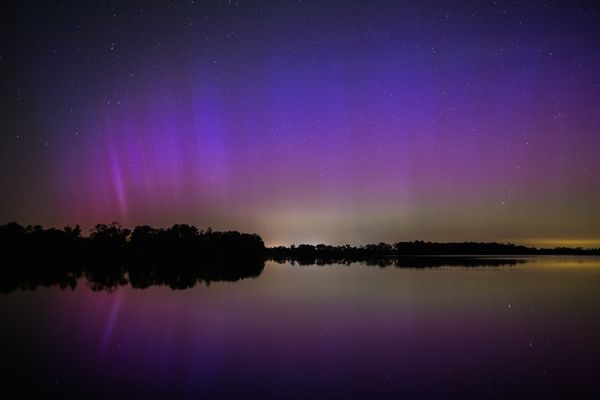
  Blue, purple, and magenta auroras hang like curtains in the sky above Hutchinson, Minnesota, on Saturday.
  Deep purple light seems to bathe the Milky Way, as seen in a picture snapped in northern Michigan early Sunday morning.
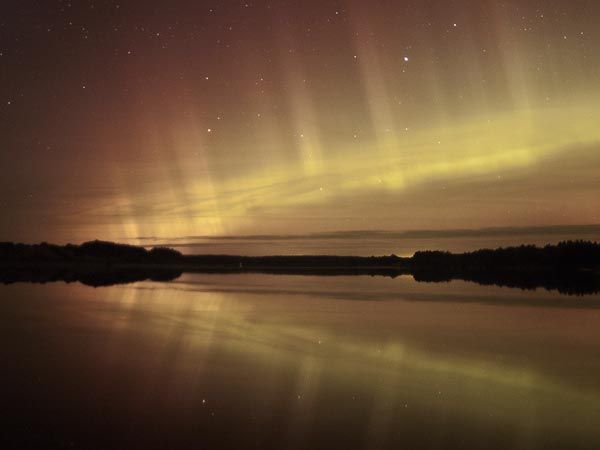
  Golden ribbons of auroral light dance over the Oreti River in southern New Zealand this weekend.
source - national geographic