for more threads like this one :
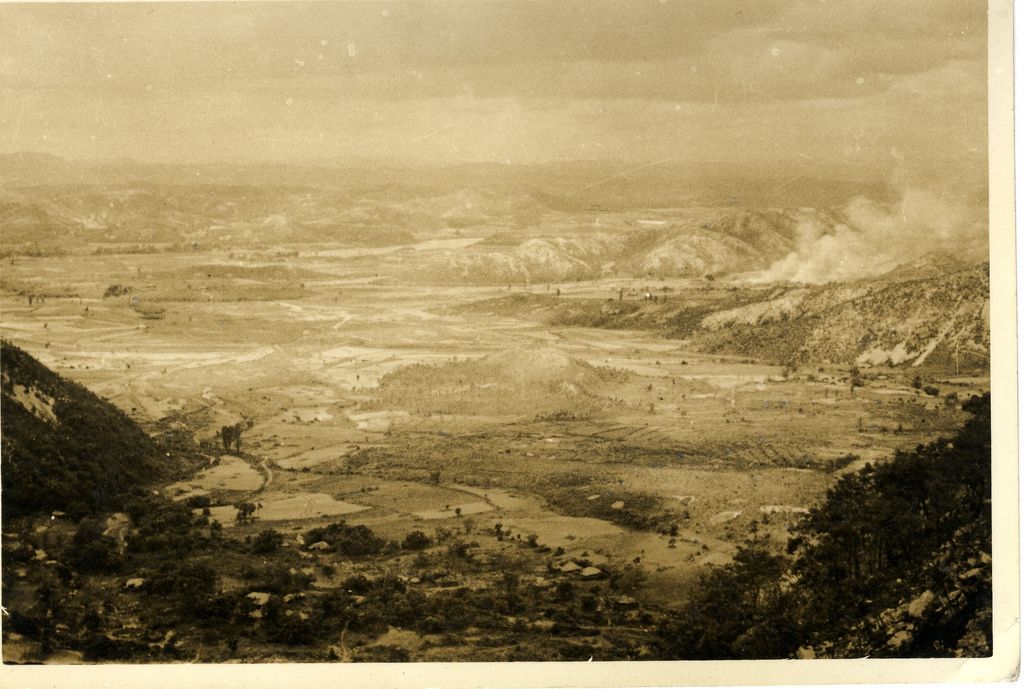
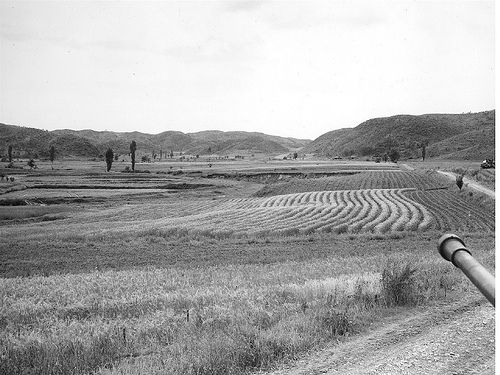
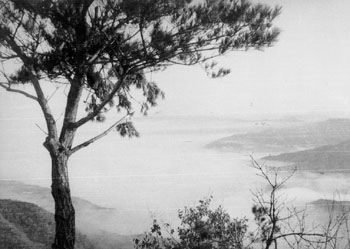
http://www.documentingreality.com/fo...me-line-45276/ 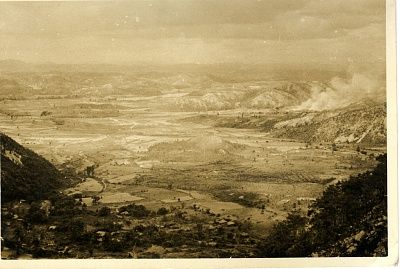 A beautiful shot of the Imjin Valley - a key loci of the fighting through much of the Korean War. Smoke rises - possibly from an artillery ranging round - a village squats at the foot of the hill, while the UN strongpoint overlooks the paddy fields.
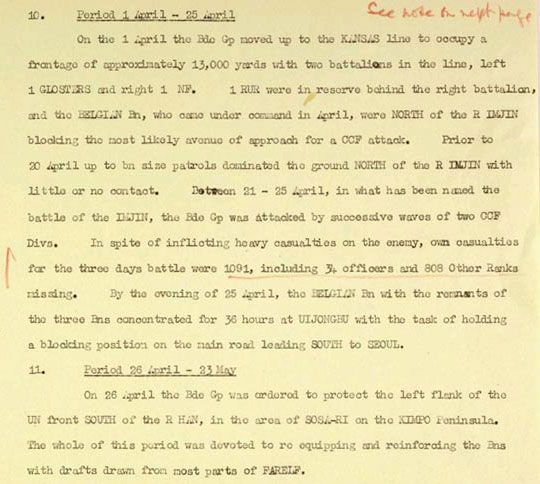
 The Battle of the Imjin River, also known as the Battle of Solma-ri or the Battle of Xuemali (simplified Chinese: 雪马里战斗; pinyin: Xuě Mǎ Lǐ Zhàn Dòu), took place 22–25 April 1951 during the Korean War. Forces from People’s Republic of China attacked UN positions on the lower Imjin River in an attempt to achieve a breakthrough and recapture the South Korean capital Seoul. The attack was part of the Chinese Fifth Phase Campaign, also known as the Chinese Spring Offensive, whose aim it was to regain the initiative on the battlefield after a successful UN counter-offensive in March 1951 had allowed UN forces to establish themselves past the 38th parallel at Line Kansas.
The section of the UN line where the battle of the Imjin River took place was defended primarily by British forces of 29th Infantry Brigade. 29th Infantry Brigade consisted of three British and one Belgian infantry battalion supported by tanks and artillery. During the course of the battle, British forces were also supported by U.S. and Philippine units. Despite facing a numerically superior enemy, 29th Infantry Brigade held its positions for more than 2 days. When the units of 29th Infantry Brigade were ultimately forced to fall back, their actions in the Battle of the Imjin River together with those of other UN forces, for example in the Battle of Kapyong, had blunted the impetus of the Chinese offensive and allowed UN forces to retreat to prepared defensive positions north of Seoul where the Chinese were halted.
“Though minor in scale, the battle's ferocity caught the imagination of the world”, especially the fate of the 1st Battalion, The Gloucestershire Regiment which was outnumbered and eventually surrounded by Chinese forces on Hill 235, a feature which became known as Gloster Hill. The last stand of the Gloucestershire Regiment together with other actions of 29th Brigade in the Battle of the Imjin River have become an important part of British military history and tradition.
The first night of attacks
The battle opened on the night of 22 April 1951. A Chinese patrol on the north bank of the river moved around the Belgians on Hill 194 and continued to advance east towards the two bridges on which the Belgians depended. Elements of 29th Brigade’s reserve, the 1st RUR, were deployed forward at about 10 p.m. in order to secure the crossing but were soon engaged by Chinese forces trying to cross the river. The Royal Ulster Rifles were unable to secure the bridges. This development meant that the Belgian battalion on the north bank of the river was in danger of being isolated from all other elements of 29th Brigade.
Chinese forces following the initial patrol either attacked the Belgian positions on Hill 194 or continued their advance towards the bridges. Those who were able to cross the Imjin attacked the Fusiliers’ right rear company, Z company, on Hill 257, a position close to the river and almost directly south of the crossings. Further downstream, Chinese forces managed to ford the Imjin and attacked the Fusiliers’ left forward company, X company, on Hill 152. The retreat of X company from Hill 152 had serious consequences for Y company which occupied the right forward position of what can be described as a squarish fusilier position marked out by four widely spaced company perimeters at the corners. Although Y company was not attacked directly, Chinese forces threatened its flanks by forcing Z and X company from their positions. After unsuccessful British attempts to regain those lost positions on Hill 257 and 194, Y company’s position was abandoned, the retreat being covered by C Squadron, 8th Hussars.
On the left of the brigade’s line, a forward deployed patrol of sixteen men repelled four attempts by a battalion of 559th Regiment, 187th Division to cross the river but was eventually forced to fall back after inflicting 70 casualties without suffering any loss. During the rest of the night, the Glosters’ right and left forward companies, A and D company, engaged Chinese units trying to cross the Imjin. By morning the next day, A and D company had suffered severe casualties; only one officer in A company remained in action. Casualties included A company’s commander, Major Pat Angier, who was killed during the night.
The Glosters' withdrawal to Hill 235
On 23 April, attempts by the Fusiliers and American forces from the 3rd Infantry Division's reserve to regain control of areas lost during the night failed. A U.S. attack by the 1st Battalion, 7th Infantry on Communist forces near Hill 257 was ordered to support the Belgian withdrawal from the north bank of the Imjin River. Despite losing seven vehicles, the Belgian battalion successfully executed its withdrawal which was coordinated with the beginning of the American attack on Hill 257. The Belgians escaped to the east and took up new positions south of the Glosters and the Fusiliers before they moved to the vicinity of 29th Brigade's command post.
At around 8.30 p.m. on 23 April, the forward companies of the Glosters were withdrawn from their positions after suffering heavy casualties. Apart from A and D company, C company under Major Paul Mitchell retreated as well but because of enemy pressure it was impossible for B company under Major Denis Harding to disengage and join the battalion’s remaining elements on and near Hill 235, a position between the Imjin and the Seolmacheon stream that became known as Gloster Hill. The men of B company (including a young Lofty Large) faced seven Chinese assaults on their position before they were also able to withdraw to Hill 235 the next morning. Only 17 men of B company remained in action after reaching the remainder of the battalion.
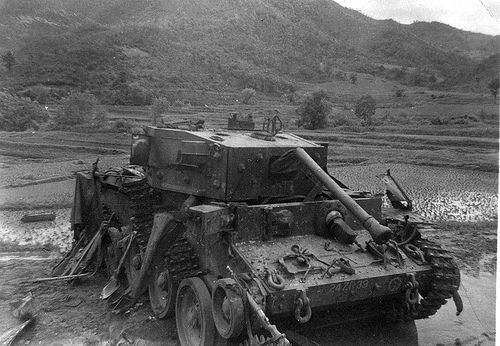
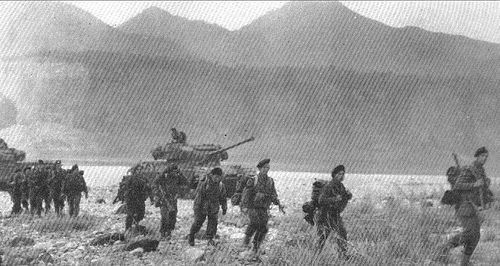
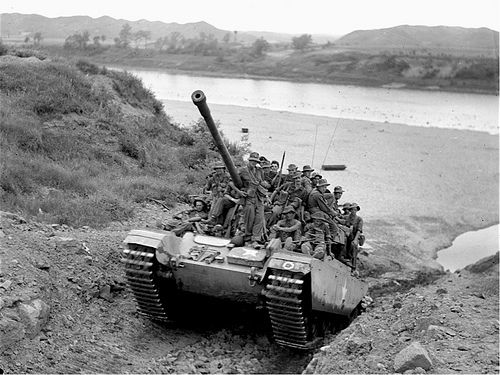
During the night in which the Glosters’ B company faced numerous attacks, the Chinese 188th Division crossed the Imjin and attacked the Fusiliers and the Royal Ulster Rifles on the right of the brigade’s line. The 187th Division also engaged the brigade’s battalions on the right, while the 189th Division kept up the pressure on the left. Most dangerous for the unity of 29th Brigade was the Chinese penetration of the line between the Gloucestershire Regiment and the Northumberland Fusiliers. As a result of this deep penetration, the Glosters were cut off. In order to have additional forces available to counter the Chinese attack and to protect the Glosters from being completely surrounded, the Philippine 10th Battalion Combat Team (BCT) was temporarily attached to 29th Brigade. A combined force of M-24 tanks of the 10th BCT and Centurions of the 8th Hussars supported by infantry reached a point 2000 yards from Hill 235 on 24 April. However, the column failed to make contact when the lead tank was hit by Chinese fire and knocked out, blocking the route and making any further advance against heavy resistance impossible. At this point, according to an official American narrative of operations, "the brigade commander considered it unwise to continue the effort to relieve the Gloucester Battalion and withdrew the relief force".
The retreat of 29th Brigade
Continued Chinese pressure on the UN forces along the Imjin prevented a planned attack by the 1st and 3rd Battalions, 65th Infantry to relieve the Glosters. When two further attempts by a tank platoon to link up with the Glosters failed, Brigadier Brodie left the decision whether to attempt a break out or to surrender to Lieutenant-Colonel Carne. No further attempts to relieve the Glosters were undertaken because at 8 a.m. on 25 April, I Corps issued the order to execute Plan Golden A which called for a withdrawal of all forces to a new defensive position further south.
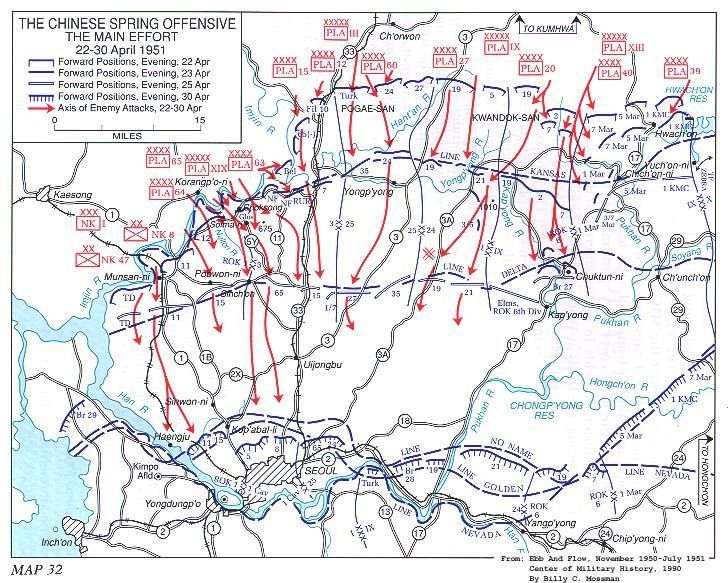
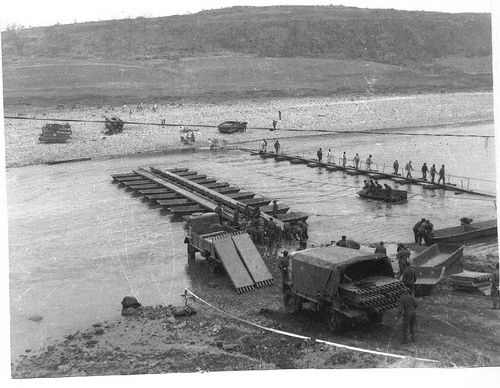
In accordance with orders issued by I Corps and supported by C Squadron, 8th Hussars, and 55 Squadron, Royal Engineers, the 1st Battalion, the Royal Northumberland Fusiliers, the 1st Battalion, the Royal Ulster Rifles, and the Belgian battalion tried to reach the safety of the next UN position. The Belgians occupied blocking positions west and southwest of 29th Brigade's command post in order to allow the other units of 29th Brigade which were still further north along Route 11, the main line of retreat, to fall back through the battalion’s positions (see map). However, the withdrawal while being under intense enemy pressure was made even more difficult by the fact that Chinese forces dominated parts of the high ground along the line of retreat and were thus able not only to observe any movements by elements of 29th Brigade but also to inflict heavy casualties on the retreating units. Among those killed was the CO of the Fusiliers, Lieutenant-Colonel Foster, who died when his jeep was hit by Chinese mortar fire. In the words of Major Henry Huth of the 8th Hussars, the retreat was "one long bloody ambush". When B company of the Ulsters which had acted as rear guard during the retreat reached the safety of the next UN line, all elements of 29th Brigade except for the Glosters had completed the withdrawal.
The Glosters on Hill 235
The Glosters' situation on Hill 235 made it impossible for them to join the rest of 29th Brigade after it had received the order to retreat. Even before the failed attempts to relieve the battalion on 24 April, B and C company had already suffered such heavy casualties that they were merged to form one company. Attempts to supply the battalion by air drop were unsuccessful. Despite their difficult situation, the Glosters held the positions on Hill 235 throughout 24 April and the night of 24/25 April. In the morning of 25 April, 45 Field Regiment could no longer provide artillery support for the Glosters. Since Brigadier Brodie had left the decision whether to attempt a break out or to surrender to Lieutenant-Colonel Carne, the Glosters' CO "gave the order to his company commanders to make for the British lines as best as they could" on the morning of 25 April. Only the remains of D company under the command of Major Mike Harvey escaped successfully from Gloster Hill and reached the safety of friendly lines after several days. The rest of the battalion was taken prisoner, including Lieutenant-Colonel Carne.
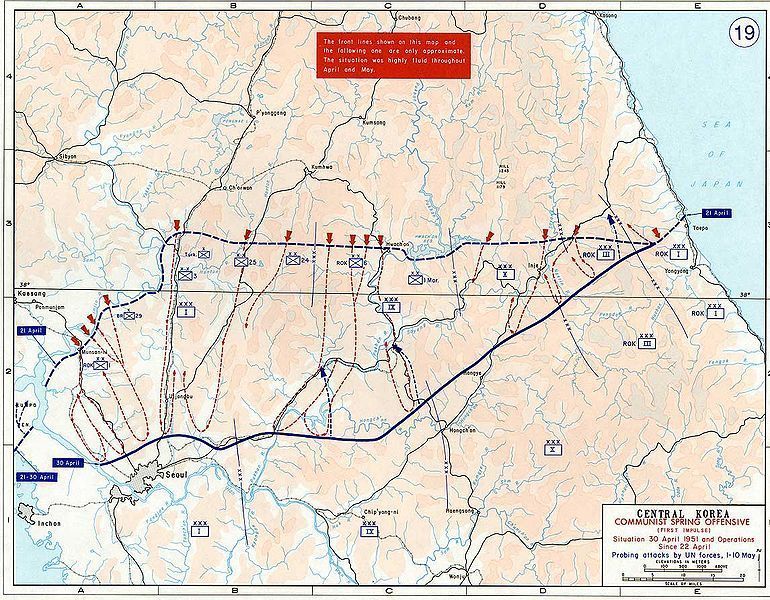
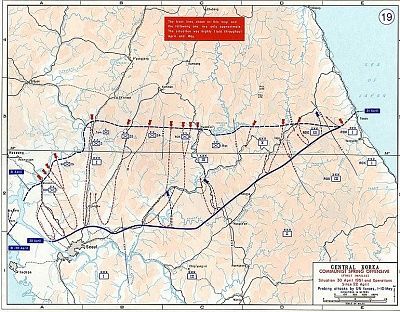 This map shows the deployment of UN forces during the initial stages of the Spring Offensive. Note the importance of 29th Brigade's position for stopping a direct advance on Seoul.
 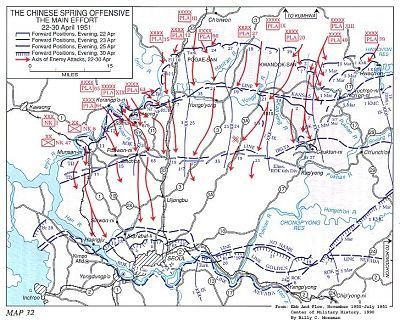 Map of the Chinese Spring Offensive, Western and Central Fronts, Korea, April 1951
 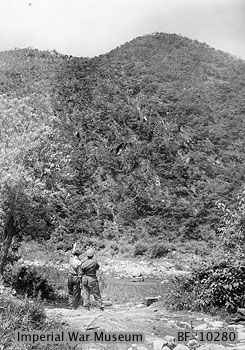 Gloster Hill five weeks after the Battle of Imjin.
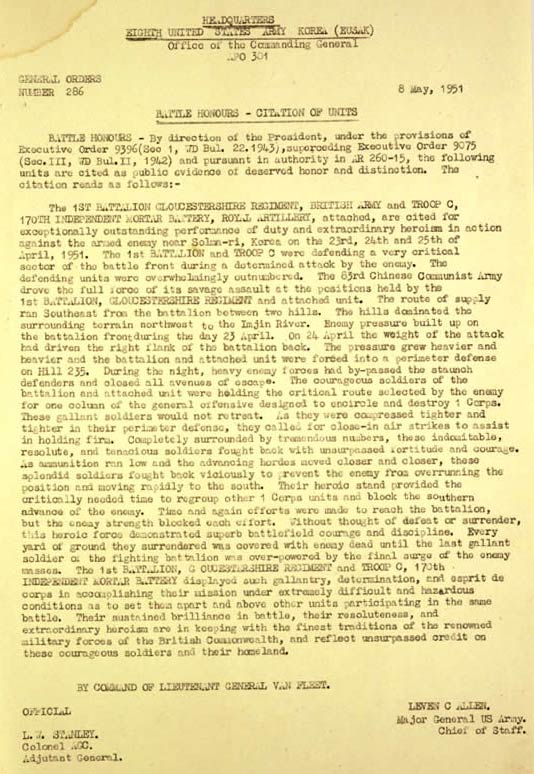
 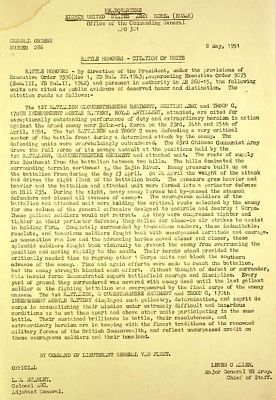 This presidential of the battle constitutes official American recognition of the bravery of both 1st Battalion, the Gloucester Regiment and C Troop, Light Mortar Battery, Royal Artillery.
 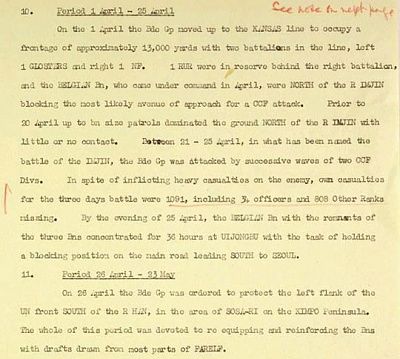 This extract from a memorandum presented to the British Cabinet reports the crossing of the 38th parallel by North Korean forces.
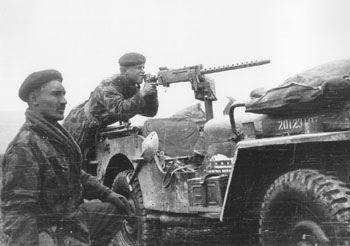
  A Belgian mobile patrol proceeds through the Imjin Valley. The Belgians were hugely respected by the British: the battalion was, in the words of Sergeant Andre VanDamme, one in which "...the spirit was firmly present." Before volunteering for Korea, a number of Belgian officers had served in the commandoes, maquis and SOE; some of the men had fought in the French Foreign Legion
  Sleeping Belgian: An undramatic, but typical scene on Line Kansas; An exhausted infantryman - probably returned from a night patrol - lies on a hilltop strongpoint, his weapon near at hand.
Source : wiki & google