|
#1
●
05-08-2013, 08:57 PM
| ||||||||
 ★ ★ GENERAL ★ ★ Poster Rank:42 male Join Date: Oct 2006 Posts: 34,450
Contributions: 35
Mentioned: 2166 Post(s) Quoted: 20745 Post(s)
| ||||||||
|
Listen To The Air Florida Flight 90 Cockpit Recording
On January 13, 1982, Air Florida Flight 90 met with a tragic accident shortly after takeoff from Washington National Airport. The flight, destined for Fort Lauderdale–Hollywood International Airport in Florida with an intermediate stop at Tampa International Airport, crashed into the 14th Street Bridge over the Potomac River. The crash resulted in the deaths of 74 out of the 79 passengers and crew on board the aircraft, as well as four individuals on the bridge. The National Transportation Safety Board (NTSB) determined that the probable cause of the accident was the flight crew's failure to activate the engine anti-ice system. This neglect, along with the decision to proceed with the takeoff despite snow and ice accumulation on the airfoil surfaces, and anomalous engine instrument readings, contributed to the fatal crash. The captain's failure to reject the takeoff under these conditions was a critical error. Earlier on the day of the accident, Washington National Airport had been closed due to a heavy snowstorm that produced 6.5 inches of snow. The airport reopened at noon under marginal conditions as the snowfall began to slacken. However, the flight's departure was delayed by about 1 hour and 45 minutes due to the backlog caused by the temporary closure. Improper de-icing procedures were also a contributing factor to the crash. The Boeing 737 was deiced with a mixture of heated water and monopropylene glycol by American Airlines, under a ground-service agreement with Air Florida. However, the agreement's specified procedures, including the use of covers for pitot tubes, static ports, and engine inlets, were not followed. Moreover, different mixture percentages were used on the aircraft's left and right sides, and the replacement of a standard nozzle with a non-modified version led to an inaccurate mixture being dispensed. Before the flight, the aircraft had trouble leaving the gate due to icy conditions and was eventually pushed back by a tug ground unit equipped with snow chains. The decision not to return to the gate for reapplication of deicing, fearing further delays, allowed more snow and ice to accumulate on the wings. The flight crew's failure to activate the engine anti-ice system, despite the freezing conditions and snowfall, played a significant role in the crash. The first officer, who was the pilot flying during the accident, was described as capable and assertive, yet the crew did not effectively respond to the challenging conditions. 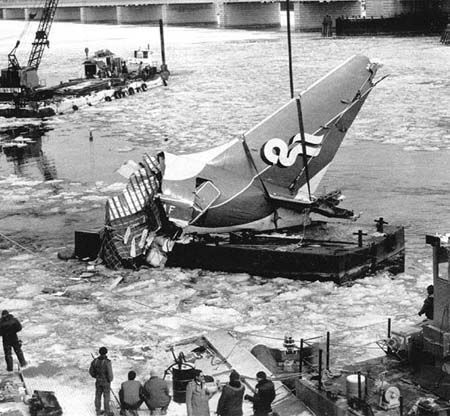 ·
__________________ Support the site and our continued existance by upgrading to a Green Name |
|
#2
●
05-09-2013, 01:04 PM
| ||||||||
 My Rank: CORPORAL Poster Rank:1537 Join Date: Nov 2009 Posts: 367 Mentioned: 1 Post(s) Quoted: 127 Post(s)
| ||||||||
|
Re: Listen To The Air Florida Flight 90 Cockpit Recording
the guy saying "were going down" seems way calm like he knows theres nothing he can do and the other guy freaks going "I KNOW!" crazy |